CM Bhajanlal Reviews Ramjal Setu Link Project, Orders Transparent Rehab
Synopsis
Chief Minister Bhajanlal Sharma chaired a high-level review of Rajasthan's Ramjal Setu Link Project on 11 July 2026, ordering officials to complete all rehabilitation and compensation work for affected families with sensitivity, transparency, and strict timelines, while maintaining regular quality checks on construction.
Key Takeaways
CM Bhajanlal Sharma chaired a high-level review of the Ramjal Setu Link Project on 11 July 2026 .
He directed that rehabilitation and compensation for all project-affected families be completed with sensitivity and transparency within fixed timelines.
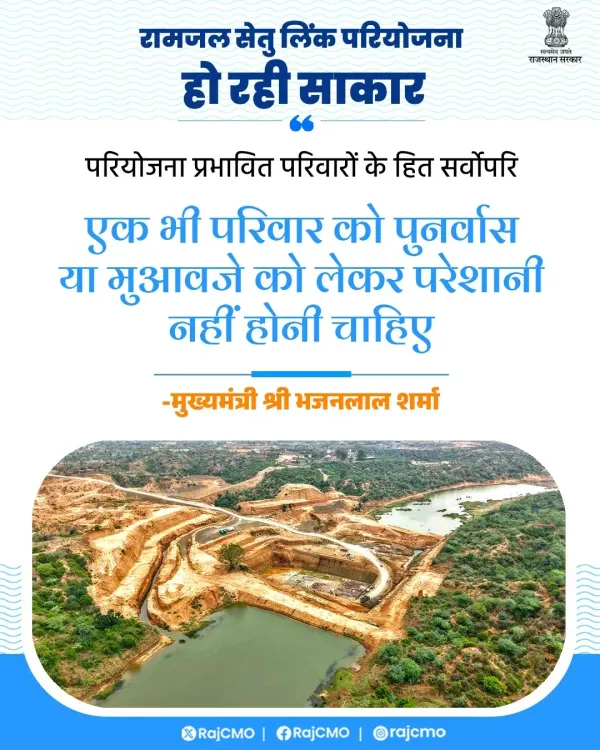
The Chief Minister stated that not a single family should face difficulty over rehabilitation or compensation.
Officials were ordered to maintain strict monitoring of project work and conduct regular quality testing of construction.
The Ramjal Setu Link Project is a flagship water infrastructure scheme of the Rajasthan BJP government led by CM Bhajanlal Sharma since December 2023.
The directive follows a broader pattern in Rajasthan of using high-level reviews to ensure accountability on large water and canal projects.
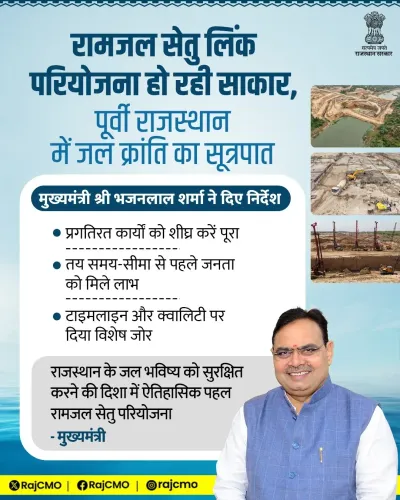
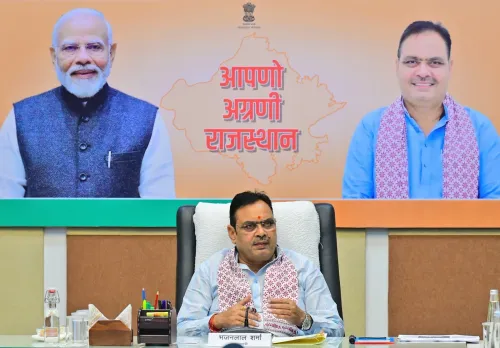
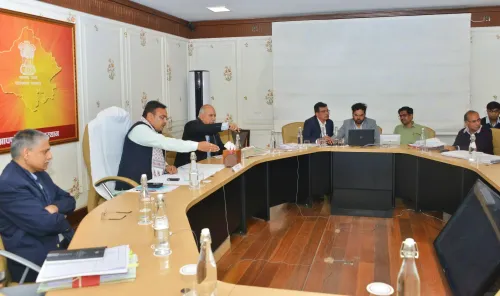
The Chief Minister's Office of Rajasthan announced on Saturday, 11 July 2026 that Chief Minister Bhajanlal Sharma chaired a high-level review of the state government's ambitious Ramjal Setu Link Project, directing officials to ensure all rehabilitation and compensation work for project-affected families is completed with sensitivity, transparency, and within fixed timelines.
Context
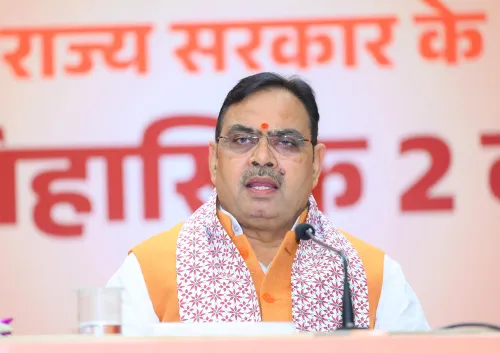
Addressing officials during the review, CM Bhajanlal Sharma said, 'ek bhi parivaar ko punarvaas ya muaavze ko lekar, pareshani nahin honi chahiye' — 'not a single family should face hardship regarding rehabilitation or compensation.' He emphasised that all related work must proceed in a time-bound manner with full transparency. The Chief Minister also directed that project officials maintain strict oversight of ongoing work so that quality testing is conducted regularly alongside timely completion.
Policy Backdrop
Rajasthan has a long history of large-scale water infrastructure initiatives, most notably the Indira Gandhi Nahar Pariyojana, which has been expanded in phases since the 1980s to address the state's chronic arid conditions. The Ramjal Setu Link Project is described by the state government as an ambitious water linkage scheme aimed at combating scarcity and improving connectivity across water-deficient regions of the state. Emphasis on rehabilitation and compensation for displaced or affected families has become a standard feature of such projects, designed to reduce local resistance and legal disputes arising from land acquisition under canal and water-transfer schemes.
Across successive governments in Rajasthan, high-level review meetings of this nature have typically served as both a progress check and a public signal of political accountability for large infrastructure undertakings. The BJP government led by CM Bhajanlal Sharma, which took office in December 2023, has positioned the Ramjal Setu Link Project as a flagship infrastructure commitment for the state.
Stakeholders and Impact
The most directly affected stakeholders are the families whose land or livelihoods fall within the project's footprint. The Chief Minister's explicit instruction that 'not a single family' should face difficulty over compensation signals a political priority to prevent the delays and disputes that have historically dogged large water projects in the state. Rural communities in the project zone stand to benefit both from the eventual water infrastructure and from the assurance of orderly, transparent rehabilitation processes.
Project officials have been placed under direct scrutiny, with the Chief Minister calling for strict monitoring and regular quality testing of construction work. This dual emphasis — on speed and on quality — reflects the administration's intent to avoid the twin pitfalls of delayed delivery and substandard infrastructure that have undermined past schemes.
What's Next
The directives issued at this review are expected to translate into structured timelines for compensation disbursement and rehabilitation milestones, with officials accountable for progress at subsequent high-level meetings. Observers will watch for formal announcements of compensation disbursement schedules and any follow-up review meetings convened by the Chief Minister's Office. The pace at which affected families receive their dues will serve as a key early indicator of whether the administration's stated commitment to sensitivity and transparency is matched by on-ground delivery.
Point of View
The BJP government is signalling political accountability on a flagship scheme while pre-empting the litigation and local resistance that derailed predecessor projects. The twin emphasis on timelines and quality testing suggests the administration is aware that Rajasthan's infrastructure record is judged as much on delivery as on announcement. Whether these directives translate into measurable outcomes will determine the political dividend the ruling party can claim from the project.
NationPress
11 Jul 2026
Frequently Asked Questions
What is the Ramjal Setu Link Project in Rajasthan?
The Ramjal Setu Link Project is an ambitious water linkage initiative of the Rajasthan state government aimed at addressing water scarcity and improving connectivity across water-deficient regions of the state.
What did CM Bhajanlal Sharma say about project-affected families?
CM Bhajanlal Sharma stated that not a single family should face hardship regarding rehabilitation or compensation, and directed that all such work be completed with sensitivity, transparency, and within fixed timelines.
When did CM Bhajanlal Sharma review the Ramjal Setu Link Project?
The high-level review was held on Saturday, 11 July 2026, as announced by the Chief Minister's Office of Rajasthan.
What instructions did CM Bhajanlal Sharma give to project officials?
He directed officials to maintain strict monitoring of all project work and ensure regular quality testing of construction, alongside timely completion of rehabilitation and compensation tasks.
Why is rehabilitation important for the Ramjal Setu Link Project?
Large water infrastructure projects in Rajasthan require land acquisition that displaces or affects local families; transparent and timely rehabilitation is essential to prevent legal disputes, local resistance, and project delays.