CM Bhajanlal Sharma Directs Officers: Zero Negligence on Roads, Schools, Health

Synopsis
The Chief Minister's Office of Rajasthan publicly directed administrative officers on 25 September 2026 to ensure zero negligence in executing state schemes, specifically naming roads, education, healthcare, water and electricity as non-negotiable delivery areas under CM Bhajanlal Sharma.
Key Takeaways
The Chief Minister's Office of Rajasthan issued a public directive on 25 September 2026 ordering administrative officers to ensure excellent scheme implementation.
Five sectors were explicitly named: roads, education, health, water and electricity.
The post tagged CM Bhajanlal Sharma directly, tying the accountability standard to his authority.
The directive was issued under the state government's branding hashtag #आपणो_अग्रणी_राजस्थान ('Our Pioneering Rajasthan').
Sharma has served as Chief Minister since December 2023 following the BJP's assembly election win.
No shortcuts. No excuses. The Chief Minister's Office of Rajasthan fired a direct warning at administrative officers on Friday, 25 September 2026, demanding flawless execution of state schemes — and making unmistakably clear that lapses in basic services will not be tolerated.
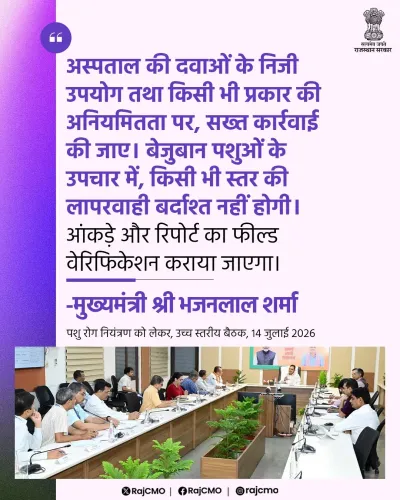
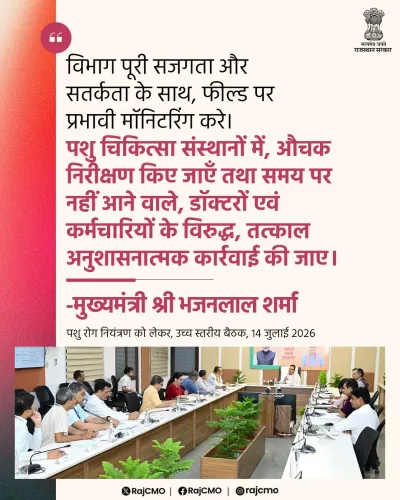
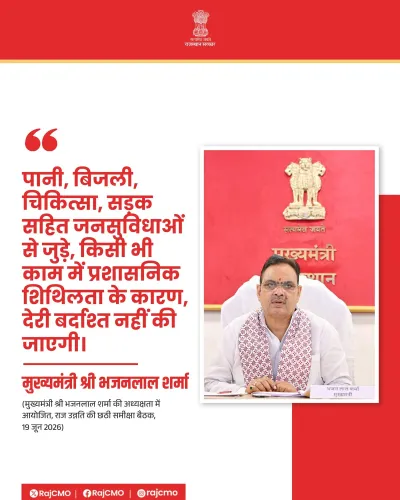
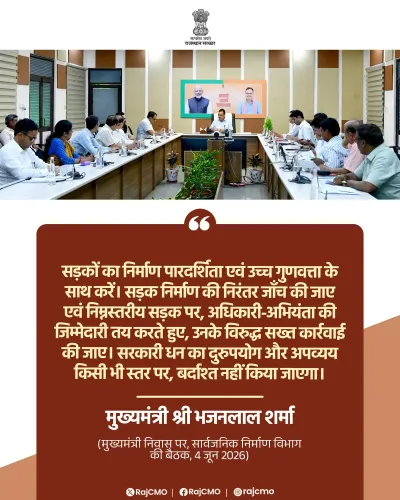
The directive, posted under the hashtag #आपणो_अग्रणी_राजस्थान ('Our Pioneering Rajasthan'), called out Chief Minister Bhajanlal Sharma by handle and instructed administrative officers to ensure 'excellent implementation' of the schemes in question. Roads, education, healthcare, water and electricity — five pillars of everyday life — were named explicitly as areas where any form of negligence would be unacceptable.
Five sectors, one non-negotiable standard
The breadth of the instruction is deliberate. By listing roads, schools, hospitals, water supply and power in the same breath, the CMO is signalling that accountability is systemic, not sector-specific. Administrative officers across Rajasthan's 50 districts are the intended audience — the bureaucrats who sit at the junction between a government scheme on paper and a citizen who actually benefits from it.
This is a pattern well established in Indian state governance: a chief minister's office periodically issues sharp public reminders to the bureaucracy, both to set the tone internally and to reassure voters that senior leadership is watching. The timing — mid-morning on a working Friday — suggests it may follow or precede an administrative review meeting.
Bhajanlal Sharma's accountability push since December 2023
Bhajanlal Sharma took charge as Chief Minister in December 2023 after the BJP's decisive assembly election victory in Rajasthan. His government has repeatedly stressed delivery-focused governance, framing its mandate around visible improvement in public services. Publicly tagging the CM by handle in the same post that issues the directive is a layered move — it ties the instruction directly to his authority and puts both the expectation and the accountability on record.
The hashtag #आपणो_अग्रणी_राजस्थान — loosely translated as 'Our Pioneering Rajasthan' — has functioned as a campaign-style branding thread for the state government's development messaging, signalling that this directive is part of a broader communications and governance push rather than an isolated remark.
For Rajasthan's residents — spread across a vast, infrastructure-stressed geography — the proof will arrive not on X but on the ground: a repaired road before monsoon damage sets in, a functioning school toilet, an uninterrupted power supply in a summer that routinely tests the grid. That is the gap this directive is asking administrators to close.
Point of View
Who came to power on a development platform in December 2023, maintaining visible pressure on delivery in five high-visibility sectors directly protects the BJP's governance brand ahead of any electoral cycle. The public tagging of the CM alongside the directive is notable: it creates a documented accountability chain, but it also raises the political stakes if ground-level delivery falls short. The broader pattern across Indian states suggests that such directives are most effective when followed by measurable district-level reviews — otherwise they risk being read as performance rather than policy.
NationPress
25 Sept 2026
Frequently Asked Questions
What did the Rajasthan CMO direct on 25 September 2026?
The Chief Minister's Office of Rajasthan directed administrative officers to ensure excellent implementation of state schemes, with zero tolerance for negligence in roads, education, health, water and electricity services.
Who is Bhajanlal Sharma and when did he become Rajasthan CM?
Bhajanlal Sharma is the BJP Chief Minister of Rajasthan, who took office in December 2023 after the party's victory in the state assembly elections.
What is the hashtag #आपणो_अग्रणी_राजस्थान?
It translates as 'Our Pioneering Rajasthan' and is used by the Rajasthan state government as a campaign-style branding thread for its development and governance messaging.
Which sectors did the Rajasthan government flag for zero negligence?
The CMO explicitly named roads, education, healthcare, water supply and electricity, alongside other public amenities, as areas requiring strict accountability.
Why do Indian state governments issue public directives to administrative officers?
Such directives are a standard governance practice — they set internal accountability expectations, signal political priority on service delivery, and often follow cabinet or departmental review meetings.