CM Bhajanlal Sharma Raises ASHA Worker Pay to ₹5,455/Month
Synopsis
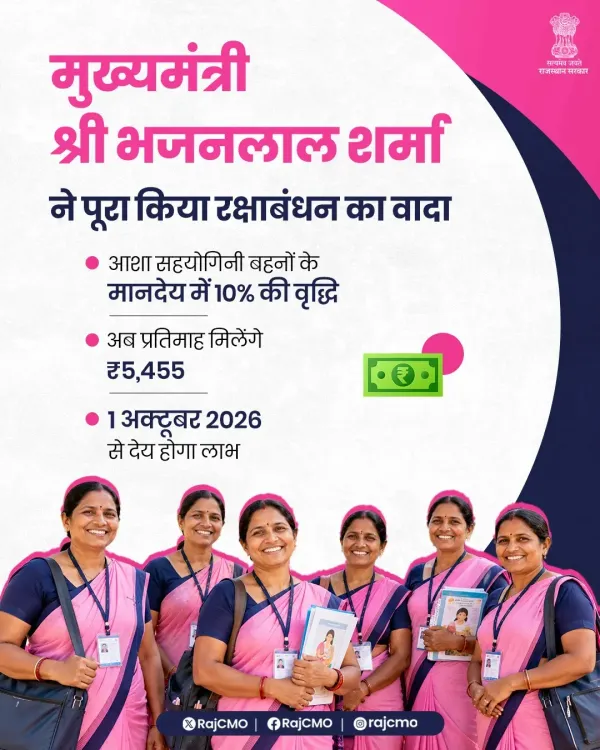
Chief Minister Bhajanlal Sharma has fulfilled a Rakshabandhan pledge by raising Rajasthan ASHA workers' monthly honorarium by 10% — from ₹4,959 to ₹5,455 — with formal financial sanction issued and payments due from 1 October 2026.
Key Takeaways
Chief Minister Bhajanlal Sharma announced a 10% honorarium increase for Rajasthan's ASHA workers on 27 October 2026 .
Monthly honorarium rises from ₹4,959 to ₹5,455 , an increase of ₹496 per month .
The state government has issued formal financial sanction for the revision; disbursement is due from 1 October 2026 .
The hike fulfils a pledge CM Sharma made to ASHA workers on the occasion of Rakshabandhan .
ASHA workers are frontline community health volunteers under the National Rural Health Mission , launched in 2005 .
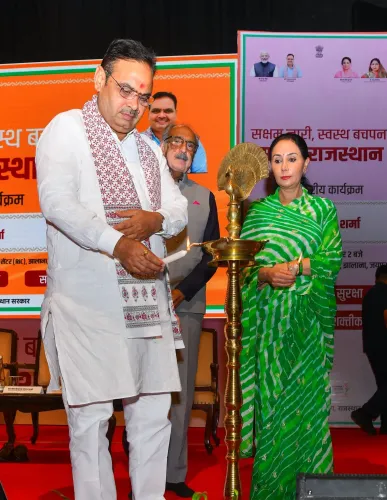
The announcement is tagged under #आपणो_अग्रणी_राजस्थान , the Sharma government's welfare-branding campaign.
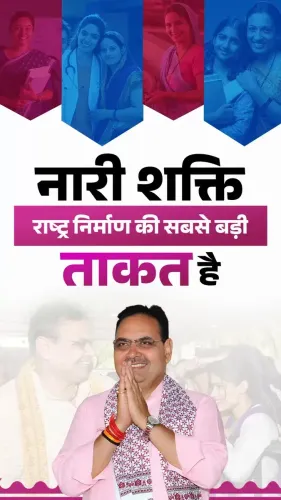
A promise made on Rakshabandhan has become a pay cheque. Chief Minister Bhajanlal Sharma has fulfilled a pledge made to Rajasthan's ASHA health volunteers, granting them a 10% honorarium hike effective 1 October 2026 — moving their monthly stipend from ₹4,959 to ₹5,455.
The Chief Minister's Office posted on Tuesday, 27 October 2026, confirming that the state government has issued formal financial approval for the revision. The post noted that the increase fulfils a commitment CM Sharma had made to aasha sahayogini bahanen (ASHA co-worker sisters) on the occasion of Rakshabandhan — a gesture that frames the announcement as a kept word, not just a budget line.
Who are Rajasthan's ASHA Workers and What Do They Do?
The Accredited Social Health Activist (ASHA) programme was launched in 2005 under the National Rural Health Mission to build a bridge between rural communities and the formal public-health system. ASHA workers — or aasha sahayoginis in Rajasthan's nomenclature — are predominantly women drawn from the villages they serve. They track pregnancies, escort mothers to government hospitals, drive immunisation, and carry out preventive-care outreach that no clinic wall can reach.
Rajasthan, with its vast desert and semi-arid geography, relies heavily on this frontline cadre to deliver maternal, child, and preventive healthcare across remote districts. The revised honorarium applies state-wide, and payment of the enhanced amount will be due from 1 October 2026.
A Pattern Across States — and Why the Symbolism Matters
Periodic honorarium revisions for ASHA workers are a recurring feature of state health governance. Several states have announced similar adjustments under the National Health Mission framework in recent years, responding to persistent demands from frontline health workers for better compensation. The work is demanding and often unacknowledged; retention of trained personnel in rural areas depends substantially on these revisions.
What distinguishes CM Sharma's announcement is the explicit thread to Rakshabandhan — a festival built on promises of protection. By tying the formal government order to a festival pledge, the administration signals that ASHA workers are not merely contractual staff but a constituency owed a duty of care. The ₹496-per-month increase may appear modest in isolation, but for workers operating at the margins of the formal economy, it represents a tangible and symbolically loaded gain.
What the State Budget Watcher Should Note
The government has issued financial sanction for the revision, meaning budget allocation is confirmed, not merely promised. With disbursement pegged to 1 October 2026, the first enhanced payments are already due. The hashtagged campaign phrase #आपणो_अग्रणी_राजस्थान (Aapno Agrani Rajasthan — 'Our Leading Rajasthan') frames the move within the Sharma government's broader welfare-branding effort.
Rajasthan's next budget cycle will be the real test — whether this 10% hike is a one-off gesture or the start of a structured pay revision mechanism for the state's frontline health workforce.
Point of View
Such optics carry real electoral weight. More broadly, Rajasthan's 10% revision is part of a wider pattern of state governments using NHM-framework honorarium hikes as low-cost, high-visibility welfare signals ahead of budget seasons. The critical question going forward is whether the Sharma government will institutionalise a regular revision mechanism — transforming a gesture into a governance standard — or whether this remains a one-time Rakshabandhan headline.
NationPress
27 Oct 2026
Frequently Asked Questions
What is the new salary of ASHA workers in Rajasthan after the 2026 hike?
Rajasthan ASHA workers will now receive ₹5,455 per month , up from ₹4,959 per month — a 10% increase announced by Chief Minister Bhajanlal Sharma.
From when will the revised ASHA worker honorarium be paid in Rajasthan?
The enhanced honorarium of ₹5,455 per month is payable from 1 October 2026 , as per the government order issued by the Rajasthan state government.
Why did CM Bhajanlal Sharma increase ASHA worker salaries?
CM Sharma had made a public pledge to Rajasthan's ASHA workers on the occasion of Rakshabandhan to raise their honorarium; the 10% hike formally fulfils that commitment.
Who are ASHA sahayoginis and what do they do?
ASHA (Accredited Social Health Activist) workers are community health volunteers under the National Rural Health Mission , launched in 2005. They provide maternal, child, and preventive healthcare outreach in rural areas.
How much has the ASHA worker honorarium increased in Rajasthan?
The honorarium has increased by ₹496 per month — a 10% rise from ₹4,959 to ₹5,455 — following a state government financial sanction.