CM Bhajanlal's Rajasthan bets on data, renewables for Viksit Bharat 2047
Synopsis
The Chief Minister's Office of Rajasthan on 23 June 2026 outlined CM Bhajanlal Sharma's six-pillar development strategy — spanning district planning, data policy, local enterprise support, innovation, investment, and renewables — aimed at making Rajasthan a leading contributor to the Viksit Bharat 2047 national goal.
Key Takeaways
The Rajasthan CMO on 23 June 2026 publicly committed the state to contributing to the Viksit Bharat 2047 national development vision.
CM Bhajanlal Sharma , in office since December 2023 , cited six pillars: district-based development, data-driven policymaking, local enterprise empowerment, innovation, investment promotion, and renewable energy.
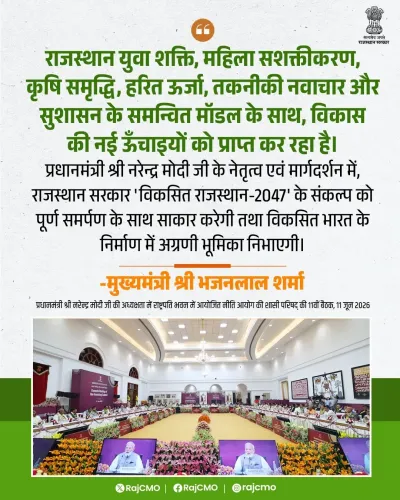
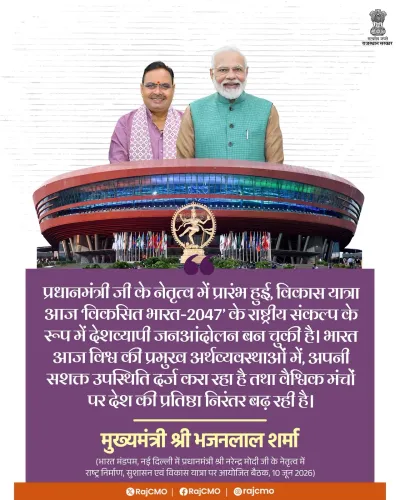
The strategy aligns with PM Modi's Viksit Bharat 2047 framework, first announced on Independence Day 2023 .
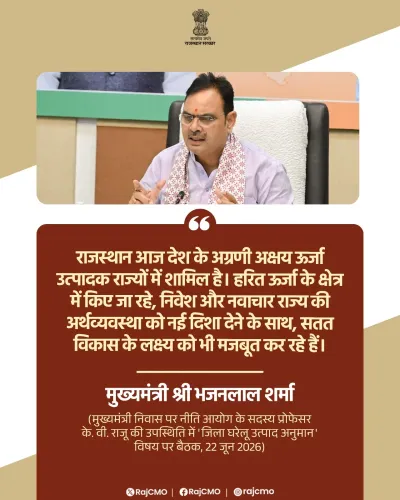
Rajasthan's renewable energy potential — particularly solar and wind — is positioned as a key asset in this development push.
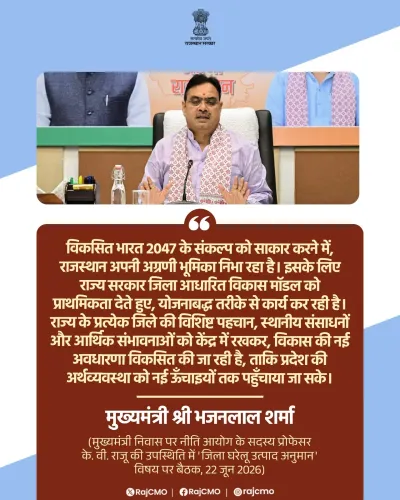
District administrations and MSME clusters are identified as core implementation units for the data-centric, decentralised planning model.
Upcoming renewable energy tenders and investor summits are expected to serve as concrete tests of the stated policy commitments.
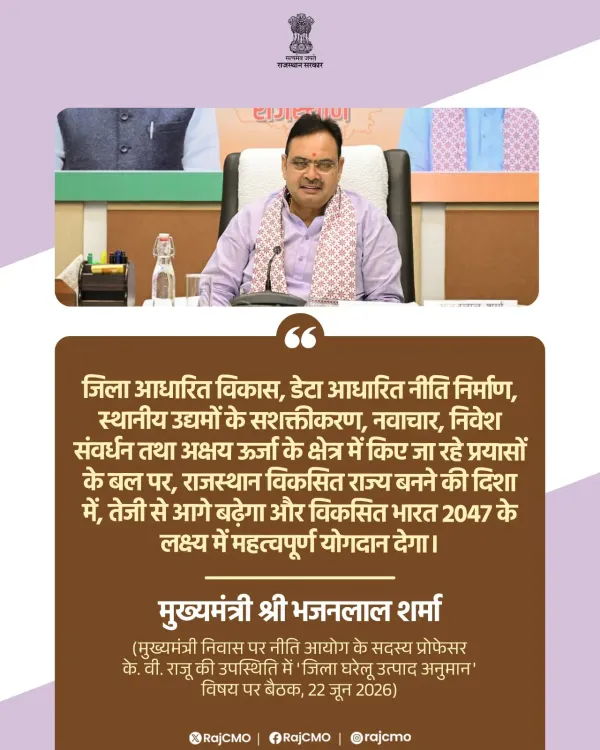
The Chief Minister's Office of Rajasthan on Tuesday, 23 June 2026 outlined the state's multi-pronged development strategy, anchoring it firmly to the national Viksit Bharat 2047 vision. The post, attributed to Chief Minister Bhajanlal Sharma, cited district-based development, data-driven policymaking, local enterprise empowerment, innovation, investment promotion, and renewable energy as the pillars of Rajasthan's accelerated progress.
Context
The CMO's post declared — in Hindi — that 'Rajasthan viksit rajya banne ki disha mein tezi se aage badhega' ('Rajasthan will move rapidly towards becoming a developed state') and will make a 'significant contribution' to the Viksit Bharat 2047 goal. The statement was accompanied by the hashtag #आपणो_अग्रणी_राजस्थान ('Our Leading Rajasthan'), a branding phrase the current administration uses to signal its governance ambitions for the state.
The post enumerated six focus areas: district-based development, data-based policy formulation, empowerment of local enterprises, innovation, investment promotion, and renewable energy. Together, these form the publicly stated framework through which the BJP-led government under CM Bhajanlal Sharma — in office since December 2023 — intends to position Rajasthan as a leading contributor to India's centenary development target.
Policy Backdrop
Prime Minister Narendra Modi first articulated the Viksit Bharat 2047 vision in his Independence Day address in 2023, calling on every state, district, and citizen to align local planning with the goal of achieving developed-nation status by 2047 — the centenary of Indian independence. Since then, states across the country have been recalibrating their governance and investment frameworks to reflect this roadmap.
Rajasthan has historically held a strategic advantage in renewable energy, particularly solar and wind, given its vast desert geography. The state's earlier solar energy policy had already set ambitious targets for capacity addition, and the current administration has signalled continued emphasis on attracting renewable energy investors. The district-level planning approach mirrors a broader national push to decentralise development and make policy more responsive to local data and ground realities.
The strategy echoes approaches adopted by states such as Gujarat and Tamil Nadu, which have combined renewable energy targets with MSME cluster support and ease-of-doing-business reforms to accelerate growth indices.
Stakeholders and Impact
Local enterprises and MSME clusters stand to be the most direct beneficiaries if the empowerment agenda translates into on-ground policy. Renewable energy investors — both domestic and international — are likely watching for concrete signals such as new capacity tenders or investor summits, which have been flagged as areas to watch in the near term.
District administrations across Rajasthan's 50 districts are central to the district-based development model. A data-driven approach implies that planning cycles, fund allocation, and performance monitoring would increasingly rely on localised metrics rather than uniform state-level benchmarks — a shift that, if implemented, could meaningfully alter how development outcomes are measured and delivered.
What's Next
Observers will look for the release of updated district development plans and any formal announcements of renewable energy tenders or investment summits in the 2025-26 fiscal cycle. The government's ability to translate this stated framework into measurable targets — with timelines and accountability mechanisms — will determine how substantive the commitment to Viksit Bharat 2047 goals ultimately proves for Rajasthan's citizens and investors.
Point of View
Allowing the administration flexibility to claim alignment across sectors without committing to specific benchmarks. What gives it political weight is the explicit tagging of CM Bhajanlal Sharma, signalling that this is a top-down priority rather than a departmental communication. The broader pattern is clear: state governments across India are competing to be seen as model contributors to the 2047 vision, and Rajasthan — with its renewable energy geography and MSME base — has credible assets to leverage in that race.
NationPress
23 Jun 2026
Frequently Asked Questions
What is Viksit Bharat 2047 and how is Rajasthan contributing to it?
Viksit Bharat 2047 is Prime Minister Narendra Modi's national vision to make India a developed nation by 2047, the centenary of independence. Rajasthan is contributing through a six-pillar strategy covering district-level planning, data-driven policy, local enterprise support, innovation, investment promotion, and renewable energy.
Who is the Chief Minister of Rajasthan in 2026?
Bhajanlal Sharma of the BJP is the Chief Minister of Rajasthan, having assumed office in December 2023.
What is Rajasthan's renewable energy strategy?
Rajasthan is leveraging its solar and wind geography to attract renewable energy investors, building on earlier state solar energy policies that targeted large-scale capacity addition. The current administration has signalled continued priority for this sector as part of its Viksit Bharat 2047 contribution.
What does 'Aapno Agrani Rajasthan' mean?
'Aapno Agrani Rajasthan' is a Rajasthani-Hindi phrase meaning 'Our Leading Rajasthan.' It is a branding slogan used by the Bhajanlal Sharma government to communicate its ambition to make Rajasthan a front-ranking state in India's development landscape.
What is district-based development in Rajasthan?
District-based development refers to a decentralised planning model where each of Rajasthan's districts formulates and implements development plans based on local data and needs, rather than a uniform state-wide template. It is one of the six pillars cited by the Rajasthan CMO in its 23 June 2026 post.