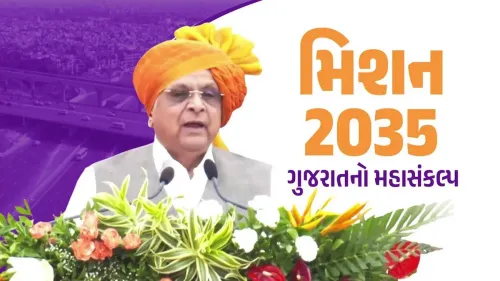
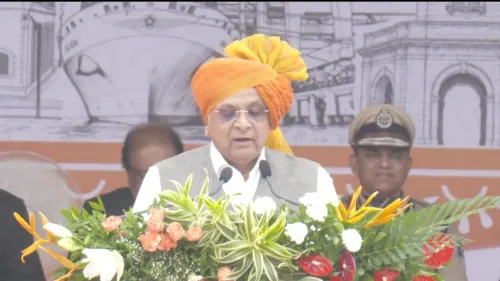
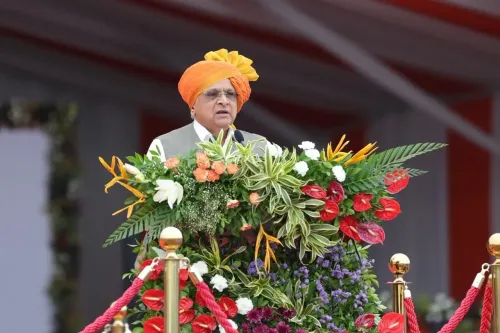
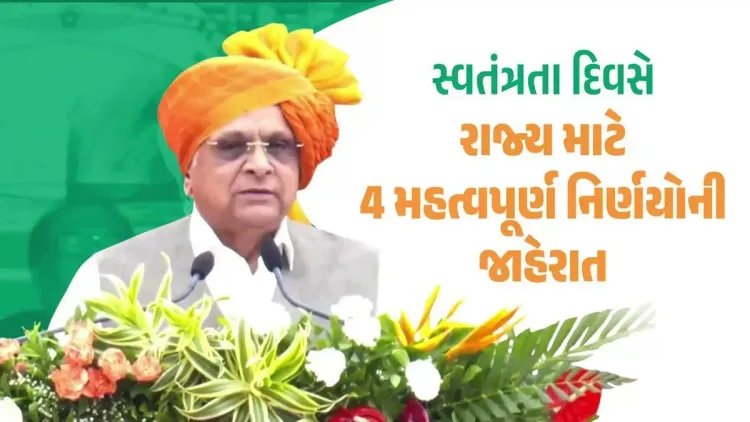
CM Bhupendra Patel Announces Four-Point Welfare Package on Gujarat's 80th I-Day
Synopsis
On the 80th Independence Day, Gujarat CM Bhupendra Patel announced free rural housing plots via private land purchase, ₹3,428 crore for road renewal, a 67% Anganwadi nutrition rate hike for 16.71 lakh children, and a higher income ceiling for overseas study loans for general-category youth.
Key Takeaways
Rural housing : Eligible families will receive free residential plots even if the state must purchase private land to provide them.
Road infrastructure : ₹3,428 crore allocated to renew and improve 2,010 km across 214 routes in Gujarat.
Child nutrition : Supplementary food rates for 16.71 lakh Anganwadi children raised by 67% , with ₹169 crore in additional funding.
Overseas education : Annual family income ceiling for unreserved-category overseas study loans raised from ₹6 lakh to ₹10 lakh .
Announcements were made on 15 August 2026 , Gujarat's 80th Independence Day address.
Rollout is expected through district administrations in the 2026-27 fiscal year .
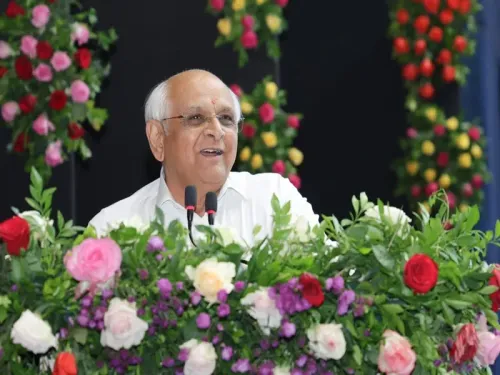
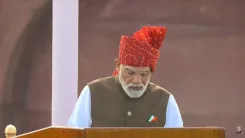
On the 80th Independence Day, Gujarat Chief Minister Bhupendra Patel turned the occasion into a policy moment — announcing a sweeping welfare package touching rural housing, road infrastructure, child nutrition, and overseas education support for the state's youth. Four concrete decisions. Four distinct constituencies. One address.
Free Plots, Even on Private Land
The most structurally novel announcement concerns housing. Where adequate government land is unavailable, the state will now purchase private land to allocate free residential plots to eligible rural families. This extends the reach of existing rural housing support — historically constrained by land availability — into new territory. The move builds on the framework of Pradhan Mantri Awas Yojana, launched in 2015, which set the national template for rural housing assistance but left land-sourcing largely to state discretion.
₹3,428 Crore for 2,010 km of Roads
On infrastructure, Patel announced an allocation of ₹3,428 crore for the renewal and improvement of 2,010 kilometres of roads across 214 routes. Gujarat governments have consistently used Independence Day addresses to roll out road packages, continuing a pattern of state highway and rural road upgrades across successive five-year plans. This round targets both renewal of ageing stretches and fresh improvements — a dual mandate that signals both maintenance discipline and expansion ambition.
Anganwadi Children Get a 67% Nutrition Boost
Perhaps the most immediate human impact lies in child nutrition. The supplementary food rate for 16.71 lakh Anganwadi children will be raised by 67%, backed by an additional allocation of ₹169 crore. Anganwadis — the frontline of India's Integrated Child Development Services network since 1975 — have long faced criticism for nutrition budgets that lag behind actual food costs. A 67% rate revision is a substantial correction, and the ₹169 crore earmark signals that this is funded, not aspirational.
Overseas Study Loans Now Open to More General-Category Families
For unreserved-category youth seeking foreign education, the annual family income ceiling for overseas study loan eligibility has been raised from ₹6 lakh to ₹10 lakh. The revision directly targets a segment that sits above poverty lines but below the financial comfort required to independently fund international higher education — a group that has historically found itself squeezed out of both reservation-linked schemes and elite private financing. Widening the income band brings more middle-income general-category families into the eligible pool.
Four announcements, each aimed at a different stage of life — shelter, mobility, early childhood, and young adulthood. The real test arrives in the 2026-27 fiscal year, when district administrations must translate allocations into disbursements on the ground.
Point of View
Road-dependent commuters, mothers of young children, and aspirational general-category students — a breadth that reflects BJP Gujarat's established practice of using the national holiday as a high-visibility policy platform. The private-land purchase mechanism for housing is the most structurally ambitious element, potentially setting a state-level precedent if it clears implementation hurdles. The 67% Anganwadi nutrition revision is the most politically durable: child malnutrition data has long been a vulnerability for Gujarat's development narrative, and a funded rate correction directly addresses that. Widening the overseas education loan ceiling for unreserved youth signals continued attention to a constituency that feels structurally disadvantaged by reservation architecture — a recurring BJP pitch to middle-income general-category families.
NationPress
15 Aug 2026
Frequently Asked Questions
What welfare schemes did Gujarat CM Bhupendra Patel announce on Independence Day 2026?
CM Bhupendra Patel announced four measures on 15 August 2026: free rural housing plots (including via private land purchase), ₹3,428 crore for road renewal across 2,010 km, a 67% increase in Anganwadi supplementary nutrition rates for 16.71 lakh children, and a higher income ceiling for overseas study loans for unreserved-category youth.
How will Gujarat provide free housing plots when government land is unavailable?
The state government will purchase private land and then allocate free residential plots to eligible rural families, extending the reach of housing assistance beyond areas where government land is readily available.
By how much has Gujarat increased the Anganwadi nutrition budget?
The supplementary food rate for Anganwadi children has been raised by 67%, with an additional allocation of ₹169 crore. This benefits approximately 16.71 lakh children enrolled in Anganwadi centres across Gujarat.
What is the new income limit for Gujarat's overseas education loan scheme for general-category students?
The annual family income ceiling for unreserved-category students to qualify for overseas study loans has been raised from ₹6 lakh to ₹10 lakh, making the scheme accessible to more middle-income families.
How much has Gujarat allocated for road infrastructure on Independence Day 2026?
Gujarat announced ₹3,428 crore for the renewal and improvement of 2,010 kilometres of roads spanning 214 routes across the state.