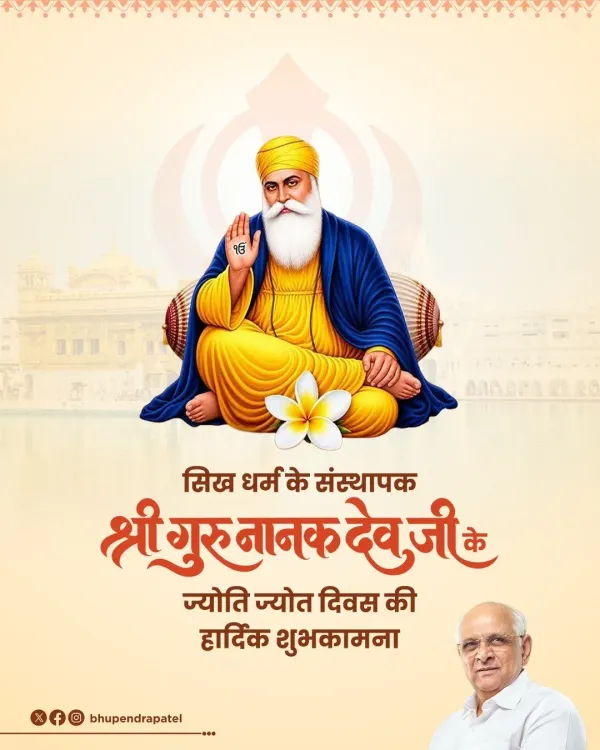
CM Bhupendra Patel pays tribute on Guru Nanak Dev Ji's Jyoti Jot Diwas
Synopsis
Gujarat Chief Minister Bhupendra Patel on October 5, 2026 paid his respects on Jyoti Jot Diwas, marking the day Guru Nanak Dev Ji — Sikhism's founder — merged with the eternal, invoking his legacy of truth, equality, and selfless service.
Key Takeaways
Gujarat CM Bhupendra Patel offered tribute to Guru Nanak Dev Ji on Jyoti Jot Diwas, October 5, 2026 .
Jyoti Jot Diwas marks the day Guru Nanak Dev Ji — born in 1469 — departed the mortal world, his light merging with the eternal.
CM Patel cited Guru Nanak's core values: truth, social harmony , selfless service, and equality.
Guru Nanak's philosophy — Naam Japo, Kirat Karo, Vand Chakko — is among history's most enduring calls for human dignity.
Gujarat has a notable Sikh presence in cities including Ahmedabad and Surat , where the day is observed with prayers and kirtans .
On the solemn occasion of Jyoti Jot Diwas — the day Sikhism's founder and first Guru, Guru Nanak Dev Ji, merged with the eternal light — Gujarat Chief Minister Bhupendra Patel offered his reverent tribute on Monday, October 5, 2026, calling for humanity to walk the path of love, peace, and selfless service that the Guru illuminated centuries ago.
In his post, CM Patel wrote: 'सिख धर्म के संस्थापक और प्रथम गुरु श्री गुरु नानक देव जी के ज्योति जोत दिवस पर उनके चरणों में कोटि कोटि नमन' — 'Crores of salutations at the feet of Shri Guru Nanak Dev Ji, founder and first Guru of Sikhism, on his Jyoti Jot Diwas.' He noted that Guru Nanak Dev Ji showed humanity the path of truth, social harmony, selfless service, and equality, and that his sacred teachings would continue to inspire all of humankind toward love, peace, goodwill, and public welfare.
The meaning of Jyoti Jot Diwas
Jyoti Jot Diwas marks the day Guru Nanak Dev Ji — born in 1469 at Nankana Sahib — departed from the mortal world, his divine light merging with the eternal. The phrase 'Jyoti Jot samaana' (merging of the light into the light) is central to Sikh theology and signifies not death, but transcendence. Observed annually, the day draws reverent remembrance from Sikh communities and political leaders across India and the global diaspora.
Guru Nanak's teachings and their enduring call
Guru Nanak Dev Ji's philosophy rested on three pillars: Naam Japo (meditate on God's name), Kirat Karo (earn an honest living), and Vand Chakko (share with others). His rejection of caste hierarchy, his emphasis on the equality of all human beings regardless of religion or birth, and his founding of the langar tradition — free community kitchens — placed him among history's most radical social reformers. CM Patel's tribute specifically invoked social harmony (samajik samarasta) and equality, values that continue to resonate in a diverse, plural India.
Gujarat, home to a significant Sikh community — particularly in Ahmedabad and Surat — observes the day with prayers and kirtans at gurudwaras across the state. For a BJP leader in a state with both deep Hindu roots and a historically integrated Sikh presence, paying tribute on this occasion carries both spiritual and civic weight. The message that the Guru's light 'will continue to inspire all of humankind' is pitched at universality — beyond any single faith or constituency.
Point of View
Paying tribute on Sikh religious occasions serves a dual purpose: it signals the party's inclusive cultural outreach beyond its core Hindu nationalist identity, and it resonates with Sikh communities — a politically significant constituency in states like Punjab, Delhi, and increasingly in urban Gujarat. CM Patel's framing of Guru Nanak's teachings as universally human, rather than exclusively religious, is a deliberate rhetorical choice that allows the message to travel across communal lines. The emphasis on 'social harmony' and 'equality' also subtly aligns the Guru's legacy with the ruling party's preferred narrative of integrated national identity. As India's Sikh diaspora grows more globally connected, such gestures by state leaders carry resonance well beyond Gujarat's borders.
NationPress
5 Oct 2026
Frequently Asked Questions
What is Jyoti Jot Diwas?
Jyoti Jot Diwas is the day commemorating the passing of Guru Nanak Dev Ji, the founder of Sikhism, when his divine light is said to have merged with the eternal. The phrase 'Jyoti Jot samaana' means the merging of light into light, signifying transcendence rather than death.
Who was Guru Nanak Dev Ji?
Guru Nanak Dev Ji was the founder and first Guru of Sikhism, born in 1469 at Nankana Sahib. He taught the principles of truth, equality of all humans, selfless service, and rejection of caste hierarchy, and established the 'langar' tradition of free community meals.
What did Gujarat CM Bhupendra Patel say about Guru Nanak Dev Ji?
CM Bhupendra Patel offered 'crores of salutations' to Guru Nanak Dev Ji on Jyoti Jot Diwas, stating that the Guru showed humanity the path of truth, social harmony, selfless service, and equality, and that his teachings would continue to inspire love, peace, and public welfare.
How is Jyoti Jot Diwas observed?
Jyoti Jot Diwas is observed with prayers, 'kirtans' (devotional singing), and remembrance gatherings at gurudwaras across India and among Sikh communities worldwide. Political leaders across parties also pay tribute to Guru Nanak Dev Ji's legacy on this day.
What are Guru Nanak's three core teachings?
Guru Nanak Dev Ji's philosophy rests on three pillars: 'Naam Japo' (meditate on God's name), 'Kirat Karo' (earn an honest living), and 'Vand Chakko' (share with others). These teachings form the ethical and spiritual foundation of Sikhism.