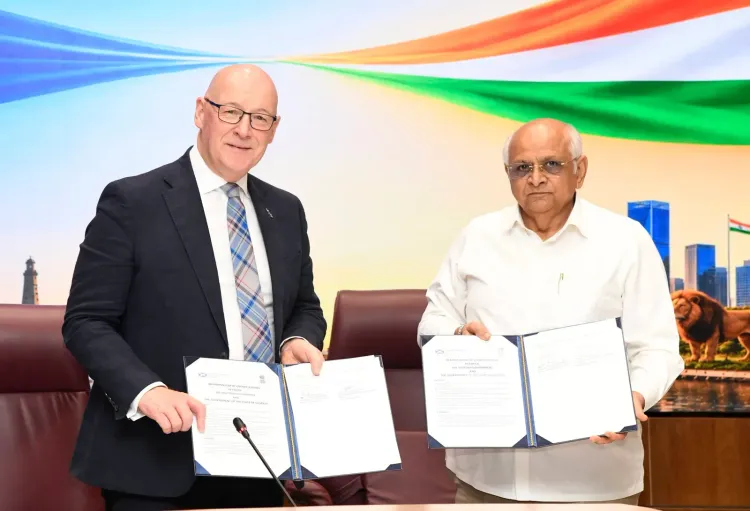
CM Bhupendra Patel Signs Gujarat-Scotland MoU in Gandhinagar
Synopsis
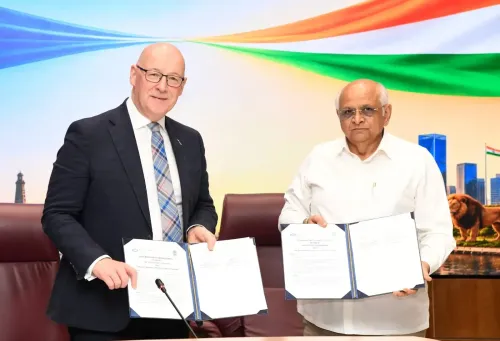
Gujarat Chief Minister Bhupendra Patel and Scotland's First Minister John Swinney signed a landmark MoU in Gandhinagar on October 23, 2026, spanning offshore wind energy, sports infrastructure for the 2030 Commonwealth Games, trade, education, and cultural exchange.
Key Takeaways
Gujarat CM Bhupendra Patel and Scotland's First Minister John Swinney signed a bilateral MoU in Gandhinagar on October 23, 2026 .
The MoU covers renewable energy, trade, investment, education, skilling, innovation, sports, and cultural exchange .
Gujarat will send a delegation to Scotland to study offshore wind expertise, targeting the state's vast coastline potential.
Scotland's experience hosting the 2026 Commonwealth Games in Glasgow is expected to guide Gujarat's preparations to host the 2030 edition .
The partnership is framed as aligned with PM Narendra Modi's vision for sustainable development and global economic ties.
This MoU reflects a broader India pattern of state-level international economic diplomacy, particularly in green energy and major sporting events.
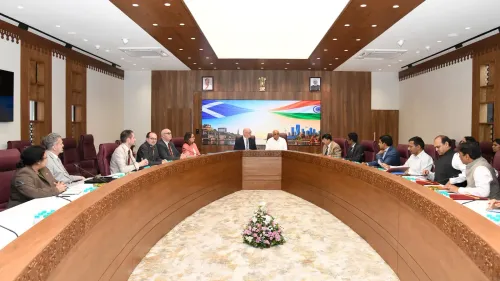
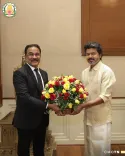
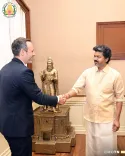
A landmark agreement sealed in Gandhinagar on October 23, 2026 is pushing Gujarat's global ambitions to a new altitude — Gujarat Chief Minister Bhupendra Patel signed a wide-ranging Memorandum of Understanding with the Scottish Government, in the presence of Scotland's First Minister John Swinney, covering renewable energy, trade, sports, education, skilling, innovation, and cultural exchange.
The MoU, as CM Patel described it, 'strongly aligns with Hon'ble PM Shri Narendra Modi ji's vision for sustainable development and building robust global relations.' That framing is deliberate — state-level international partnerships have become a key instrument of India's broader economic diplomacy, and Gujarat has consistently been at its vanguard.
Gujarat's coastline, Scotland's offshore wind playbook
Gujarat holds one of the longest coastlines of any Indian state — a geographic asset that has long been eyed for offshore wind development but remains comparatively underharvested. Scotland, by contrast, has spent two decades building what is now globally recognised offshore wind expertise, dating back to the early 2000s when it first anchored turbines in the North Sea. The MoU commits Gujarat to sending a dedicated delegation to Scotland specifically to study that model and apply it at home. That is not a goodwill visit. That is a technology-transfer mission with a coastline on the line.
India has set aggressive renewable energy targets under its Paris Agreement commitments, and Gujarat — already a national leader in solar and onshore wind — is the natural first mover for offshore wind at scale. The Scotland partnership gives it a direct line to the world's most battle-tested offshore operators, cutting years off a learning curve.
The 2030 Commonwealth Games connection
Sport is the other headline. Gujarat has stated its intent to host the 2030 Commonwealth Games, and the timing of this MoU is no coincidence — Scotland is preparing to host the 2026 edition in Glasgow. CM Patel was explicit: Scotland's experience 'will be invaluable' as Gujarat develops world-class sports infrastructure and builds what he called 'a strong fitness culture.' Having a games-tested partner walk alongside a games-aspiring state is precisely the kind of institutional knowledge transfer that makes the difference between a well-run event and a transformative one.
The research note flags that the official confirmation status of Gujarat hosting the 2030 Commonwealth Games is not independently established in prior public records — a detail worth watching as formal Commonwealth Games Federation announcements follow.
Patel-Swinney: a sub-national diplomacy moment
The presence of First Minister John Swinney — Scotland's top elected official since May 2024 — in Gandhinagar for the signing elevates this beyond a routine administrative MoU. Devolved UK administrations pursuing direct economic partnerships with Indian states reflects an accelerating pattern in India-UK relations, one that runs parallel to national-level negotiations and often moves faster. For Scotland, deepening ties with one of India's most investment-active states is a clear economic priority. For Gujarat, having a European government at the table in its own capital is a statement of confidence.
The next concrete signal to watch: the composition and timeline of the Gujarat delegation heading to Scotland for offshore wind study, and whether early-stage joint projects emerge from what today was a framework promise.
Point of View
Not just freelanced. The offshore wind angle is the most consequential: Gujarat's long coastline is an underleveraged national asset, and a direct technology-transfer relationship with Scotland could compress India's offshore wind development timeline significantly. The Commonwealth Games thread adds political weight domestically, but the energy partnership is where the long-term economic returns will be measured.
NationPress
23 Oct 2026
Frequently Asked Questions
What is the Gujarat-Scotland MoU about?
The MoU signed on October 23, 2026 in Gandhinagar covers cooperation in renewable energy (especially offshore wind), trade, investment, education, skilling, innovation, sports infrastructure, and cultural exchange between Gujarat and the Scottish Government.
Who signed the MoU between Gujarat and Scotland?
Gujarat Chief Minister Bhupendra Patel signed the MoU on behalf of Gujarat, and Scotland's First Minister John Swinney represented the Scottish Government at the signing ceremony in Gandhinagar.
What is Gujarat's plan for offshore wind energy with Scotland?
Gujarat will send a dedicated delegation to Scotland to study Scotland's globally recognised offshore wind expertise, with the goal of harnessing Gujarat's extensive coastline for large-scale offshore wind power generation.
How is Scotland connected to Gujarat's 2030 Commonwealth Games plans?
Scotland is hosting the 2026 Commonwealth Games in Glasgow , and its experience in organising that event is expected to guide Gujarat in developing world-class sports infrastructure and event management for a future Commonwealth Games hosting bid.
Why is Gujarat considered a leader in renewable energy in India?
Gujarat established itself as India's renewable energy leader through wind and solar policies dating back to the early 2000s and 2015, and it holds one of the country's longest coastlines, making it a prime candidate for offshore wind expansion.