Gujarat, Scotland Sign MoU on Energy, Education and Sports
Synopsis
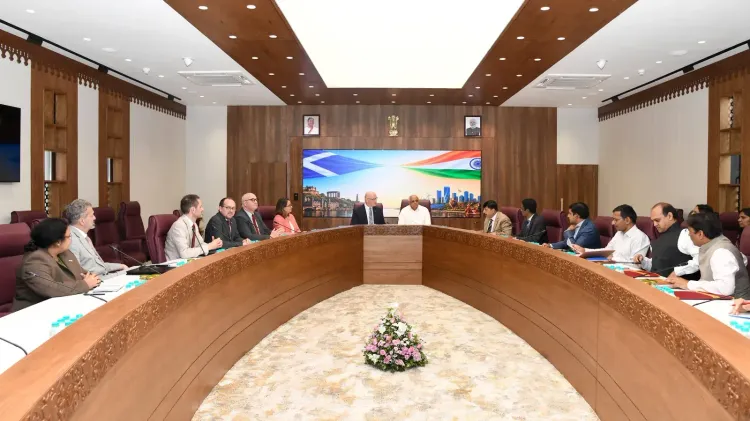
Gujarat CM Bhupendra Patel and Scotland First Minister John Swinney signed an MoU in Gandhinagar on October 23, 2026, covering offshore energy, education, skilling, sports and life sciences, with Patel proposing a Gujarat delegation visit to Scotland for offshore energy knowledge exchange.
Key Takeaways
The Government of Gujarat and the Government of Scotland signed an MoU in Gandhinagar on October 23, 2026 .
Chief Minister Bhupendra Patel and First Minister John Swinney were both present at the signing.
The MoU covers People Connect, Economic Relations, Sustainable Development, Innovation, Education and Skilling, Sports and Energy .
Scotland's First Minister highlighted new opportunities in Culture, Sports, Renewable Energy and Life Sciences .
CM Patel proposed a Gujarat delegation visit to Scotland to study offshore energy expertise, citing Gujarat's position as India's leading renewable energy state with the country's longest coastline.
The agreement aligns with broader India-UK climate and economic cooperation frameworks and India's trend of sub-national green-sector diplomacy.
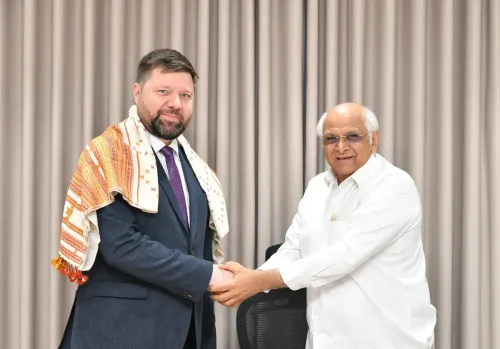
A significant sub-national diplomatic moment unfolded in Gandhinagar on Friday, October 23, 2026, as the Government of Gujarat and the Government of Scotland formalised a landmark Memorandum of Understanding in the presence of Chief Minister Bhupendra Patel and Scotland's First Minister John Swinney — opening a structured corridor for cooperation across renewable energy, education, skilling, sports and life sciences.
What the MoU puts on the table
The agreement, as outlined by the Chief Minister's Office of Gujarat, is designed to build a 'bridge of friendship and mutual understanding' between the two governments. Its pillars span People Connect, Economic Relations Development, Sustainable and Inclusive Economic Development, and Innovation and Prosperity. Beyond the headline categories, the MoU specifically commits both sides to developing 'practical cooperation opportunities' in Knowledge and Experience Sharing and in sectors of mutual interest — including Education and Skilling, Sports, and Energy.
First Minister John Swinney, who has led the Scottish Government since 2024, expressed confidence that the agreement would unlock 'new development opportunities' between Gujarat and Scotland in Culture, Sports, Renewable Energy and Life Sciences. He also signalled Scotland's keenness to share its expertise in offshore energy with Gujarat — a sector where Scotland holds a globally recognised edge in offshore wind and marine renewables.
Gujarat's coastline as Scotland's next classroom
Chief Minister Bhupendra Patel responded by underscoring Gujarat's standing: the state is India's leading state in renewable energy and, crucially, holds the country's longest coastline — a geography that makes it uniquely positioned for offshore energy development. 'Scotland is a global leader in offshore energy,' he noted, and with that framing he made a pointed suggestion: a Gujarat delegation should visit Scotland specifically to study and draw guidance from its offshore energy expertise. That proposal, floated in the meeting room, is now the most concrete near-term deliverable to watch.
The bilateral logic is clean. Gujarat's renewable energy policy ambition — aligned with India's national non-fossil fuel targets — needs the kind of deep offshore engineering knowledge that Scotland has built over decades in the North Sea and beyond. Scotland, in turn, gains a high-growth partner in one of India's most investment-active states.
India's sub-national diplomacy in green sectors
This agreement fits a broader pattern of Indian states conducting sub-national diplomacy to secure technology partnerships and investment in green sectors — bypassing the slower rhythms of sovereign-level negotiations to move faster on specific sectoral goals. Scotland has actively promoted its offshore energy expertise through international agreements, and this MoU with Gujarat aligns with the wider India-UK economic and climate cooperation framework. For both sides, it is a bet that state-to-devolved-nation partnerships can deliver faster, more targeted outcomes than waiting for the larger bilateral architecture to catch up.
If the proposed Gujarat delegation to Scotland materialises, it will be the first practical test of whether this MoU generates real knowledge transfer — or remains a well-photographed handshake.
Point of View
Creating a knowledge-transfer channel that neither side could easily replicate through central-government channels alone. CM Patel's on-the-spot proposal for a Gujarat delegation to Scotland signals that this is not a ceremonial agreement — there is a near-term operational test built in. The broader arc is India's green energy ambition finding partners at the devolved-government level, where speed and specificity trump diplomatic protocol.
NationPress
23 Oct 2026
Frequently Asked Questions
What is the Gujarat-Scotland MoU about?
The MoU is a bilateral agreement signed on October 23, 2026, between the Governments of Gujarat and Scotland to strengthen cooperation in offshore renewable energy, education and skilling, sports, life sciences, and economic development.
Who signed the Gujarat-Scotland MoU?
The MoU was concluded in the presence of Gujarat Chief Minister Bhupendra Patel and Scotland's First Minister John Swinney in Gandhinagar.
Why is Gujarat interested in Scotland's offshore energy expertise?
Gujarat holds India's longest coastline and is the country's leading state in renewable energy. CM Bhupendra Patel noted this geography offers vast offshore energy potential, and Scotland's global leadership in offshore wind makes it an ideal knowledge partner.
What is Scotland's First Minister John Swinney's role in this agreement?
John Swinney, who has led the Scottish Government since 2024, was present at the Gandhinagar signing and expressed confidence that the MoU would open development opportunities in Culture, Sports, Renewable Energy and Life Sciences between Gujarat and Scotland.
Will a Gujarat delegation visit Scotland after this MoU?
CM Bhupendra Patel proposed during the meeting that a Gujarat delegation should visit Scotland specifically to study and draw guidance from its offshore energy expertise — the most concrete near-term outcome proposed at the signing.