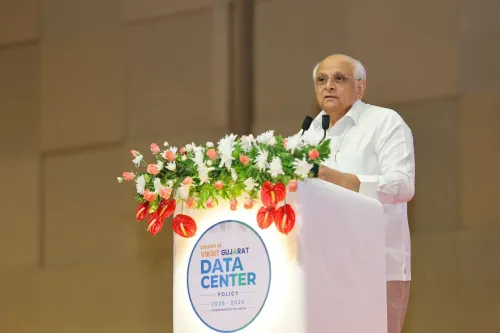
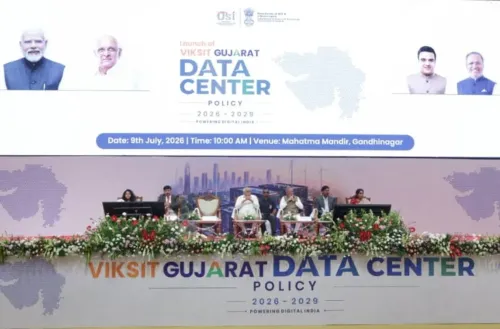
CM Bhupendra Patel unveils Viksit Gujarat Data Center Policy 2026-29

Synopsis
Gujarat Chief Minister Bhupendra Patel on 9 July 2026 announced the Viksit Gujarat Data Center Policy (2026-2029), framing it as a cornerstone of the state's contribution to India's digital infrastructure and the Viksit Bharat national vision for 2047.
Key Takeaways
Bhupendra Patel , Chief Minister of Gujarat , announced the Viksit Gujarat Data Center Policy (2026-2029) on 9 July 2026 .
The policy aims to create a 'secure, future-ready digital backbone' aligned with the national Digital India programme and Viksit Bharat vision.
Gujarat has a prior track record of IT and ITeS incentive frameworks dating to 2016 , providing institutional continuity for the new policy.
Primary beneficiaries are expected to be IT firms and data centre operators seeking investment destinations within India's industrial corridors.
Detailed incentive structures, land-allocation norms, and MoUs with data-centre companies are awaited following the policy notification.
The 2026-2029 timeframe directly supports the central government's push for large-scale, secure data capacity under the Viksit Bharat 2047 framework.
Gujarat Chief Minister Bhupendra Patel on Thursday, 9 July 2026 unveiled the Viksit Gujarat Data Center Policy (2026-2029), positioning the western state as a key node in India's expanding digital infrastructure network. The announcement, made via the Chief Minister's official X account, frames the policy as a deliberate step toward building a 'secure, future-ready digital backbone' in support of the national Viksit Bharat vision.
Context
In his post, CM Patel described the policy as 'meticulously designed', linking it directly to the Digital India programme and the broader ambition of a developed India by 2047. The three-year policy window — 2026 to 2029 — signals a structured, medium-term commitment rather than a one-off announcement. The accompanying video released alongside the post offers visual glimpses of the policy's stated objectives, though detailed provisions and incentive structures are yet to be formally notified.
Policy Backdrop
Gujarat has a well-established tradition of using industrial policy as an economic lever. Earlier IT and ITeS frameworks covering 2016 to 2021 offered targeted incentives for data centre operators and electronics manufacturers, laying groundwork for the current initiative. Nationally, the Digital India programme — launched in July 2015 — set the template for state-level data infrastructure drives, and several Indian states have since introduced dedicated data-centre policies to attract private capital into the sector.
The Viksit Bharat framework, articulated by Prime Minister Narendra Modi, calls for India to achieve developed-economy status by 2047. Data sovereignty, secure storage capacity, and large-scale processing infrastructure are widely regarded as foundational requirements of that goal, giving state-level policies like Gujarat's a direct role in the national roadmap.
Stakeholders and Impact
The primary beneficiaries of the policy are expected to be IT firms, hyperscale and colocation data centre operators, and technology-sector investors scouting locations within India's industrial corridors. Gujarat's existing infrastructure — including connectivity, power networks, and established industrial zones — makes it a competitive candidate for large data-centre campuses.
Broader stakeholders include state and central government departments that depend on secure digital infrastructure for e-governance services, as well as citizens who stand to benefit from improved data security and faster digital service delivery. The policy's 'secure' emphasis also resonates with ongoing national conversations around data localisation and digital sovereignty.
What's Next
Observers will watch for the formal policy gazette notification, which is expected to spell out land-allocation norms, power-supply guarantees, fiscal incentives, and eligibility criteria for data-centre developers. Announcements of memoranda of understanding with major domestic or international data-centre companies would be the next concrete indicator of the policy's traction. The 2026-2029 horizon also means that implementation milestones and investment targets will likely be tracked against Gujarat's broader industrial calendar, including future investor summits.
Point of View
The announcement reinforces Gujarat's positioning as a pro-industry state that translates central government vision — here, Viksit Bharat — into concrete sub-national policy. The deliberate three-year horizon signals an attempt to offer investors planning certainty, a recurring theme in Gujarat's industrial outreach. Whether the policy delivers on that promise will depend on the incentive depth and regulatory speed revealed in the forthcoming formal notification.
NationPress
9 Jul 2026
Frequently Asked Questions
What is the Viksit Gujarat Data Center Policy 2026-2029?
The Viksit Gujarat Data Center Policy (2026-2029) is a state-level framework announced by Gujarat Chief Minister Bhupendra Patel on 9 July 2026, designed to attract data-centre investment and build secure digital infrastructure in Gujarat in support of the national Digital India and Viksit Bharat programmes.
Who announced the Gujarat data centre policy?
Gujarat Chief Minister Bhupendra Patel, a senior BJP leader, announced the policy on 9 July 2026 through his official X account.
How does the Gujarat data centre policy relate to Viksit Bharat?
The policy is explicitly framed as Gujarat's contribution to the Viksit Bharat national vision, which calls for India to become a developed economy by 2047, with secure and large-scale digital infrastructure as a foundational requirement.
What incentives does the Viksit Gujarat Data Center Policy offer?
The specific incentive structures and provisions of the policy have not yet been formally notified. Detailed guidelines on fiscal incentives, land allocation, and eligibility are expected to be released after the official policy gazette notification.
Which companies will benefit from Gujarat's data centre policy?
IT firms, hyperscale and colocation data centre operators, and technology-sector investors are the primary intended beneficiaries, alongside state departments and citizens who rely on secure e-governance infrastructure.