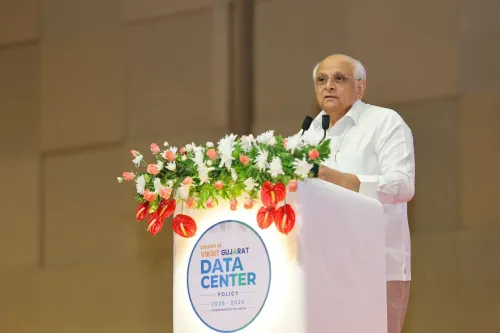
CM Bhupendra Patel Launches Viksit Gujarat Data Center Policy 2026

Synopsis
Gujarat Chief Minister Bhupendra Patel on 9 July 2026 launched the Viksit Gujarat Data Center Policy 2026-2029, targeting ₹6 lakh crore in investment and 7.5 GW of capacity anchored by a mandatory 51% green energy requirement across Dholera SIR, Sanand, and GIFT City.
Key Takeaways
Viksit Gujarat Data Center Policy 2026-2029 was launched by CM Bhupendra Patel on 9 July 2026 .
The policy targets investment of approximately ₹6 lakh crore to build 7.5 GW of data centre capacity.
A mandatory 51% green energy footprint is built into the policy framework.
Key locations identified are Dholera SIR , Sanand , and GIFT City in Gujarat.
The policy positions Gujarat as a hub for Green AI and hyperscale data infrastructure on a global scale.
The initiative is framed within PM Narendra Modi's broader Digital India and national AI readiness agenda.
The Chief Minister's Office of Gujarat announced on Thursday, 9 July 2026 that Chief Minister Bhupendra Patel launched the 'Viksit Gujarat Data Center Policy 2026-2029', a landmark state policy targeting approximately ₹6 lakh crore in investment to build a 7.5 GW data centre capacity with a mandatory 51% green energy footprint.
Context
The CMO Gujarat framed the policy launch as a step toward positioning the state as the 'tech capital of India,' crediting Prime Minister Narendra Modi's vision for digital infrastructure. The announcement identifies three strategic locations — Dholera SIR, Sanand, and GIFT City — as the anchors for this hyperscale and Green AI infrastructure push. The policy period runs from 2026 to 2029.
The official post stated that Gujarat is 'architecting the global future of Green AI and hyper-scale data infrastructure,' signalling ambitions that extend well beyond domestic demand to attract global cloud and AI investors.
Policy Backdrop
The Viksit Gujarat Data Center Policy 2026-2029 sits within a broader national arc that began with the Digital India programme in 2015 and was reinforced by a draft national data centre policy around 2020, which sought to promote data localisation and infrastructure growth across Indian states. Gujarat's new policy builds directly on that foundation while adding a state-specific incentive layer.
The 51% mandatory green energy requirement is particularly significant: it aligns with India's net-zero commitments and mirrors the sustainability standards increasingly demanded by international hyperscale technology firms before committing capital to new facilities. Gujarat's existing momentum in electronics and semiconductor investment makes it a natural candidate to compete for such projects.
Multiple Indian states have introduced dedicated data centre policies in recent years to capture rising demand from global cloud providers and AI companies. Gujarat's policy differentiates itself through the scale of its investment target and the green energy mandate, as well as the readiness of purpose-built zones like Dholera Special Investment Region, a planned greenfield industrial hub, and GIFT City, India's first operational international financial services smart city.
Stakeholders and Impact
The policy is directly aimed at data centre developers, hyperscale technology investors, AI companies, and renewable energy providers. Sanand, historically developed as an automobile manufacturing cluster near Ahmedabad, is now being repositioned as a destination for electronics and data infrastructure — reflecting a deliberate industrial diversification strategy by the state government.
GIFT City already hosts fintech and data infrastructure tenants and is expected to serve as a high-visibility anchor for international investors evaluating Gujarat's data centre ecosystem. The mandatory green energy clause creates a parallel opportunity for renewable energy developers to scale capacity in tandem with data centre buildout.
What's Next
Attention will now turn to the rollout of specific incentives under the policy, power allocation mechanisms, and the signing of investment memoranda of understanding, likely at upcoming industry events or the Vibrant Gujarat summit series. Possible linkages with national-level semiconductor and electronics production-linked incentive schemes could further amplify the policy's reach.
If the investment targets are realised, the 7.5 GW capacity would represent one of the largest concentrated data centre buildouts in South Asia, with implications for India's positioning in the global AI infrastructure race.
Point of View
Sanand, and GIFT City — the state is hedging across greenfield, brownfield, and financial-services verticals simultaneously. This move intensifies the inter-state competition for data centre capital and sets a policy benchmark that other states will be under pressure to match.
NationPress
9 Jul 2026
Frequently Asked Questions
What is the Viksit Gujarat Data Center Policy 2026-2029?
The Viksit Gujarat Data Center Policy 2026-2029 is a state government framework launched on 9 July 2026 by CM Bhupendra Patel to attract hyperscale data centre investment, targeting approximately ₹6 lakh crore and 7.5 GW of capacity with a mandatory 51% green energy requirement.
What is the green energy requirement under the Gujarat data centre policy?
The policy mandates that at least 51% of the energy powering data centres established under it must come from green or renewable sources, aligning with India's net-zero commitments and international investor sustainability standards.
Which locations in Gujarat are targeted for data centre development?
The policy identifies three strategic zones: Dholera Special Investment Region (SIR) , a planned greenfield industrial hub; Sanand , an industrial cluster near Ahmedabad; and GIFT City , India's first operational international financial services smart city.
How much investment does Gujarat's new data centre policy target?
The policy targets investment of approximately ₹6 lakh crore , making it one of the most ambitious state-level data centre investment targets announced in India.
How does the Gujarat data centre policy relate to the Digital India programme?
The policy builds on the national Digital India programme launched in 2015 and the draft national data centre policy of around 2020 , adding a state-specific incentive and green energy layer to accelerate Gujarat's share of India's growing digital infrastructure capacity.