CM Samrat Choudhary Hails NDDB Office Move to Patna
Synopsis
Bihar Chief Minister Samrat Choudhary has welcomed the NDDB's decision to establish a permanent office near the COMFED campus in Patna, a step he says will strengthen the state's dairy cooperative movement, raise farmer incomes, and accelerate rural economic growth.
Key Takeaways
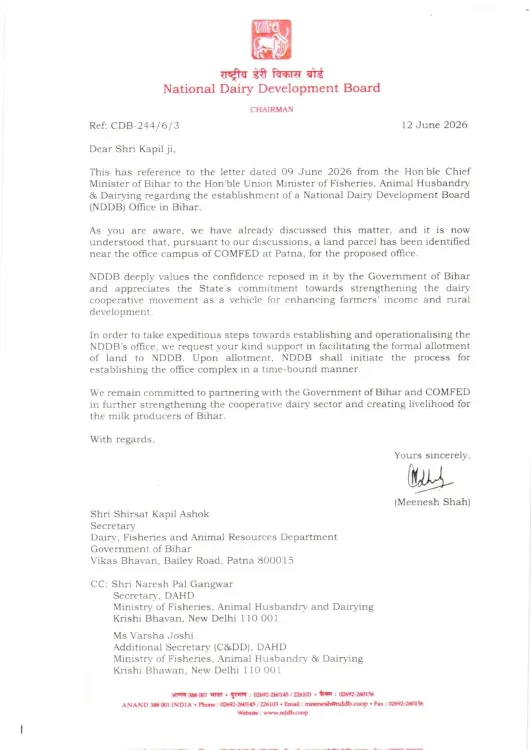
The National Dairy Development Board (NDDB) has advanced land-allocation proceedings for a new office in Patna , with a site near the COMFED campus identified.
Bihar Chief Minister Samrat Choudhary announced the development on June 12, 2026 , describing it as major news for milk producers and cooperative stakeholders.
NDDB was founded in 1965 and led Operation Flood (1970–1996), making India the world's largest milk producer.
COMFED , established in 1983 , is Bihar's apex dairy cooperative body linking village producers to markets.
The new office is expected to provide on-ground technical support, planning, and training to Bihar's dairy cooperatives.
CM Choudhary credited Prime Minister Narendra Modi and Union Minister Lalan Singh for the decision.
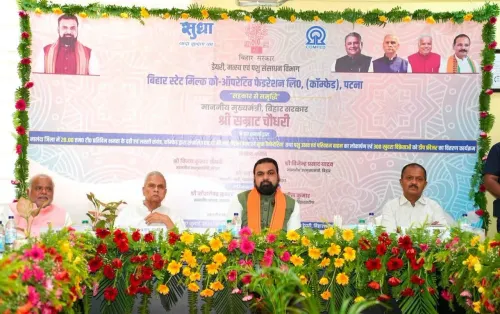
Bihar Chief Minister Samrat Choudhary on Friday, June 12, 2026, welcomed the National Dairy Development Board's move to establish a permanent office in Patna, calling it a major development for the state's milk producers, livestock farmers, and cooperative sector. The NDDB has advanced the land-allocation process, with a site near the COMFED campus in Patna identified for the new office, clearing the path for its formal establishment.
Context
In his post on X, Chief Minister Choudhary described the development as 'एक बड़ी खुशखबरी' ('a big piece of good news') for dairy producers and cooperative stakeholders across Bihar. He noted that land had been identified near the COMFED complex in Patna and that the process of land allocation had been moved forward, paving the way for the office's establishment. He expressed gratitude to Prime Minister Narendra Modi and Union Minister for Fisheries, Animal Husbandry and Dairying Lalan Singh for the decision.
The post was accompanied by hashtags including #विकसित_भारत ('Developed India'), #समृद्ध_बिहार ('Prosperous Bihar'), and #DairyDevelopment, signalling the initiative's alignment with the central government's broader rural-economy agenda.
Policy Backdrop
The National Dairy Development Board was established in 1965 to replicate the Amul cooperative model — known as the Anand pattern — across India. Its flagship programme, Operation Flood, launched in 1970 and running through 1996, transformed India into the world's largest milk producer and is widely credited with driving the country's White Revolution.
COMFED, the Bihar State Milk Co-operative Federation Ltd, was set up in 1983 to organise village-level dairy cooperatives and connect producers to markets across the state. Despite Bihar's large cattle population, the state has historically lagged behind western and southern counterparts in dairy productivity and cooperative infrastructure. A permanent NDDB presence in Patna is expected to provide technical support, planning assistance, and training directly within the state.
Stakeholders and Impact
Bihar's dairy sector encompasses hundreds of thousands of smallholder milk producers and livestock farmers, many of them in rural districts with limited access to institutional support. A local NDDB office would reduce dependence on remote coordination and allow faster deployment of technical expertise and central-scheme resources to COMFED-affiliated cooperatives.
Chief Minister Choudhary stated the initiative would 'provide new strength to the milk cooperative movement in the state, help increase farmers' incomes, and give fresh momentum to the rural economy.' Analysts note that strengthening dairy value chains in eastern India is also seen as a lever to reduce rural out-migration by creating on-farm livelihoods.
What's Next
Attention will now turn to the operationalisation timeline of the NDDB office once land allocation is formally completed. Follow-on approvals for infrastructure funding under central dairy and animal-husbandry schemes, and the scope of programmes the new office will administer, will determine how quickly benefits reach producers on the ground. The Bihar government's coordination with both NDDB and COMFED in the coming months will be closely watched as a test of the centre-state cooperative model in one of India's most populous states.
Point of View
A state that has long underperformed its agricultural potential relative to its cattle population. For Chief Minister Choudhary, publicly crediting Prime Minister Modi and Union Minister Lalan Singh serves a dual purpose: reinforcing the BJP's narrative of centre-state synergy on rural welfare while positioning his administration as an active facilitator of federal schemes. The initiative fits a broader pattern of successive central governments using cooperative dairy expansion in eastern India to address farmer income stagnation and check rural out-migration. The real test will be how quickly the office becomes operational and whether it catalyses measurable gains in milk procurement, producer prices, and cooperative membership across Bihar's districts.
NationPress
29 Jul 2026
Frequently Asked Questions
What is the NDDB office being set up in Bihar?
The National Dairy Development Board (NDDB) is establishing a permanent state-level office in Patna, Bihar, with land identified near the COMFED campus. The office will provide technical support, planning, and training to Bihar's dairy cooperatives.
What is COMFED Bihar?
COMFED, or the Bihar State Milk Co-operative Federation Ltd, is the state's apex dairy cooperative body established in 1983. It organises village-level milk cooperatives and connects producers to markets across Bihar.
How will the NDDB office benefit Bihar farmers?
A local NDDB office is expected to boost the dairy cooperative movement by offering on-ground technical expertise, faster access to central-scheme resources, and support for increasing milk productivity — all of which can raise incomes for smallholder dairy farmers.
Who approved the NDDB office in Bihar?
Bihar Chief Minister Samrat Choudhary credited Prime Minister Narendra Modi and Union Minister for Fisheries, Animal Husbandry and Dairying Lalan Singh for the decision to advance the NDDB office establishment in Bihar.
What is Operation Flood and how does it relate to this development?
Operation Flood was an NDDB-led programme launched in 1970 that ran until 1996 and made India the world's largest milk producer by replicating the Amul cooperative model nationally. The new Bihar office continues this legacy of expanding institutional dairy support to states that still have significant growth potential.