CM Samrat Choudhary pays tribute to BKU founder Mahendra Singh Tikait
Synopsis
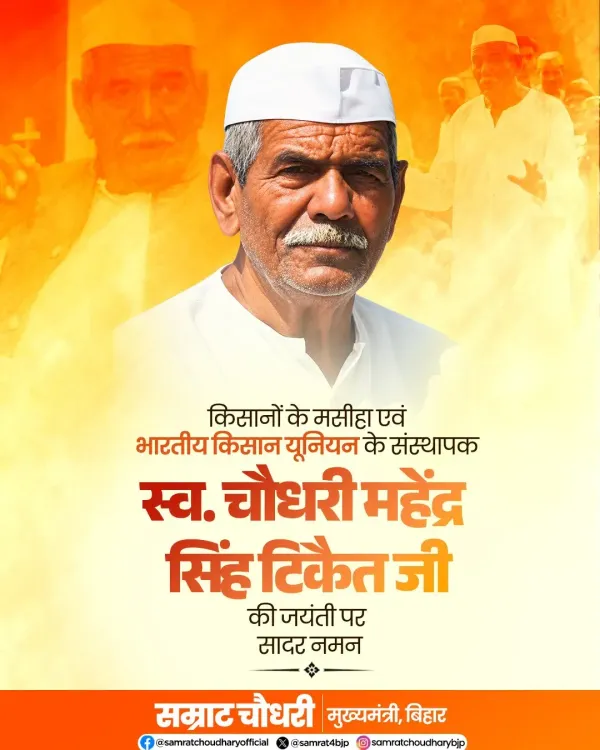
Bihar Chief Minister Samrat Choudhary paid tribute to Bharatiya Kisan Union founder Mahendra Singh Tikait on his birth anniversary, honouring the farmer leader's lifelong struggle for agrarian rights and dignity across India.
Key Takeaways
Bihar CM Samrat Choudhary posted a tribute on 6 October 2026 marking the birth anniversary of BKU founder Mahendra Singh Tikait .
Tikait founded the Bharatiya Kisan Union , one of India's most influential grassroots farmer organisations.
His 1988 Boat Club rally in New Delhi was among the largest farmer mobilisations in independent India.
His son Rakesh Tikait continued the BKU legacy, most prominently during the 2020-21 farm-law protests .
Choudhary's cross-party tribute underlines the enduring political weight of farmer-rights figures in North India's electoral calculus.
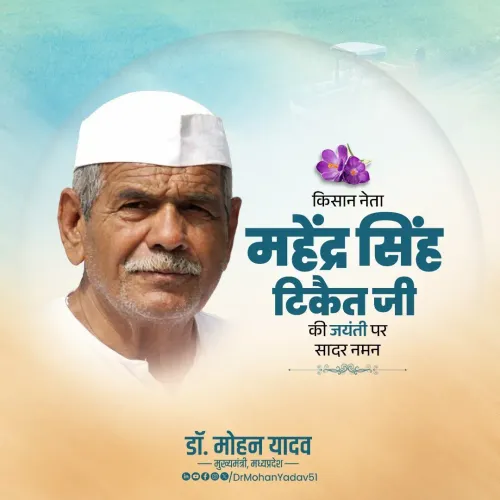
On the birth anniversary of farmer-union icon Chaudhary Mahendra Singh Tikait, Bihar Chief Minister Samrat Choudhary paused on Tuesday, 6 October 2026 to honour a man whose life was spent entirely in the trenches of agrarian struggle — a rare gesture that crosses political lines and speaks to the enduring moral weight of India's farm-rights movement.
Posting in Hindi on X, CM Choudhary wrote: 'Kisan on ke adhikaron evam samman ke liye aajeevan sangharsharat rahe Bharatiya Kisan Union ke sansthapak...' — offering a respectful salute ('sadar naman') to the founder of the Bharatiya Kisan Union (BKU), and adding that Tikait's 'struggle and dedication for the welfare of farmers will always be remembered.'Who was Mahendra Singh Tikait?
Chaudhary Mahendra Singh Tikait was the founding president of the Bharatiya Kisan Union, one of India's most powerful grassroots farmer organisations. Born in Sisauli village, Muzaffarnagar, Uttar Pradesh, he became the defining voice of the sugarcane-belt farmer from the late 1980s onward. His landmark agitations — including the massive 1988 Boat Club rally in New Delhi where hundreds of thousands of farmers camped on the lawns of the capital — forced state and central governments to engage with farm-sector grievances at a scale rarely seen before.
Tikait's politics were fiercely non-partisan. He mobilised across caste and crop lines, insisting that the farmer's identity transcended electoral allegiance. That legacy of principled stubbornness is precisely why tributes from leaders of all parties — including the BJP — carry a certain sincerity on his birth anniversary. His son, Rakesh Tikait, later carried the BKU flag into the prolonged 2020-21 farm-law protests, cementing the Tikait name as shorthand for agrarian resistance in the national imagination.
Why a BJP Chief Minister's tribute lands differently
The BKU under both Mahendra Singh and Rakesh Tikait has historically been a thorn in the side of governments that undervalue rural incomes — including BJP-led administrations. CM Choudhary's decision to publicly honour the elder Tikait on his jayanti is a signal of the political ground reality in North Indian states: farm communities are an electoral force too large to ignore, and gestures of cross-partisan respect cost little but buy goodwill in the sugarcane and paddy belts that straddle the Bihar-UP corridor.
Bihar itself has a substantial farmer population, and Choudhary — as a senior BJP leader navigating coalition arithmetic in one of India's most agrarian states — understands that reverence for figures like Tikait speaks directly to the lived anxieties of rural voters around land rights, minimum support prices, and crop-loan waivers.
Point of View
Not just policy responses. Tikait's legacy has grown more potent since the 2020-21 protests, making his birth anniversary a politically charged date. Choudhary's post is calibrated symbolism: it costs nothing and signals to Bihar's large rural electorate that the ruling dispensation is not deaf to the language of farm-rights history. The real test, as always, will be in procurement prices and irrigation budgets — not anniversary tweets.
NationPress
6 Oct 2026
Frequently Asked Questions
Who was Mahendra Singh Tikait?
Mahendra Singh Tikait was the founder-president of the Bharatiya Kisan Union (BKU) and one of India's most prominent farmer leaders, known for large-scale agitations demanding better prices and rights for cultivators, especially in the sugarcane belt of western Uttar Pradesh.
What is the Bharatiya Kisan Union (BKU)?
The Bharatiya Kisan Union is a major grassroots farmer organisation founded by Mahendra Singh Tikait. It became nationally prominent through mass rallies in the 1980s and 1990s and later played a central role in the 2020-21 farm-law protests under Rakesh Tikait.
When is Mahendra Singh Tikait's birth anniversary?
Mahendra Singh Tikait's birth anniversary falls on 6 October, marked annually by farmer groups and political leaders across North India.
Why did Bihar CM Samrat Choudhary tribute Tikait?
CM Samrat Choudhary posted a tribute to honour Tikait's lifelong dedication to farmer rights and dignity, calling his struggle unforgettable — a gesture that reflects the political importance of agrarian communities in Bihar and neighbouring states.
Who is Rakesh Tikait and how is he related to Mahendra Singh Tikait?
Rakesh Tikait is the son of Mahendra Singh Tikait and a national spokesperson of the BKU. He became a prominent face of the 2020-21 protests against the now-repealed central farm laws, continuing his father's legacy of farmer mobilisation.