CM Dhami Credits Modi Vision for Piped Water in 16 Cr Homes
Synopsis
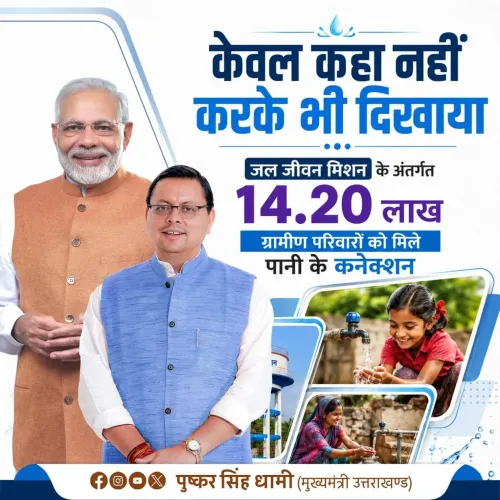
Uttarakhand Chief Minister Pushkar Singh Dhami credited PM Narendra Modi's public-interest vision for delivering piped drinking water to approximately 16 crore households, highlighting the reach of the Jal Jeevan Mission launched in 2019.
Key Takeaways
The Chief Minister's Office of Uttarakhand shared a statement by CM Pushkar Singh Dhami on June 9, 2026 crediting PM Modi for the mission's scale.
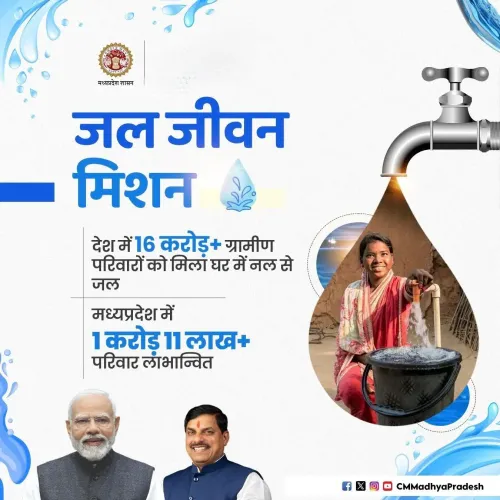
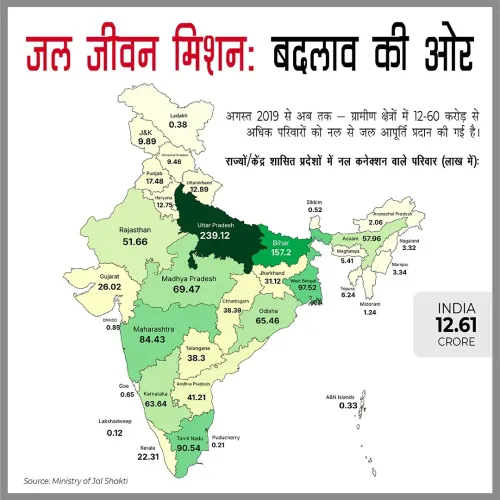
Approximately 16 crore households are now receiving piped drinking water supply, according to the statement.
The Jal Jeevan Mission was launched under the Ministry of Jal Shakti in 2019-20 with a target of tap connections for all rural households.
Uttarakhand has implemented the mission under challenging Himalayan terrain, requiring dedicated funding and gravity-fed schemes.
The mission is part of a broader household-delivery policy framework that also includes Swachh Bharat Mission and PM Awas Yojana .
Future benchmarks will focus on sustained operation and maintenance of completed water infrastructure, not just new connections.
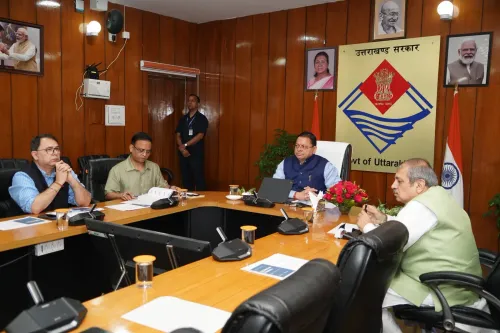
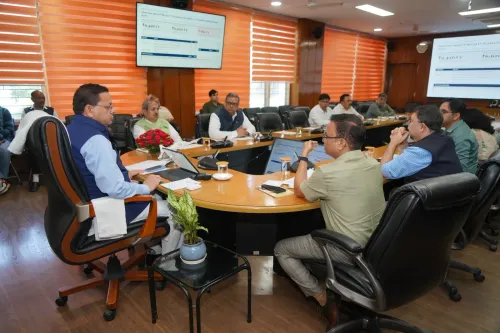
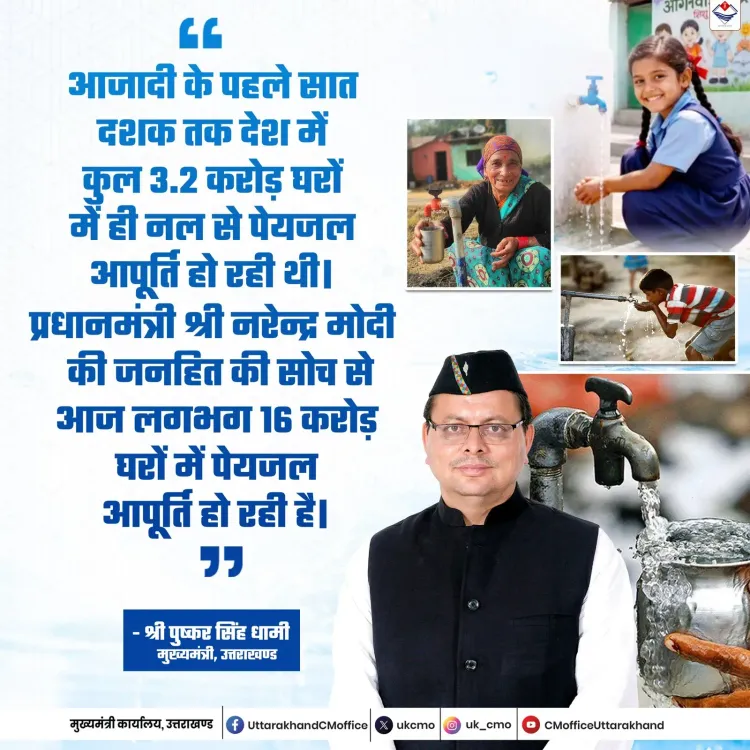
The Chief Minister's Office of Uttarakhand, on Tuesday, June 9, 2026, shared a statement by Chief Minister Pushkar Singh Dhami crediting Prime Minister Narendra Modi's public-interest vision for enabling piped drinking water supply to approximately 16 crore households across the country.
Context
Speaking in the context of the Jal Jeevan Mission, CM Dhami stated — 'Pradhanmantri Shri Narendra Modi ki janhit ki soch se aaj lagbhag 16 crore gharon mein peyajal aapoorti ho rahi hai' ['Owing to Prime Minister Narendra Modi's public-interest thinking, today approximately 16 crore homes are receiving drinking water supply']. The remark underscores the Uttarakhand government's alignment with the Centre's flagship rural infrastructure agenda.
The Jal Jeevan Mission was announced in the Union Budget 2019-20 under the Ministry of Jal Shakti, with the stated goal of providing functional household tap connections to every rural household in India. The programme has since been cited by the central and state governments as one of the most visible delivery-focused welfare missions of the current administration.
Policy Backdrop
The Jal Jeevan Mission represents a departure from earlier water-supply programmes by focusing on measurable, household-level outcomes rather than infrastructure creation alone. States are required to report progress on a real-time national dashboard maintained by the Ministry of Jal Shakti, creating a layer of public accountability.
Uttarakhand, a Himalayan state with difficult terrain and dispersed rural settlements, has been among the states that received dedicated funding components to address geographic constraints. Delivering piped water to remote hill villages involves significantly higher per-connection costs compared to plains states, making central support critical to implementation.
The broader pattern of household-level delivery missions — including the Swachh Bharat Mission for sanitation and PM Awas Yojana for housing — reflects a consistent policy architecture that has defined central welfare programming since 2014. The Jal Jeevan Mission sits within this framework as its water-access pillar.
Stakeholders and Impact
The primary beneficiaries of the mission are rural households, particularly women and girls who have historically borne the burden of fetching water from distant sources. Access to in-home tap connections reduces time poverty and has downstream effects on health, education attendance, and economic participation.
State governments are co-implementing partners, responsible for last-mile infrastructure, operations, and maintenance. Uttarakhand's state machinery has had to adapt standard implementation models to suit mountain geography, including the use of gravity-fed schemes and spring-shed development alongside conventional piped networks.
What's Next
Observers will watch for the release of quarterly Jal Jeevan Mission progress dashboards by the Ministry of Jal Shakti and Uttarakhand's annual rural water supply implementation reports, which will provide verified household-connection figures. Sustained operation and maintenance of completed infrastructure — rather than new connections alone — is increasingly the benchmark by which the mission's long-term success will be assessed.
Point of View
A BJP-governed state, such messaging also reinforces vertical alignment with the central leadership. The broader significance lies in how the Jal Jeevan Mission has become a primary proof-point for the ruling dispensation's 'last-mile delivery' governance argument.
NationPress
23 Oct 2026
Frequently Asked Questions
What is the Jal Jeevan Mission?
The Jal Jeevan Mission is a centrally sponsored scheme launched in 2019-20 under India's Ministry of Jal Shakti, aimed at providing functional household tap connections for safe drinking water to every rural household in the country.
How many households have received piped water under Jal Jeevan Mission?
According to a statement by Uttarakhand Chief Minister Pushkar Singh Dhami shared on June 9, 2026, approximately 16 crore households across India are now receiving piped drinking water supply under the mission.
What is Uttarakhand's role in the Jal Jeevan Mission?
Uttarakhand is a co-implementing state partner for the Jal Jeevan Mission, responsible for last-mile infrastructure delivery. The state has received dedicated funding to address its mountainous terrain, using gravity-fed schemes and spring-shed development.
Who launched the Jal Jeevan Mission in India?
The Jal Jeevan Mission was announced by the central government under Prime Minister Narendra Modi in the Union Budget 2019-20, with implementation overseen by the Ministry of Jal Shakti.
What comes after Jal Jeevan Mission connections are installed?
Policy observers note that sustained operation and maintenance of completed water infrastructure is the next critical benchmark, as ensuring long-term functionality of tap connections is as important as the initial installation.