Owaisi flags ITBP DG's Arunachal-China admission, slams Modi govt
Synopsis
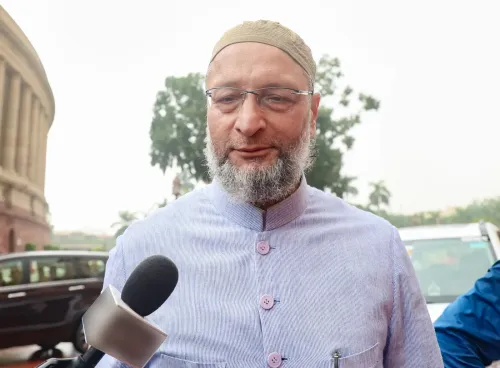
AIMIM president Asaduddin Owaisi cited a statement by the ITBP Director General on the Arunachal-China border situation, accusing the Modi government of keeping the country uninformed. He said repeated parliamentary questions went unanswered — and now he knows why.
Key Takeaways
AIMIM president Asaduddin Owaisi flagged a statement by the DG ITBP on the Arunachal Pradesh–China border as 'extremely concerning' on 23 October 2026 .
Owaisi accused the Narendra Modi government of deliberately withholding information from the public about ground realities on the Line of Actual Control .
The ITBP is India's primary force guarding the LAC; its chief's public statements carry significant institutional weight.
India-China border tensions have persisted since the June 2020 Galwan clash , which killed 20 Indian soldiers .
Opposition MPs have been seeking specifics on patrolling rights and buffer zones in Arunachal sectors since 2021, with the government citing 'stability'.
Owaisi's challenge sets up a potential flashpoint in the upcoming winter session of Parliament , where the government will face pressure to respond.
A statement from the Director General of the Indo-Tibetan Border Police (ITBP) about the situation on the Arunachal Pradesh–China border has triggered sharp political fallout — with AIMIM president and Hyderabad MP Asaduddin Owaisi calling it confirmation of what the government had been 'keeping the country in the dark' about, in a post on X on Friday, 23 October 2026.
What the ITBP chief's admission means
Owaisi's intervention zeroes in on what he describes as an official acknowledgement from the DG ITBP — the force that bears primary responsibility for guarding the Line of Actual Control (LAC) across Arunachal sectors — of a ground situation serious enough to qualify, in his words, as 'extremely concerning'. The significance lies precisely in the source: not an opposition allegation, but a statement from the uniformed head of India's China-border force.
'I have raised this issue even earlier and have not got any answers from the government,' Owaisi wrote. 'Now we know why.' The three-word close lands like a verdict — implying that official silence was not routine caution but deliberate concealment.
Six years of LAC silence — and why Arunachal is different
The backdrop stretches back to June 2020, when the Galwan Valley clash killed 20 Indian soldiers and shattered a decades-old understanding on the LAC. Since then, India and China have held successive corps commander-level talks, achieving phased disengagements at several friction points. But Arunachal Pradesh — which Beijing claims entirely as 'South Tibet' — has remained a separate, persistently sensitive theatre.
Between 2021 and 2023, opposition MPs repeatedly pressed the government for specifics on patrolling rights and buffer zones in Arunachal's sectors. The government's consistent answer: the situation is 'stable and under control'. Critics argued those formulations obscured ground realities rather than described them. Owaisi's post suggests that the DG ITBP's latest statement has now cracked that official line open.
Parliament, public accountability, and what comes next
Owaisi's challenge is as much procedural as political. By stating on the record that he sought answers and received none, he is laying the groundwork for a formal parliamentary question — potentially in the upcoming winter session — that the government will now find harder to deflect with boilerplate reassurances.
The Ministry of Home Affairs, which supervises the ITBP, and ITBP headquarters have not issued a public response to the remarks. Whether the DG's statement will be clarified, walked back, or amplified in official channels will determine whether this becomes a sustained accountability flashpoint or a one-day news cycle.
For border residents, ITBP personnel, and the broader public asking what is actually happening along one of the world's most contested mountain frontiers, the demand is simple: an answer that matches the honesty of the question.
Point of View
He shifts the burden of explanation squarely onto the government. This fits a longer pattern since Galwan — where the political battle has been as much about the right to know as about the ground situation itself. If the DG's statement stands uncontradicted, it becomes very difficult for the Ministry of Home Affairs to sustain the 'stable and under control' framing that has been the default response for six years. The winter session of Parliament may be where this accountability gap either gets formally closed — or publicly widened.
NationPress
23 Oct 2026
Frequently Asked Questions
What did the ITBP DG say about the Arunachal border with China?
The specific content of the ITBP Director General's statement has not been officially released in full public detail; Owaisi described it as a confirmation of a concerning border situation that he says the government had previously not disclosed to the public or Parliament.
Why is Arunachal Pradesh a flashpoint in India-China relations?
Arunachal Pradesh is claimed by China in its entirety as 'South Tibet,' making it one of the most sensitive sectors of the disputed Line of Actual Control . India firmly rejects this claim and administers the state as an integral part of the country.
What is the ITBP and what is its role on the China border?
The Indo-Tibetan Border Police (ITBP) is India's dedicated border-guarding force on the Line of Actual Control with China, covering high-altitude sectors from Ladakh to Arunachal Pradesh. Its Director General oversees all LAC deployments and is a key source of ground intelligence.
Has Owaisi raised the Arunachal border issue in Parliament before?
Yes. Asaduddin Owaisi stated in his post that he had raised the issue 'even earlier' and received no answers from the government — a pattern consistent with broader opposition complaints since 2021 about inadequate official disclosure on LAC developments.
What happened at Galwan Valley in 2020?
In June 2020 , Indian and Chinese troops clashed in Galwan Valley in Ladakh, resulting in the deaths of 20 Indian soldiers — the deadliest India-China border confrontation in decades. The clash triggered ongoing corps commander-level negotiations and phased disengagements at multiple LAC friction points.