Owaisi accuses Modi govt of hiding China border truth
Synopsis
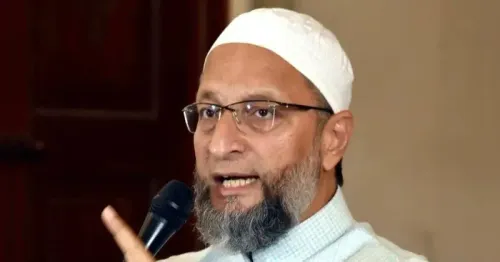
AIMIM president Asaduddin Owaisi has accused the Modi government of a deliberate pattern of opacity on the China border — citing blocked parliamentary debate and PM Modi's contested June 2020 claim that no Chinese troops were present on Indian territory.
Key Takeaways
AIMIM president Asaduddin Owaisi posted on 23 October 2026 accusing the Modi government of keeping citizens 'in the dark' on the real border situation with China .
Owaisi alleged there has been no parliamentary discussion, no questions allowed, and no press conference from PM Modi on border matters.
He specifically called out PM Modi's June 2020 all-party meeting statement that no Chinese troops were present on Indian territory, calling it 'obviously not true or factual'.
The Galwan Valley clash of June 2020 triggered the original controversy, with opposition parties disputing the government's characterisation of events since then.
The government has consistently cited the sensitivity of ongoing negotiations as justification for limiting public and parliamentary disclosure on LAC developments.
With a parliamentary winter session approaching, opposition pressure for a full-floor India-China border debate is expected to intensify.
A pointed question about what the public actually knows — and what it has been allowed to know — sits at the heart of a sharp political challenge issued by AIMIM president Asaduddin Owaisi on Friday, 23 October 2026. In a post on X, Owaisi alleged a deliberate pattern of opacity by the Narendra Modi government on the real situation along India's border with China, arguing that citizens have been systematically kept in the dark through suppressed parliamentary debate and unchallenged official claims.
Owaisi's critique is direct and multi-pronged: no parliamentary discussion, no questions permitted, no press conferences from the Prime Minister — and, he argues, at least one claim from the top that was factually wrong. 'That was obviously not true or factual,' he wrote, referring specifically to a statement PM Modi made in June 2020, in which the Prime Minister asserted that no Chinese troops were present on Indian territory.The June 2020 statement that still haunts the debate
At an all-party meeting convened in the immediate aftermath of the Galwan Valley clash of June 2020, Prime Minister Modi stated that neither had anyone entered Indian territory, nor was any post captured. The statement drew instant fire from opposition leaders at the time, who called it contradictory to satellite imagery and ground-level reporting that suggested significant incursions along the Line of Actual Control (LAC) in eastern Ladakh.
The government's consistent position has been that operational and diplomatic details of border management are sensitive and should not be litigated in open floor debates, a stance critics read as an excuse to foreclose accountability. That fault-line — between 'national security sensitivity' and 'democratic transparency' — has never been resolved.
Parliament as the missing forum
Owaisi's framing pointedly names Parliament of India as the institution that should have been the primary arena for border accountability. Opposition parties have, across multiple sessions since 2020, sought dedicated time for a full discussion on the India-China standoff, the pace of disengagement, and the status of patrolling rights at friction points. Those demands have largely gone unmet, with the government citing ongoing negotiations as a reason to limit public disclosure.
The absence of a Prime Ministerial press conference — a consistent feature of Modi's decade in office — adds another layer to the accountability argument. Without regular structured questioning, the only available windows for scrutiny are parliamentary Question Hour and floor debates, both of which, Owaisi argues, have been effectively closed on this specific file.
Why this charge keeps returning
This is not a new accusation, but its persistence is itself the political story. Each time a border-adjacent event surfaces — a new disengagement agreement, a diplomatic meeting, satellite imagery showing infrastructure build-up — the original June 2020 statement gets relitigated. The opposition's argument is structural: if the founding claim was inaccurate, every subsequent assurance about 'normalisation' rests on a cracked foundation.
The government has never formally retracted or clarified the June 2020 formulation, leaving a rhetorical gap that critics like Owaisi continue to widen. With the Parliament's winter session on the horizon, calls for a comprehensive LAC debate are unlikely to soften.
The real test of democratic accountability on the border is not just whether the government eventually speaks — it is whether Parliament gets to ask the questions in the first place.
Point of View
The democratic feedback loop on national security breaks down. This recurring charge reflects a wider pattern where border policy, like many sensitive files under this government, has been managed as an executive prerogative rather than a parliamentary one — a tension that deepens with every new disengagement headline that arrives without a floor debate.
NationPress
23 Oct 2026
Frequently Asked Questions
What did PM Modi say about China in June 2020?
At an all-party meeting in June 2020 , following the Galwan Valley clash , PM Modi stated that no Chinese troops had entered Indian territory and no Indian post had been captured. Opposition parties, including AIMIM , have consistently disputed this claim as inaccurate.
Why is Owaisi criticising Modi on the China border in 2026?
Asaduddin Owaisi alleges a continuing pattern of the Modi government denying citizens and Parliament full information about the India-China border situation — citing no parliamentary debate, no press conferences, and the unretracted June 2020 claim.
Has Parliament discussed the India-China border standoff?
Opposition parties have repeatedly demanded a dedicated parliamentary debate on the Line of Actual Control (LAC) standoff since 2020 , but the government has generally declined, citing the sensitivity of ongoing diplomatic and military negotiations.
What is the Galwan Valley clash?
The Galwan Valley clash was a deadly military confrontation between Indian and Chinese troops in eastern Ladakh in June 2020 , marking the most serious India-China border violence in decades and triggering a prolonged standoff along the LAC .
Does PM Modi hold regular press conferences?
PM Narendra Modi does not hold regular structured press conferences, a practice that opposition leaders including Owaisi have cited as limiting public accountability on sensitive national security issues such as the India-China border .