CM Dhami pays tribute to freedom fighter Shri Dev Suman on jayanti
Synopsis
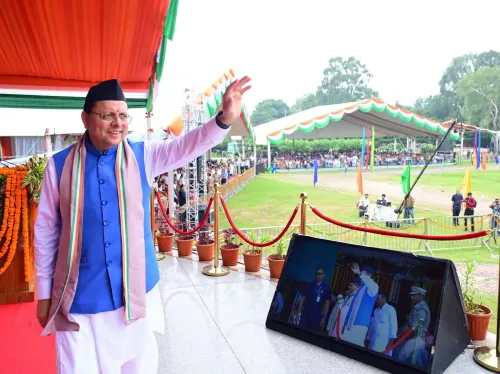
Uttarakhand Chief Minister Pushkar Singh Dhami on 25 May 2026 paid homage to Shri Dev Suman, the revolutionary leader of the Tehri Jan Andolan, on his birth anniversary, calling his supreme sacrifice an enduring inspiration for national service and dedication.
Key Takeaways
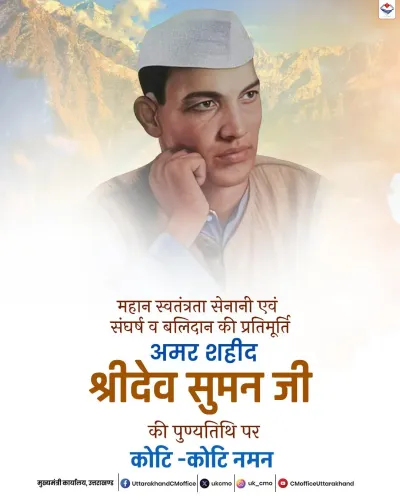
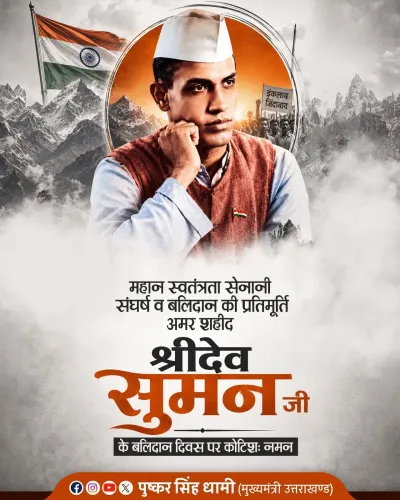
CM Pushkar Singh Dhami posted a tribute to Shri Dev Suman on his birth anniversary on 25 May 2026 .
Shri Dev Suman was a prominent freedom fighter who led the Tehri Jan Andolan in the 1930s–40s against the princely ruler of Tehri Garhwal.
Suman died in 1944 after a prolonged hunger strike in prison, demanding civil liberties and merger with independent India.
Dhami described Suman as an 'immortal son of Devbhoomi Uttarakhand' and a 'great revolutionary' whose sacrifice inspires national service and courage.
Since Uttarakhand's formation in 2000 , successive state governments have used such jayantis to link the state's identity to pre-independence regional sacrifices.
Analysts will watch for follow-up government announcements on Dev Suman memorials or inclusion of Tehri Jan Andolan history in state school curricula.
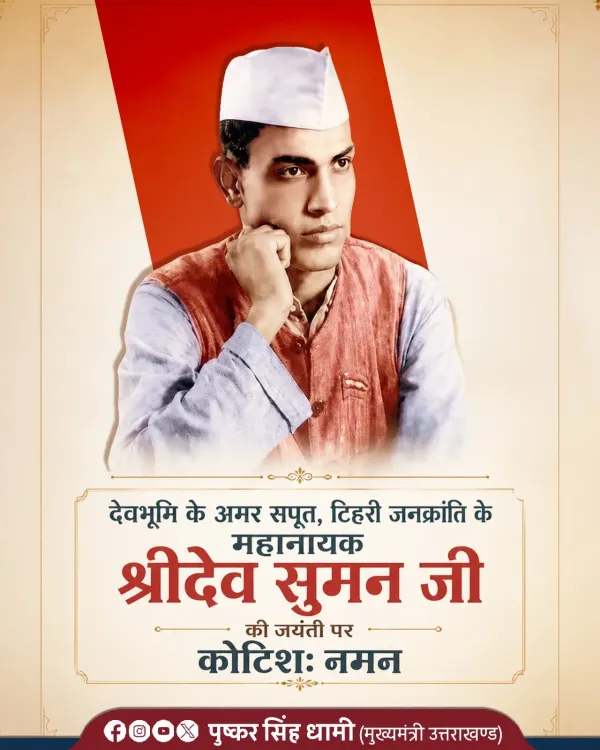
Uttarakhand Chief Minister Pushkar Singh Dhami on Monday, 25 May 2026, paid tribute to Shri Dev Suman, the celebrated freedom fighter and leader of the Tehri Jan Andolan, on the occasion of his birth anniversary. Dhami hailed Suman as an 'immortal son of Devbhoomi Uttarakhand' and a 'great revolutionary,' invoking his supreme sacrifice in the cause of the motherland's freedom.
In his post, Dhami wrote — 'देवभूमि उत्तराखण्ड के अमर सपूत, महान क्रांतिकारी, टिहरी जनआंदोलन के महानायक श्रीदेव सुमन जी की जयंती पर कोटिशः नमन' — translated: 'Countless salutations on the birth anniversary of the immortal son of Devbhoomi Uttarakhand, the great revolutionary, the hero of the Tehri Jan Andolan, Shri Dev Suman.' He added that Suman's supreme sacrifice for the freedom of the motherland 'will forever inspire us toward national service, courage, and dedication.'
Context
Shri Dev Suman, born in the Tehri Garhwal region, was one of the most prominent regional freedom fighters of pre-independence India. He led the Tehri Jan Andolan, a mass movement in the 1930s and 1940s that demanded responsible government, abolition of feudal practices, and the eventual merger of the princely state of Tehri Garhwal with independent India. Suman died in 1944 following prolonged imprisonment and a relentless hunger strike, becoming a symbol of sacrifice and democratic resistance in the Himalayan region.
The Tehri Jan Andolan is regarded as one of the significant regional struggles that ran parallel to the national freedom movement, drawing attention to the feudal conditions prevailing in princely states even as the broader independence campaign gathered momentum across British India.
Policy Backdrop
Since Uttarakhand's formation as a separate state in 2000, successive state governments have observed the jayantis of regional martyrs to anchor the new state's identity in its pre-independence sacrifices. Commemorating figures like Shri Dev Suman has become a consistent feature of state-level political messaging, linking local histories of resistance to the broader nationalist narrative.
Since 2014, BJP state units across India have systematically organised commemorations of lesser-known revolutionaries — particularly those from princely states — to broaden the nationalist pantheon and connect regional histories to contemporary governance. In Uttarakhand, this has included discussions around martyr memorials, heritage tourism, and the inclusion of local freedom-struggle chapters in school curricula.
Stakeholders and Impact
Garhwali communities, for whom Shri Dev Suman is a revered figure, and Uttarakhand's student population are the primary audiences for such commemorations. Tributes of this nature reinforce a sense of regional pride and cultural continuity, particularly among younger generations who may have limited exposure to sub-national freedom-struggle narratives outside formal education.
Observers note that such public remembrances by sitting chief ministers carry institutional weight — they signal the state's intent to keep regional martyrs visible in public memory and can precede formal policy actions such as memorial restoration projects or curriculum revisions.
What's Next
Attention will now turn to whether the Uttarakhand government follows this tribute with concrete announcements — such as the restoration or development of Dev Suman memorials in Tehri, or the inclusion of dedicated chapters on the Tehri Jan Andolan in state school textbooks ahead of the next assembly session. As Uttarakhand deepens its effort to document and celebrate its distinct pre-statehood history, the legacy of figures like Shri Dev Suman is likely to remain central to both cultural policy and political identity in the state.
Point of View
Princely-state freedom fighters to widen the nationalist narrative beyond the dominant Congress-era canon. By publicly invoking Suman's sacrifice on his jayanti, Dhami reinforces Uttarakhand's distinct cultural identity while aligning the state's foundational story with the party's broader ideological project of inclusive nationalist memory. The tribute also carries a forward-looking dimension: in a state where heritage tourism and educational reform are active policy priorities, commemorations of this kind often serve as political signals ahead of concrete government action. Whether this remains a ceremonial gesture or translates into measurable policy — memorial restoration, curriculum inclusion — will be the real test of the state's commitment to Suman's legacy.
NationPress
10 Oct 2026
Frequently Asked Questions
Who was Shri Dev Suman?
Shri Dev Suman was a freedom fighter from the Tehri Garhwal region of present-day Uttarakhand who led the Tehri Jan Andolan, a mass movement in the 1930s and 1940s demanding responsible government and the abolition of feudal practices in the princely state of Tehri Garhwal. He died in 1944 after a prolonged hunger strike in prison.
What was the Tehri Jan Andolan?
The Tehri Jan Andolan was a popular movement in the 1930s and 1940s that sought civil liberties, responsible government, and the eventual merger of the princely state of Tehri Garhwal with independent India. It is considered one of the significant regional struggles contemporaneous with the national freedom movement.
Why did CM Dhami post a tribute to Dev Suman?
CM Pushkar Singh Dhami posted the tribute on 25 May 2026 to mark Shri Dev Suman's birth anniversary, or jayanti. Dhami honoured Suman as an 'immortal son of Devbhoomi Uttarakhand' and called his sacrifice an enduring inspiration for national service and dedication.
What is the significance of Dev Suman for Uttarakhand?
Dev Suman is one of the most revered regional martyrs of Uttarakhand, particularly among Garhwali communities. His sacrifice is seen as foundational to the state's identity, and successive Uttarakhand governments have observed his jayanti to connect the state's history to pre-independence struggles for democratic rights.
What policy actions might follow CM Dhami's tribute to Dev Suman?
Observers will watch for government announcements on the restoration or development of Dev Suman memorials in Tehri, as well as possible inclusion of Tehri Jan Andolan chapters in Uttarakhand school textbooks. However, no specific schemes tied to this jayanti have been officially announced.