CM Dhami: Jageshwar Dham pilgrims surge 150% in 2026
Synopsis
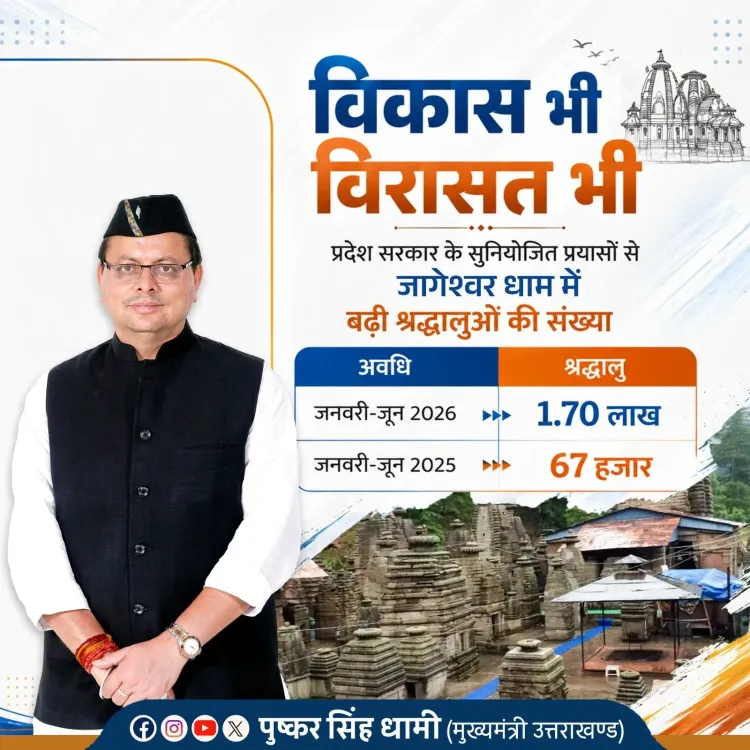
Uttarakhand CM Pushkar Singh Dhami says pilgrim arrivals at Jageshwar Dham jumped from 67,000 to 1.70 lakh in the first half of 2026, crediting planned infrastructure works under the state's 'Vikas bhi, Virasat bhi' framework for the 150-percent surge.
Key Takeaways
1.70 lakh pilgrims visited Jageshwar Dham in January-June 2026 , compared to 67,000 in the same period of 2025 — a rise of over 150 percent .
CM Pushkar Singh Dhami attributed the surge to systematic expansion of pilgrim facilities and planned development works at the site.
The growth is framed as evidence of the 'Vikas bhi, Virasat bhi' policy delivering measurable outcomes at heritage pilgrimage centres.
Jageshwar Dham , located in Almora district , is an ancient Shiva temple complex with Archaeological Survey of India protected status.
The CM cited new employment and self-employment opportunities for local residents as a direct benefit of increased pilgrim footfall.
The state government may extend similar infrastructure-led development to additional pilgrimage sites across Uttarakhand.
A 150-percent surge in pilgrims at one of Uttarakhand's most ancient Shiva shrines is now the sharpest proof yet that Uttarakhand Chief Minister Pushkar Singh Dhami's infrastructure-led pilgrimage push is moving the needle — and fast. Between January and June 2026, 1.70 lakh devotees visited Jageshwar Dham in Almora district, up from just 67,000 in the same period of 2025.
What the numbers say about Jageshwar's transformation
The jump — from 67,000 to 1.70 lakh in a single year — is not incidental. CM Dhami, posting on Thursday, 13 August 2026, attributed the rise directly to 'suuniyojit vikas karyon' (सुनियोजित विकास कार्यों) — planned, systematic development works — rolled out at the temple complex. Jageshwar, a cluster of over a hundred ancient stone temples nestled in a deodar forest, had long been an underserved pilgrimage site despite its deep archaeological and spiritual significance.
The state government's expansion of pilgrim facilities — better approach roads, sanitation, rest areas, and visitor infrastructure — appears to have removed the friction that kept footfall low. The result: a shrine that drew fewer than a thousand visitors a day in early 2025 is now receiving nearly three times that volume through the same six-month window in 2026.
The 'Vikas bhi, Virasat bhi' engine behind the numbers
Dhami has anchored his government's heritage agenda on the slogan 'Vikas bhi, Virasat bhi' — 'Development too, Heritage too' — since taking charge as Chief Minister in 2022. The framework is a deliberate attempt to resolve a tension that has long plagued hill-state governance: how to modernise without hollowing out cultural identity. Jageshwar is now the clearest data point the government has cited in favour of that bet.
The CM's post explicitly links the pilgrimage surge to two downstream outcomes: new employment and self-employment opportunities for local residents, and a 'new identity' for the region's faith, culture, and heritage. In a state where tourism is among the primary economic engines, those two outcomes are not rhetorical — they translate directly into vendor income, hospitality jobs, and local craft sales.
Jageshwar's place in Uttarakhand's pilgrimage economy
Jageshwar Dham, located roughly 36 kilometres from Almora town, is one of the twelve Jyotirlingas in some traditional enumerations and holds Archaeological Survey of India protected status. Its remoteness — and the relative scarcity of pilgrim amenities — had historically kept it off the mass-tourism circuit even as sites like Kedarnath and Badrinath drew millions annually. The state's decision to prioritise infrastructure here signals an intent to distribute pilgrimage traffic — and its economic benefits — more evenly across Uttarakhand's religious geography.
For local communities in and around Almora, the multiplier effect of a pilgrimage surge is tangible: priests, porters, hoteliers, food stalls, and artisans all see direct demand. Dhami's framing positions the government not just as a builder of roads but as a catalyst for a self-sustaining local economy rooted in cultural heritage.
If Jageshwar's first-half numbers hold through the year, 2026 could mark the site's highest-ever recorded annual footfall — and the template may well be replicated at other underserved tirthasthals across the state.
Point of View
Quantifiable win to showcase its 'Vikas bhi, Virasat bhi' positioning ahead of any future electoral cycle — a slogan that now has a number attached to it. The strategy of channelling infrastructure investment into heritage pilgrimage sites, rather than purely commercial tourism, also reflects a broader BJP-governed-state pattern of using religious identity as an economic development lever. If the model proves replicable at lesser-known tirthasthals, Uttarakhand could meaningfully diversify its pilgrimage economy beyond the saturated Char Dham circuit. The key test will be whether the employment and cultural-preservation outcomes Dhami claims are documented with the same rigour as the headline visitor figures.
NationPress
13 Aug 2026
Frequently Asked Questions
How many pilgrims visited Jageshwar Dham in 2026?
1.70 lakh (170,000) pilgrims visited Jageshwar Dham between January and June 2026 , according to CM Pushkar Singh Dhami's post on 13 August 2026.
What is Jageshwar Dham and where is it located?
Jageshwar Dham is an ancient Shiva temple complex located approximately 36 kilometres from Almora town in Uttarakhand . It is an Archaeological Survey of India protected site and holds significant religious and archaeological importance.
What is the 'Vikas bhi, Virasat bhi' scheme in Uttarakhand?
' Vikas bhi, Virasat bhi ' — meaning 'Development too, Heritage too' — is a guiding framework adopted by the Dhami government since 2022 to balance infrastructure modernisation with the preservation of Uttarakhand's cultural and religious heritage.
Why did pilgrim numbers at Jageshwar Dham increase so sharply?
CM Dhami credited the surge to planned development works and expansion of pilgrim facilities at Jageshwar Dham, including improved infrastructure for devotees, which made the site more accessible and comfortable to visit.
What economic benefits has the Jageshwar Dham development brought to locals?
The Uttarakhand government says increased pilgrim footfall has created new employment and self-employment opportunities for local residents in areas such as hospitality, food, transport, and local crafts around the Jageshwar Dham area.