CM Dhami Flags Rising Tourist Inflow, Vows Better Roads in Uttarakhand

Synopsis
Uttarakhand Chief Minister Pushkar Singh Dhami said tourist and pilgrim arrivals are rising steadily and pledged sustained work on roads, infrastructure and allied facilities to make the journey safe, easy and convenient, reinforcing his government's focus on pilgrimage-led development across the Himalayan state.
Key Takeaways
CM Pushkar Singh Dhami says tourist and pilgrim numbers in Uttarakhand are rising continuously.
State government pledges sustained work on infrastructure, road connectivity and allied arrangements.
Stated goal: make pilgrim journeys 'safe, easy and convenient'.
Statement aligns with the Char Dham National Highway project, approved in 2016 for all-weather access.
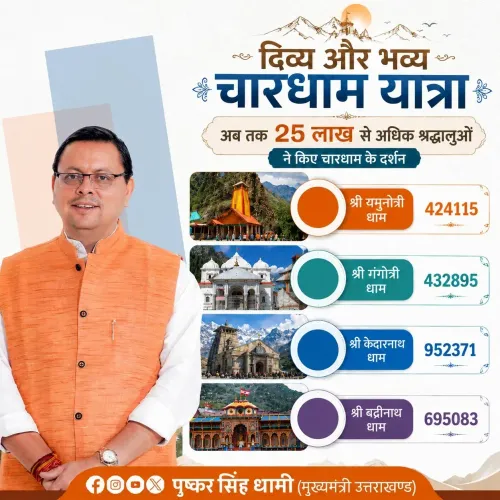
Key shrines covered: Badrinath, Kedarnath, Gangotri and Yamunotri.
Message reinforces tourism as a central pillar of Uttarakhand's economic strategy.
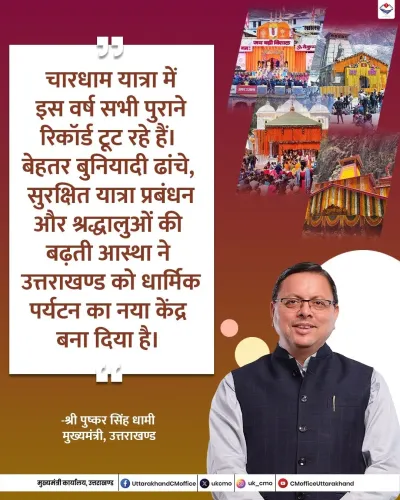
Uttarakhand Chief Minister Pushkar Singh Dhami on 3 June 2026 said the number of tourists and pilgrims visiting the Himalayan state is rising steadily, and pledged that his government is working continuously to upgrade infrastructure, road connectivity and allied facilities to make the journey safer and smoother. The statement, posted on X with an accompanying video, frames pilgrim convenience as a core deliverable of the state administration.
In the post, written in Hindi, the Chief Minister said: 'The number of tourists and devotees coming to Uttarakhand is continuously rising. Our government is working incessantly to ensure better infrastructure, robust road connectivity and other arrangements, so that the journey of devotees becomes safe, easy and convenient.' The original phrase surakshit, sugam aur suvidhajanak (safe, easy and convenient) has become a recurring formulation in the state government's pilgrimage messaging.
Context
Uttarakhand, a Himalayan state of roughly 1.1 crore people, depends heavily on religious tourism for jobs and revenue, particularly through the annual Char Dham Yatra to Badrinath, Kedarnath, Gangotri and Yamunotri. The yatra season, which typically runs from late April to early November, draws devotees from across India and abroad and places sustained pressure on mountain roads, accommodation and emergency services.
Dhami, a BJP leader who has served as Chief Minister since 2021, has consistently positioned tourism-led development as a pillar of his administration. His latest message aligns with the state's broader push to project Uttarakhand as a year-round destination beyond the traditional pilgrimage calendar.
Policy backdrop
The most prominent infrastructure spine for pilgrim traffic is the Char Dham National Highway project, approved in 2016 to provide all-weather connectivity to the four shrines. The programme involves widening and realignment of hundreds of kilometres of mountain roads across fragile terrain, and has been a touchstone for debates on the trade-off between access and ecological risk.
Beyond roads, successive state governments have layered on helicopter services to Kedarnath, ropeway proposals, parking facilities at base towns such as Sonprayag and Govindghat, and digital registration systems for yatris. Dhami's reference to 'other arrangements' is consistent with this multi-pronged template that treats access, safety and crowd management as a single problem set.
Stakeholders and impact
The primary beneficiaries cited in the post are pilgrims and tourists, but the downstream stakeholders are wider: tour operators, hoteliers, pony and palanquin workers, taxi unions and local traders in towns along the yatra routes. For Himalayan districts such as Rudraprayag, Chamoli and Uttarkashi, the yatra is the single biggest seasonal economic event.
Safety has become a particularly sensitive theme after repeated incidents of landslides, road blockages and weather-linked disruptions during recent yatra seasons. By foregrounding the words 'safe' and 'convenient', the Chief Minister is also responding to a public conversation in which pilgrim welfare and disaster preparedness are increasingly intertwined.
What's next
The immediate watch points are the pace of pending stretches of the Char Dham highway, state budget allocations for pilgrim facilities, and any fresh standard operating procedures the administration may roll out for the remainder of the current yatra season. Decisions on crowd caps, slot-based darshan and helicopter capacity at Kedarnath will signal how the government balances rising footfall with on-ground capacity.
For Dhami, the political stakes are tangible: a smoothly run yatra reinforces the BJP's governance narrative in a state where pilgrimage is both faith and livelihood, while any major disruption tends to dominate the public mood well beyond the hill districts.
Point of View
Easy and convenient' has become standard issue across the state's tourism communications, signalling continuity rather than a pivot. With the Char Dham highway still progressing in stretches and recurring weather-linked disruptions in recent seasons, the real test lies in execution metrics. Politically, a smooth yatra is a low-risk, high-reward narrative the BJP will want to own through the season.
NationPress
16 Oct 2026
Frequently Asked Questions
What did Uttarakhand CM Pushkar Singh Dhami say about tourists?
Dhami said the number of tourists and pilgrims visiting Uttarakhand is rising continuously, and his government is working to improve infrastructure and roads so journeys are safer and more convenient.
What is the Char Dham Yatra?
The Char Dham Yatra is the annual Himalayan pilgrimage to four shrines in Uttarakhand: Badrinath, Kedarnath, Gangotri and Yamunotri, undertaken largely between late April and early November.
What is the Char Dham National Highway project?
It is a road development programme approved in 2016 to provide all-weather connectivity to the four Char Dham shrines through widening and realignment of mountain highways in Uttarakhand.
Why is pilgrim safety a focus in Uttarakhand?
The state's mountainous terrain, monsoon landslides and high seasonal footfall make road safety, crowd management and emergency response critical concerns during the yatra season.
Who benefits from Uttarakhand's pilgrimage economy?
Pilgrims and tourists are the direct beneficiaries, while hoteliers, tour operators, taxi unions, pony and palanquin workers and local traders in hill districts depend on yatra footfall for livelihoods.