CM Dhami Backs Aromatic Farming with ₹118 Cr Mahak Kranti Push
Synopsis
Uttarakhand CM Pushkar Singh Dhami has announced ₹118 crore under the Mahak Kranti Yojana to promote aromatic plant cultivation, aiming to raise farmer incomes and boost rural self-employment across the Himalayan state.
Key Takeaways
₹118 crore is being deployed under the Mahak Kranti Yojana to promote aromatic plant cultivation in Uttarakhand .
The scheme targets twin goals: raising farmer incomes and encouraging rural self-employment .
CM Pushkar Singh Dhami described the initiative as a significant step toward agricultural innovation and rural economic empowerment.
Uttarakhand's Himalayan agro-climate is considered well-suited for high-value aromatic crops such as lavender, lemongrass, and mint.
The initiative aligns with a broader national push for farmer income growth and crop diversification that has driven state-level programmes since 2016 .
District-wise disbursement and farmer enrolment figures for 2026–27 will be the key metrics to watch.
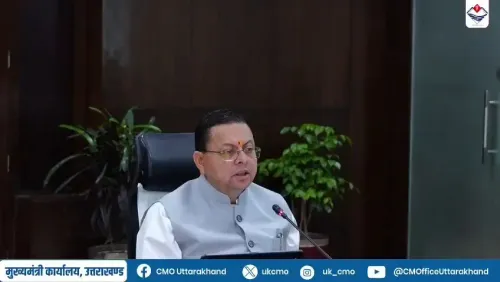
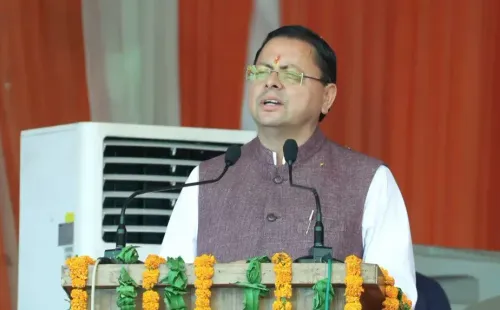
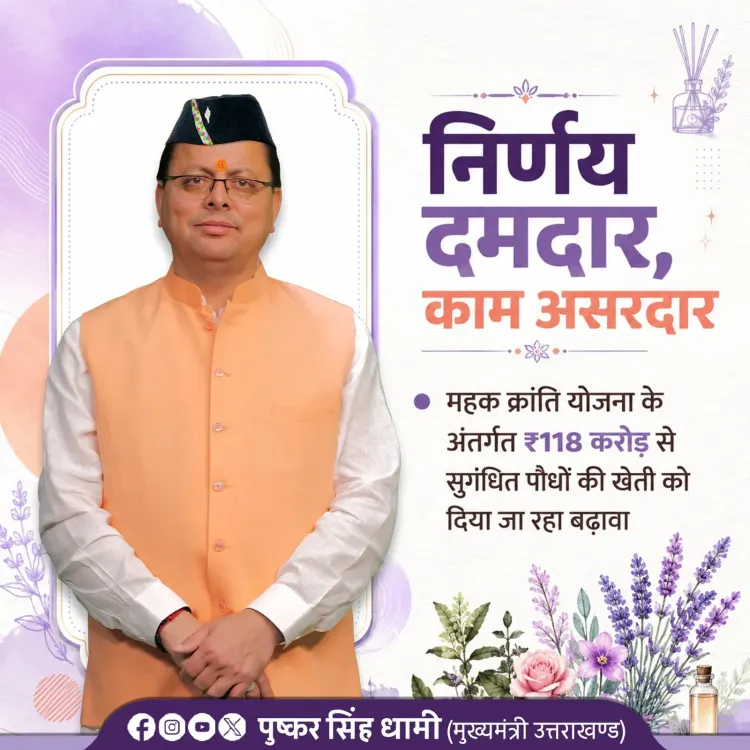
Uttarakhand Chief Minister Pushkar Singh Dhami on Saturday, 23 May 2026, announced that his government is channelling ₹118 crore under the Mahak Kranti Yojana to promote aromatic plant cultivation across the state, with the twin goals of raising farmer incomes and encouraging self-employment in rural areas.
Context
Posting in Hindi on X, CM Dhami said: 'हमारी सरकार किसानों की आय बढ़ाने और स्वरोजगार को प्रोत्साहित करने हेतु महक क्रांति योजना के अंतर्गत ₹118 करोड़ की सहायता से सुगंधित पौधों की खेती को बढ़ावा दे रही है' — translated: 'Our government is promoting the cultivation of aromatic plants with assistance of ₹118 crore under the Mahak Kranti Yojana to increase the income of farmers and encourage self-employment.' He added that the initiative is proving to be an important step towards fostering innovation in agriculture and strengthening the rural economy.
Uttarakhand is a Himalayan state with agro-climatic conditions well-suited to high-value aromatic and medicinal crops such as lavender, lemongrass, rosemary, and mint. Smallholder farmers in the state's hilly terrain have historically struggled with low returns from staple cereal cultivation, making crop diversification a recurring policy priority.
Policy Backdrop
The Mahak Kranti Yojana — loosely translated as the 'Fragrance Revolution Scheme' — is a state-level programme designed to shift farmers toward aromatic crops that command premium prices in essential-oil and herbal-product markets. Such schemes typically combine subsidies on planting material with marketing linkages, enabling farmers to move beyond subsistence agriculture.
The broader push aligns with a national policy direction dating to 2016, when the Government of India set a target of doubling farmers' incomes, prompting state governments to launch crop-diversification programmes. BJP-governed states have increasingly framed such efforts within the language of rural self-reliance and entrepreneurship, positioning aromatic farming as a vehicle for both income growth and import substitution in the essential-oils sector.
Across India, medicinal and aromatic crop promotion has gained traction as a strategy to raise returns per acre without requiring large landholdings — an important consideration in hill states where average farm sizes are small.
Stakeholders and Impact
The primary beneficiaries of the ₹118 crore outlay are expected to be small and marginal farmers and rural entrepreneurs in Uttarakhand, particularly those in districts where arable flatland is scarce and alternative livelihoods are limited. Aromatic crop cultivation also opens pathways for value-added processing — distillation of essential oils, herbal extracts — creating downstream employment beyond the farm gate.
Rural women entrepreneurs and self-help groups have historically been significant participants in aromatic farming programmes in hill states, as the crop cycle and processing work are compatible with household-level enterprise. If marketing linkages are established effectively, the scheme could reduce distress migration from rural Uttarakhand — a persistent social challenge in the state.
What's Next
Attention will now turn to the district-wise disbursement of the ₹118 crore allocation and the pace of farmer enrolment during the 2026–27 agricultural season. The government's ability to connect aromatic crop producers with essential-oil buyers and export channels will be a key determinant of whether the scheme translates announcement into measurable income gains. If adoption figures prove strong, Mahak Kranti Yojana could become a replicable model for other hill states seeking to diversify away from low-margin cereal farming.
Point of View
Linking local crop schemes to national rural-economy goals. With ₹118 crore at stake, the scheme is substantive enough to move the needle for smallholder farmers if procurement and marketing pipelines are in place — but aromatic crop programmes have historically struggled at the value-chain stage, not the cultivation stage. For CM Dhami, the announcement also carries political weight: rural distress and out-migration remain live issues in Uttarakhand ahead of future electoral cycles. The scheme's real test will be whether beneficiary numbers and income-uplift data are published transparently in the months ahead.
NationPress
16 Oct 2026
Frequently Asked Questions
What is Mahak Kranti Yojana?
Mahak Kranti Yojana is an Uttarakhand state government scheme that provides financial support to farmers for cultivating aromatic plants, with the aim of raising agricultural incomes and promoting rural self-employment.
How much money has Uttarakhand allocated for aromatic farming?
The Uttarakhand government has allocated ₹118 crore under the Mahak Kranti Yojana to promote aromatic plant cultivation across the state.
Which crops are promoted under Mahak Kranti Yojana?
The scheme focuses on aromatic plants suited to Uttarakhand's Himalayan climate, which typically include crops such as lavender, lemongrass, rosemary, and mint that yield essential oils and herbal products.
Who benefits from Mahak Kranti Yojana in Uttarakhand?
Small and marginal farmers and rural entrepreneurs in Uttarakhand are the primary beneficiaries, with potential downstream employment in essential-oil processing also benefiting rural communities.
Why is Uttarakhand promoting aromatic plant farming?
Uttarakhand's hilly terrain limits large-scale cereal farming, making high-value aromatic crops an attractive alternative to raise per-acre returns and reduce rural distress migration, in line with national goals for farmer income growth.