CM Dhami launches Agniveer Employment Cell in Uttarakhand
Synopsis
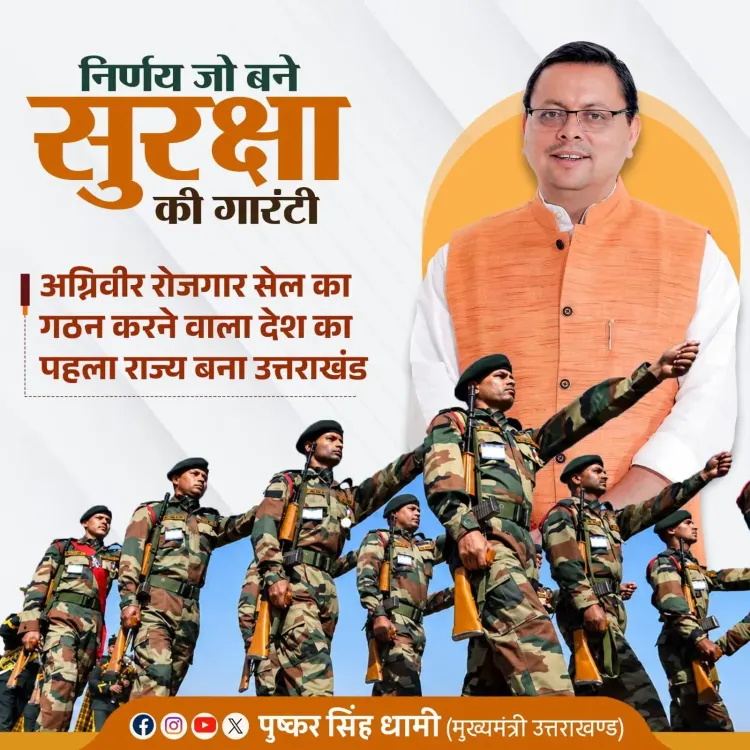
Uttarakhand CM Pushkar Singh Dhami announced the formation of an Agniveer Employment Cell on 27 October 2026, creating a dedicated state mechanism for rehabilitation, employment, and self-reliance of retired Agniveers — extending the state's veteran welfare push into central scheme territory.
Key Takeaways
Uttarakhand CM Pushkar Singh Dhami announced the Agniveer Employment Cell on 27 October 2026 .
The cell targets three outcomes for retired Agniveers: rehabilitation, employment placement, and self-reliance ( aatmanirbharta ).
The Agnipath scheme , launched by the Government of India in June 2022 , recruits soldiers on four-year short-term contracts .
Uttarakhand has one of India's highest per-capita military representations, making veteran welfare a significant issue in the state.
Multiple BJP-ruled states have created similar cells or job-reservation policies for Agniveers, reflecting a coordinated central-state welfare approach.
Actual placement outcomes and rollout details of the cell remain to be seen as the first Agniveer cohorts complete service.
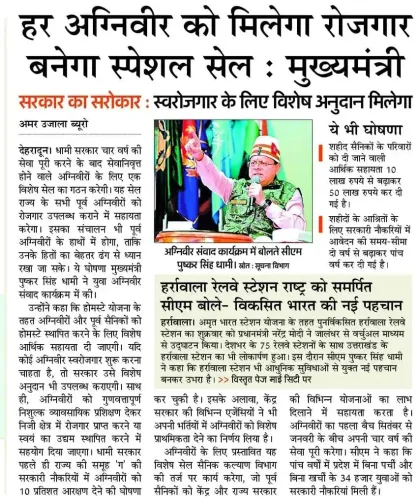
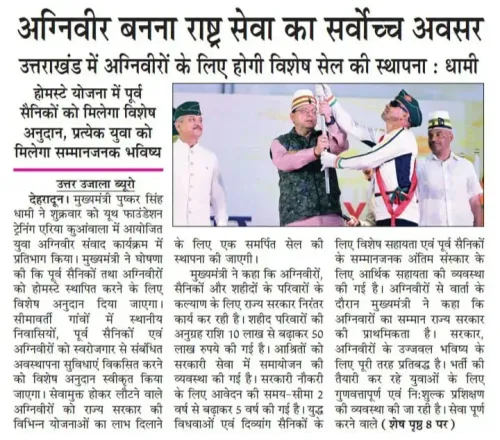
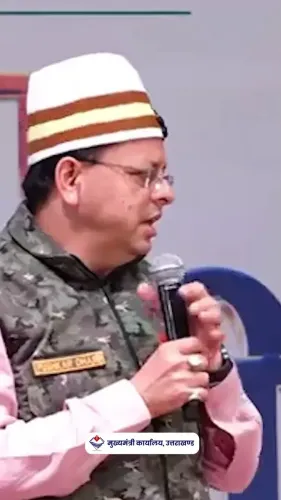
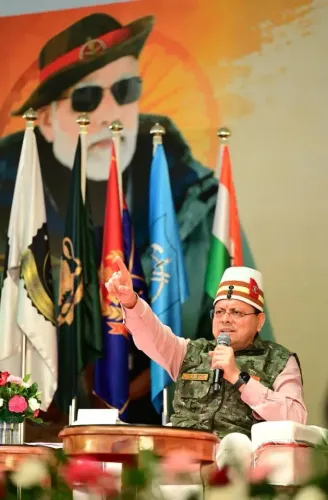
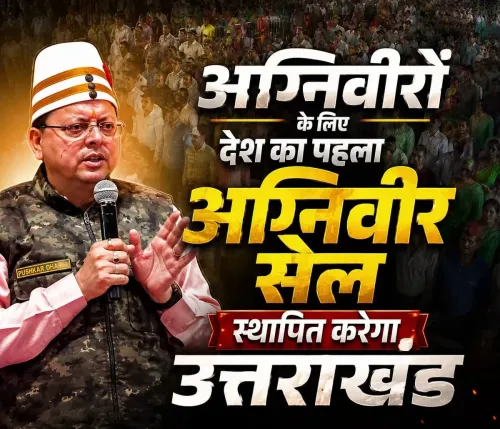
A new front has opened in the battle over what happens after a soldier's four-year Agniveer tenure ends. On Tuesday, 27 October 2026, Uttarakhand Chief Minister Pushkar Singh Dhami announced the formation of an Agniveer Employment Cell — a dedicated state mechanism aimed at channelling retired Agniveers into jobs, skill programmes, and self-employment opportunities.
Posting on X, CM Dhami wrote: 'Agniveer Rozgar Cell ka gathan isi disha mein ek mahatvapurna pahel hai' — 'The formation of the Agniveer Employment Cell is an important initiative in this direction' — framing it as part of the state government's broader commitment to the welfare of soldiers, veterans, and their families.
What the Agniveer Employment Cell is designed to do
The cell is intended to address three specific gaps: rehabilitation, employment placement, and aatmanirbharta — self-reliance — for Agniveers completing their service. By creating a single institutional channel, Uttarakhand signals it will not leave post-service reintegration to chance or to the central government alone.
The Agnipath scheme, launched by the Government of India in June 2022, inducted recruits into the armed forces on four-year short-term contracts. While the scheme included provisions for skill training and re-employment support, it triggered widespread protests at the time over concerns about limited tenure and inadequate rehabilitation pathways after discharge.
Uttarakhand's place in the Agniveer welfare map
Uttarakhand has one of India's highest per-capita representations in the armed forces — the state's hill districts have supplied soldiers to the Indian Army for generations, making veteran welfare a deeply personal political issue here, not merely an administrative one. CM Dhami's government has previously announced multiple ex-servicemen welfare schemes, and this cell fits into that established pattern.
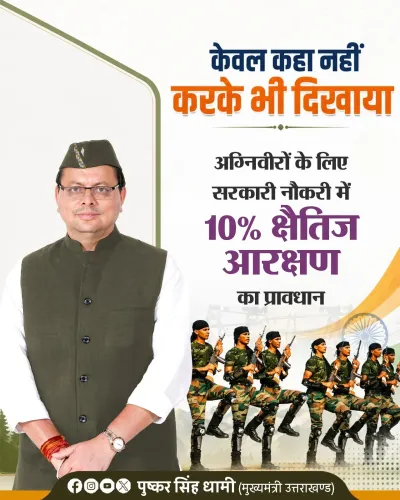
Across BJP-ruled states, a distinct playbook has emerged: state governments create dedicated cells or reservation quotas in state-government jobs and skill-development pipelines to absorb Agniveers once their central service ends. The approach threads central defence policy together with state welfare administration, giving the ruling party credit at both levels.
The broader race among states to rehabilitate Agniveers
Uttarakhand is not alone. Multiple states have moved to set up analogous structures, but the rollout details — actual placement numbers, the speed of operationalisation, the sectors targeted — will determine whether these cells become functioning institutions or remain on paper. Those outcomes are what to watch as the first cohort of Agniveers begins completing their four-year tenures.
For now, Dhami's announcement plants a clear political flag: the state government intends to be the bridge between the Agniveer's uniform and their next livelihood.
The real test will come when the first batch of retired Agniveers arrives at the cell's door — and the queue, not the announcement, tells the story.
Point of View
BJP-governed states are effectively building a welfare scaffolding around a central policy that was designed and defended at the national level, sharing both the credit and the accountability. For Uttarakhand specifically, where military service is a cultural cornerstone, this move carries outsized local resonance beyond its administrative weight. The real policy test will be whether the cell produces verifiable placement data — because without numbers, it risks becoming a signalling exercise rather than a structural fix.
NationPress
27 Oct 2026
Frequently Asked Questions
What is the Agniveer Employment Cell announced by CM Dhami?
The Agniveer Employment Cell is a state government body announced by Uttarakhand Chief Minister Pushkar Singh Dhami on 27 October 2026 to facilitate rehabilitation, employment, and self-reliance for Agniveers who have completed their service tenure.
What is the Agnipath scheme and who are Agniveers?
The Agnipath scheme is a central government defence recruitment policy launched in June 2022 that enrolls soldiers, called Agniveers, on short-term four-year contracts in the Indian armed forces, after which most are discharged with skill training and re-employment support.
Why did the Agnipath scheme face protests?
The Agnipath scheme faced widespread protests in 2022 primarily over concerns that the four-year tenure was too short and that post-discharge rehabilitation and employment provisions were inadequate for recruits who had trained for permanent military careers.
Has Uttarakhand done anything before for ex-servicemen welfare?
Yes, the Uttarakhand government under CM Dhami has announced multiple ex-servicemen welfare initiatives previously, reflecting the state's historically high military participation rate and the political importance of veteran communities there.
Are other states also creating Agniveer employment cells?
Yes, multiple states — particularly BJP-governed ones — have moved to create dedicated cells or reservation quotas in state government jobs to support Agniveers after their central service ends, though outcomes and timelines vary by state.