CM Dhami Lays Foundation for Rs 235 Cr Haridwar Projects
Synopsis
Chief Minister Pushkar Singh Dhami on 21 July 2026 launched four infrastructure projects worth Rs 235 crore under the Haridwar-Rishikesh Ganga Corridor, targeting Har Ki Pauri revival and area redevelopment ahead of Mahakumbh-2027.
Key Takeaways
CM Pushkar Singh Dhami performed the ground-breaking for four projects totalling approximately Rs 235 crore under the Haridwar-Rishikesh Ganga Corridor on 21 July 2026 .
The four projects cover the Administrative Route Corridor (Rs 43.25 cr) , revival of Har Ki Pauri and Subhash Ghat (Rs 66.76 cr) , northern-zone infrastructure at Har Ki Pauri (Rs 66.34 cr) , and redevelopment of Rodi Belwala (Rs 58.84 cr) .
All projects are being executed by the Uttarakhand Investment and Infrastructure Development Board (UIIDB) and are aimed at strengthening arrangements for Mahakumbh-2027 .
The state is simultaneously advancing the Kedarkhand Temple Mala Mission , Manaskhand Temple Mala Mission , Sharda Corridor , Goljyu Corridor , and Vivekananda Corridor .
Additional works under way include road widening, a new bridge over the Roh River , a heliport, pod-taxi, and a ropeway to Chandi Devi and Mansa Devi temples.
The Haridwar Medical College is in its final construction phase, and a Model Degree College at Laldhang is also being established.
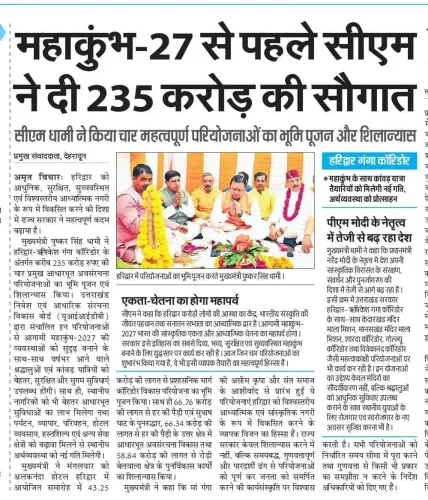
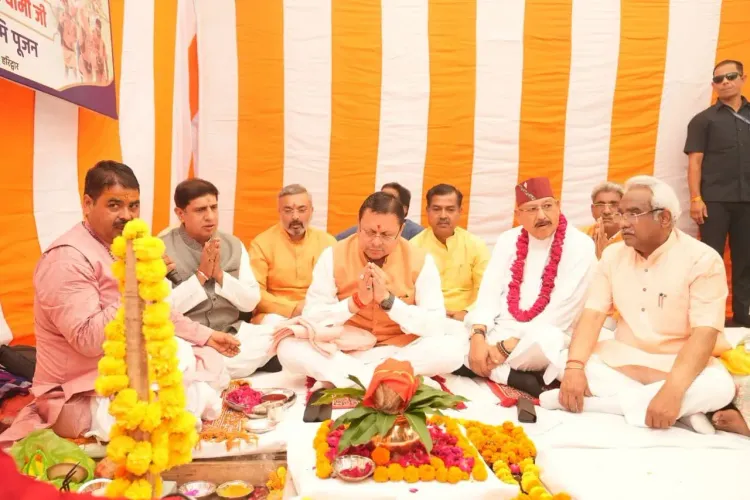
Chief Minister Pushkar Singh Dhami on Tuesday, 21 July 2026, laid the foundation stones for four major infrastructure projects worth approximately Rs 235 crore under the Haridwar-Rishikesh Ganga Corridor, marking a significant push by the Uttarakhand government to transform Haridwar into a world-class spiritual and cultural city ahead of Mahakumbh-2027.
Context
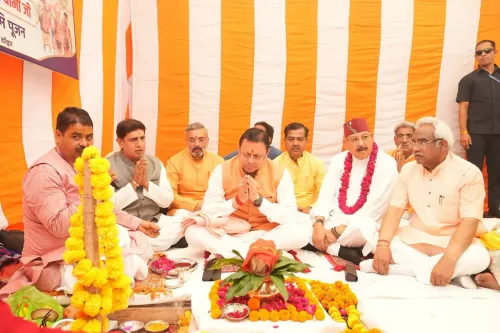
The groundbreaking ceremony was held at Alkannanda Hotel, Haridwar, where CM Dhami performed the bhoomi pujan (ground-breaking ritual) for the four projects being executed by the Uttarakhand Investment and Infrastructure Development Board (UIIDB). The four projects are: a Rs 43.25 crore Administrative Route Corridor Development Project; a Rs 66.76 crore revival of Har Ki Pauri and Subhash Ghat; a Rs 66.34 crore infrastructure development in the northern zone of Har Ki Pauri; and a Rs 58.84 crore redevelopment of the Rodi Belwala area.
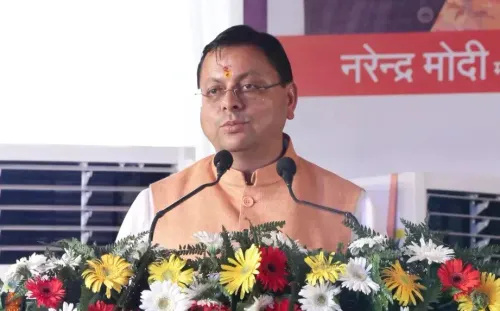
Speaking at the event, CM Dhami stated that these projects are part of a broader vision to develop Haridwar as a world-class spiritual and cultural city. He directed officials to complete all projects within stipulated timelines without compromising on quality.
Policy Backdrop
CM Dhami linked the initiative to the cultural heritage agenda championed by Prime Minister Narendra Modi, saying the country is rapidly advancing in the preservation, promotion, and renaissance of its cultural heritage. Alongside the Haridwar-Rishikesh Ganga Corridor, the Uttarakhand government is simultaneously working on the Kedarkhand Temple Mala Mission, Manaskhand Temple Mala Mission, Sharda Corridor, Goljyu Corridor, and Vivekananda Corridor.
This approach mirrors a broader national pattern that has accelerated since the 2013 Kedarnath disaster, when Uttarakhand began converting seasonal religious infrastructure into permanent, year-round urban assets. The shift from temporary annual arrangements to durable upgrades also serves the resident population and the wider local economy.
Stakeholders and Impact
The projects are expected to directly benefit pilgrims, kanwariya (Shiva devotees who carry sacred Ganga water) travellers, local residents, and the tourism and hospitality sector. CM Dhami noted that the state had historically focused only on temporary arrangements during the annual Kanwar Yatra, but the government is now building permanent, modern infrastructure along the kanwar patri marg (Kanwar pilgrimage track) to serve the crores of pilgrims who arrive every year.
Broader connectivity works already under way include road widening from Bahadrabad-SIDCUL to Shivalik Nagar, a new bridge over the Roh River between Jwalapur and Shivalik Nagar, and road strengthening from Patanjali Yogpeeth to Pheropur. Pilgrim-facing projects in the pipeline include a heliport, a pod-taxi project, and a ropeway from Har Ki Pauri to Maa Chandi Devi and Maa Mansa Devi temples. The Haridwar Medical College is also in its final phase of construction, and a Model Degree College at Laldhang and a health centre at Shyampur are being established.
What's Next
CM Dhami described Mahakumbh-2027 as a 'grand festival of India's cultural unity and spiritual consciousness' and said the state government is working on a 'war footing' to make it the most divine, grand, safe, and well-organised Kumbh in history. The four projects inaugurated today are explicitly framed as part of that preparation.
The pace of completion of the UIIDB-led works, progress on parallel temple corridor projects, and any central government funding announcements for additional Kumbh-related works will be closely watched as 2027 approaches. The outcome will also test whether Uttarakhand's model of converting pilgrimage events into permanent economic assets delivers tangible benefits for local residents and traders beyond the event itself.
Point of View
CM Dhami is simultaneously positioning the state as a model executor of central priorities and building a visible pre-election record of development. The pivot from temporary Kanwar Yatra arrangements to permanent infrastructure also reflects a maturing understanding that pilgrimage economies require year-round assets, not seasonal fixes. Whether timelines hold will be the real test of this ambitious multi-corridor strategy.
NationPress
23 Jul 2026
Frequently Asked Questions
What are the four projects launched under the Haridwar-Rishikesh Ganga Corridor?
The four projects are: the Administrative Route Corridor Development Project (Rs 43.25 crore), revival of Har Ki Pauri and Subhash Ghat (Rs 66.76 crore), infrastructure development in the northern zone of Har Ki Pauri (Rs 66.34 crore), and redevelopment of the Rodi Belwala area (Rs 58.84 crore).
What is the total cost of the Haridwar infrastructure projects launched on 21 July 2026?
The four projects together cost approximately Rs 235 crore and are being executed by the Uttarakhand Investment and Infrastructure Development Board (UIIDB).
How are these projects connected to Mahakumbh-2027?
CM Dhami explicitly stated that the projects are part of preparations for Mahakumbh-2027 in Haridwar, aiming to provide safe, modern and well-organised facilities for the millions of pilgrims expected to attend.
What other corridor projects is the Uttarakhand government working on?
Besides the Haridwar-Rishikesh Ganga Corridor, the state is working on the Kedarkhand Temple Mala Mission, Manaskhand Temple Mala Mission, Sharda Corridor, Goljyu Corridor, and Vivekananda Corridor.
What connectivity improvements are planned for Haridwar ahead of Mahakumbh-2027?
Works in progress include road widening from Bahadrabad-SIDCUL to Shivalik Nagar, a new bridge over the Roh River between Jwalapur and Shivalik Nagar, a heliport, a pod-taxi project, and a ropeway from Har Ki Pauri to Maa Chandi Devi and Maa Mansa Devi temples.