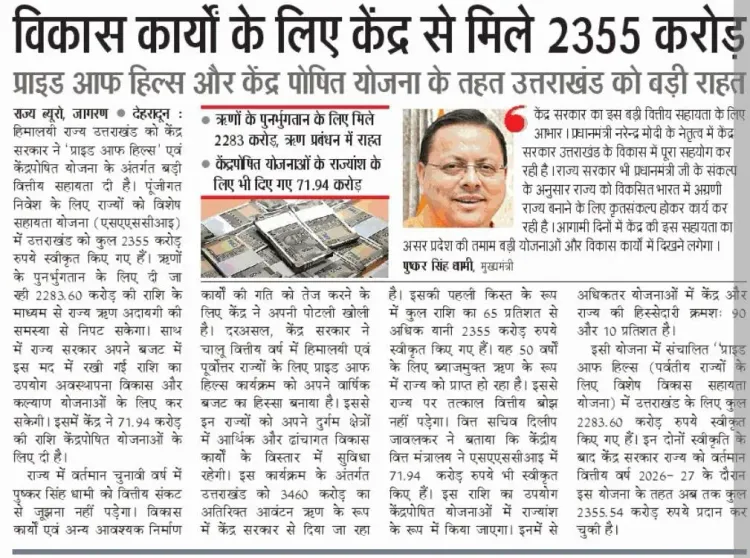
CM Dhami Thanks PM Modi for Rs 2,355 Cr Grant to Uttarakhand
Synopsis
The Chief Minister's Office of Uttarakhand announced on 24 June 2026 that CM Pushkar Singh Dhami has thanked PM Narendra Modi after the central government sanctioned ₹2,355 crore for development works in the state, underscoring ongoing centre-state fiscal cooperation.
Key Takeaways
The central government approved ₹2,355 crore for development works in Uttarakhand , announced on 24 June 2026 .
Chief Minister Pushkar Singh Dhami publicly thanked Prime Minister Narendra Modi for the sanction.
The announcement was made via the official Chief Minister's Office of Uttarakhand account on X.
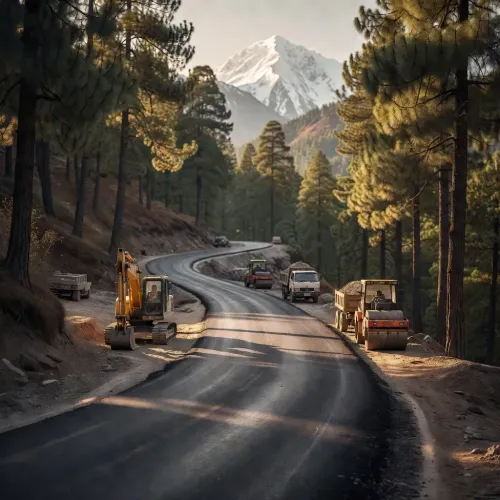
Uttarakhand regularly receives higher central transfers due to its Himalayan terrain, strategic location, and tourism-driven infrastructure needs.
The Char Dham connectivity project , approved in 2016 , is a precedent for large-scale central investment in the state.
Utilisation of funds will be monitored through project-wise certificates submitted by the state administration.
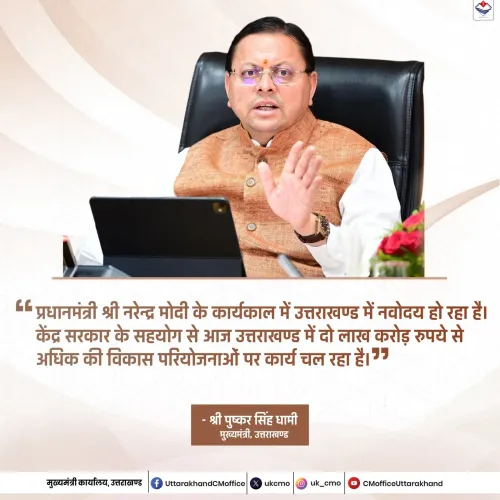
The Chief Minister's Office of Uttarakhand announced on Wednesday, 24 June 2026 that Chief Minister Pushkar Singh Dhami has expressed gratitude to Prime Minister Narendra Modi after the central government approved ₹2,355 crore for development works in the state.
Context
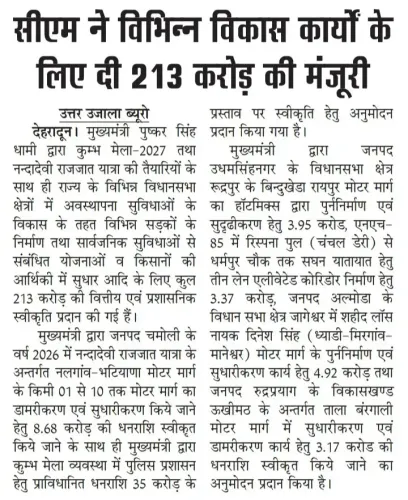
The Chief Minister's Office posted on X stating that CM Dhami thanked PM Modi for the central sanction of ₹2355 करोड़ विकास कार्यों के लिए ('₹2,355 crore for development works') to Uttarakhand. The announcement follows the routine mechanism through which the central government releases funds to states under various development and infrastructure schemes.
Uttarakhand, a Himalayan state carved out of Uttar Pradesh in 2000, has historically received higher-than-average central transfers owing to its difficult terrain, strategic border location, and the infrastructure demands of its pilgrimage and tourism economy.
Policy Backdrop
Central allocations to hill states form a core pillar of India's fiscal federalism, with successive Union budgets earmarking dedicated outlays for roads, bridges, disaster-resilient construction, and tourism infrastructure in Uttarakhand. The Char Dham connectivity project, approved by the central government in 2016, remains one of the most prominent examples of large-scale central investment in the state's road network.
The centre-state funding mechanism requires states to submit project-wise utilisation certificates before subsequent tranches are released, ensuring a degree of accountability in the deployment of sanctioned amounts. Grants of this scale typically cover a basket of ongoing and new works spread across multiple departments.
Stakeholders and Impact
The primary beneficiaries of the ₹2,355 crore sanction are the residents of Uttarakhand, whose daily lives are directly affected by the quality of roads, bridges, drinking-water systems, and other public infrastructure. The state administration — including district-level implementing agencies — will now be responsible for translating the approved funds into on-ground projects.
For the BJP-led state government, the announcement also carries political significance: it reinforces the party's narrative of cooperative federalism and the centre's responsiveness to the developmental needs of a state it has governed since 2017. Tourism operators, pilgrims visiting the Char Dham circuit, and border-area communities stand to benefit if the funds are directed toward connectivity and resilience projects.
What's Next
Attention will now shift to the state government's project-wise breakdown of how the ₹2,355 crore will be utilised, and the timelines it sets for completion. Observers will track whether utilisation certificates are submitted on schedule and whether the next Union Budget includes supplementary grants for the state.
State assembly debates on implementation timelines and departmental allocation of funds are expected to follow. The sanction also sets a benchmark for civil society groups and opposition legislators to demand transparency in project execution across Uttarakhand's districts.
Point of View
355 crore to Uttarakhand fits squarely within the BJP's long-running political strategy of visibly channelling development funds to states it governs, reinforcing the 'double-engine government' narrative ahead of any electoral cycle. For CM Dhami, publicly crediting PM Modi for the release is a standard but deliberate act of political signalling — one that consolidates loyalty within the party hierarchy while positioning the state government as an effective interlocutor with New Delhi. The announcement also reflects the structural reality of India's fiscal federalism, where Himalayan states remain disproportionately dependent on central transfers for capital expenditure. The real test, as with most such sanctions, will be the pace and quality of on-ground utilisation rather than the headline figure.
NationPress
24 Jun 2026
Frequently Asked Questions
Why did CM Dhami thank PM Modi for ₹2,355 crore?
Chief Minister Pushkar Singh Dhami thanked PM Narendra Modi because the central government sanctioned ₹2,355 crore for development works in Uttarakhand , a grant that requires central approval before state agencies can deploy the funds.
What will the ₹2,355 crore be used for in Uttarakhand?
The funds are approved for development works in Uttarakhand . A project-wise breakdown is expected from the state government; historically, such central grants in the state cover roads, bridges, tourism infrastructure, and disaster-resilient construction.
How does the central government release development funds to Uttarakhand?
Under India's fiscal federalism framework, the central government sanctions funds to states through scheme-specific grants and transfers. States must submit utilisation certificates for prior releases before receiving subsequent tranches.
What is the significance of central grants for a hill state like Uttarakhand?
Uttarakhand's Himalayan terrain makes infrastructure construction significantly more expensive than in plains states. The state has historically depended on higher central transfers for capital works, including the Char Dham connectivity project approved in 2016 .
What is the 'double-engine government' narrative referenced in Uttarakhand's development context?
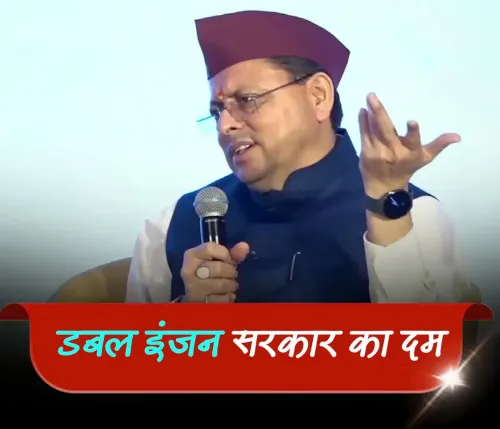
The 'double-engine government' is a BJP political formulation arguing that states and the centre governed by the same party achieve faster development due to smoother coordination and fund flows, a narrative CM Dhami regularly invokes when announcing central grants.