CM Dhami: Uttarakhand builds 6,000-acre land bank for industry
Synopsis
Uttarakhand CM Pushkar Singh Dhami announced a government-developed land bank of over 6,000 acres to attract industrial investment, accelerate new enterprise formation, and generate employment for local youth — tackling the state's chronic out-migration challenge.
Key Takeaways
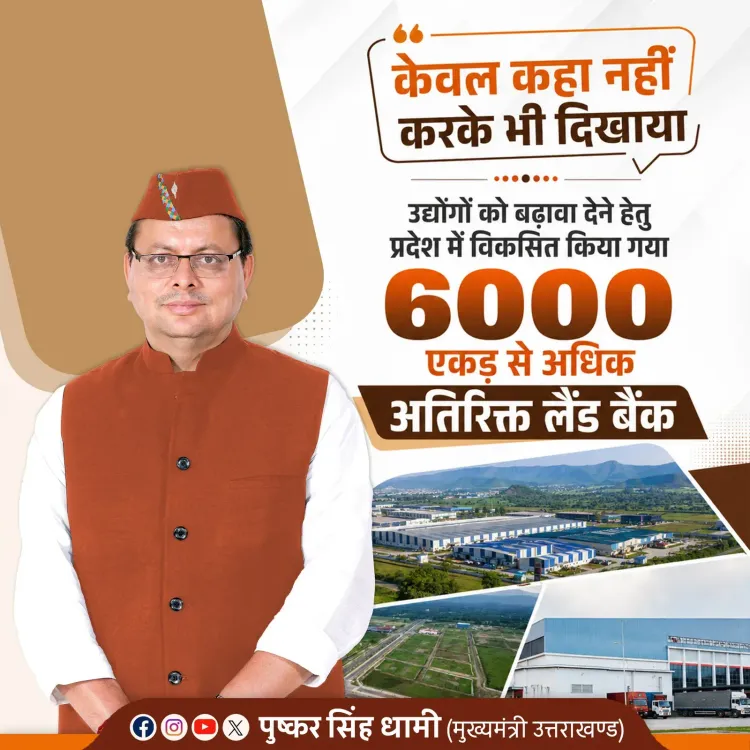
Uttarakhand has developed a land bank of over 6,000 acres to attract industrial investment, CM Dhami announced on August 3, 2026 .
The initiative aims to position Uttarakhand as a leading investment destination and accelerate new enterprise formation.
The government has explicitly linked the land bank to generating employment and self-employment opportunities for local youth.
Regionally balanced development is a stated goal, addressing the state's chronic hill-to-plains and out-of-state youth migration.
The strategy mirrors land-bank and single-window models used by other hill and northeastern Indian states competing for private investment.
Actual employment outcomes from units commissioned on the land bank will be the defining measure of the policy's success.
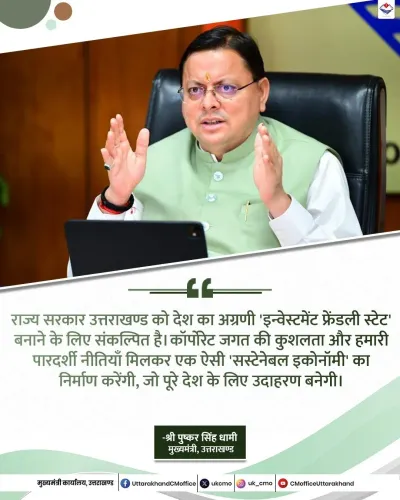
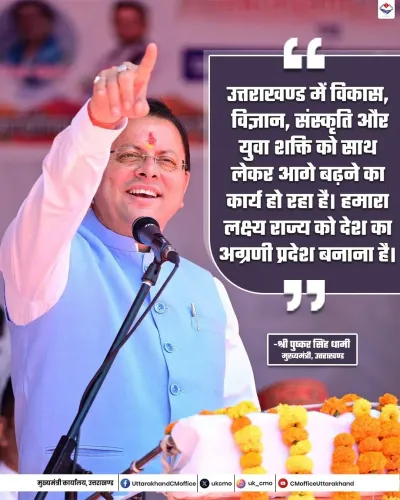
A state long defined by mountains and out-migration is betting on land — 6,000 acres of it — to rewrite its economic story. Uttarakhand Chief Minister Pushkar Singh Dhami announced on Monday, August 3, 2026 that his government has developed a land bank exceeding 6,000 acres to attract industrial investment and position the state as a premier destination for new enterprises.
In his post, CM Dhami wrote: 'उद्योग आधारित अर्थव्यवस्था को मजबूत बनाने और प्रदेश को निवेश के प्रमुख केंद्र के रूप में स्थापित करने के उद्देश्य से हमारी सरकार ने 6,000 एकड़ से अधिक लैंड बैंक विकसित किया है।' ('To strengthen the industry-based economy and establish the state as a major centre of investment, our government has developed a land bank of more than 6,000 acres.')
From land to livelihoods: the pitch to industry
The land bank, Dhami said, has already accelerated the establishment of new industries in the state. But the government is framing this as more than an infrastructure play. The initiative, he stressed, is aimed at generating broad employment for local youth, promoting self-employment, and ensuring regionally balanced development — a pointed acknowledgement of Uttarakhand's long-standing challenge: its young people leave. Uttarakhand, carved out of Uttar Pradesh in 2000, has wrestled with persistent hill-to-plains and out-of-state migration since its formation. Tourism and agriculture — the twin pillars of the state economy — have not generated enough jobs to retain an educated, aspirational youth population. Every successive government has reached for industrial policy as the answer.A familiar tool, a sharper pitch
Land-bank strategies are not new to Uttarakhand or to India's hill and northeastern states. What shifts with each iteration is the scale of ambition and the specificity of the target. By consolidating over 6,000 acres into a single investable pool, the Dhami government is signalling to investors that land — historically the most friction-heavy variable in setting up a factory or a logistics hub — has been de-risked. The approach mirrors single-window and land-bank models that several other states have deployed to compete for manufacturing relocations and greenfield projects. The broader pattern matters here. India's push to position itself as a global manufacturing alternative has intensified demand from investors for 'plug-and-play' industrial corridors. A pre-assembled land bank in a state with road and rail connectivity to the Indo-Gangetic plain — and proximity to key northern markets — is a credible card to play.Youth employment: the real test ahead
Dhami's framing is deliberate: jobs, not just factories. The promise of 'vyapak rozgar ke avsar' ('broad employment opportunities') and 'swayrozgar ko protsahan' ('encouragement of self-employment') ties the industrial land policy directly to the state's most politically sensitive pressure point. Whether units established on the land bank actually hire locally — and in what numbers — will be the metric that defines the initiative's legacy. Watch for employment data tied to units commissioned on the land bank, and any follow-up investment summits or policy revisions in the state assembly that sharpen the incentive structure for investors who commit to local hiring.Point of View
But the explicit linkage to youth employment and 'regionally balanced development' signals a more politically calibrated pitch than previous iterations. For a BJP government heading into a state where out-migration is an electoral liability, framing industrial land as a jobs instrument — not just an investment metric — is strategically sound. The real test will be whether investor uptake translates into verifiable local hiring, or whether the land bank remains a supply-side bet without matching demand. If employment data backs the claim, it becomes a replicable model for other hill states watching closely.
NationPress
3 Aug 2026
Frequently Asked Questions
What is the Uttarakhand land bank announced by CM Dhami?
The Uttarakhand government has developed a land bank of over 6,000 acres to provide ready, investable land to new industries, reducing the friction of land acquisition for businesses looking to set up in the state.
How will the land bank help Uttarakhand youth?
CM Dhami has said the initiative is designed to generate broad employment opportunities for local youth and promote self-employment, directly addressing the state's problem of young people migrating out in search of work.
Why does Uttarakhand need a land bank for industry?
Uttarakhand has long relied on tourism and agriculture, which do not generate enough jobs to retain its youth. A pre-assembled land bank lowers barriers for investors and is intended to diversify the state's economic base.
Is a land bank policy new for Uttarakhand?
No — successive Uttarakhand governments since the state's formation in 2000 have pursued industrial policies involving land and infrastructure. The Dhami government's 6,000-acre pool is the latest and largest articulation of this strategy.
What should we watch for after this Uttarakhand land bank announcement?
Key signals will include employment data from units established on the land bank, new investment summits targeting the consolidated land pool, and any state assembly revisions to the industrial incentive framework.