CM Dhami: Uttarakhand crosses ₹3 lakh crore in MoUs
Synopsis
Uttarakhand Chief Minister Pushkar Singh Dhami announced on 15 July 2026 that the state has secured MoUs worth over ₹3 lakh crore — a historic first — with more than ₹1 lakh crore already grounded, signalling a major shift in the state's industrial investment trajectory.
Key Takeaways
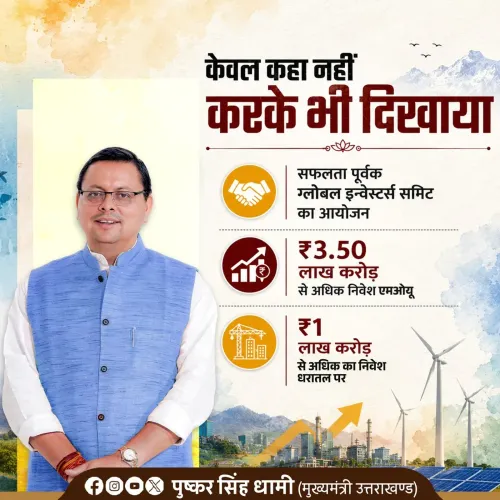
Uttarakhand has signed investment MoUs worth more than ₹3 lakh crore , the highest in the state's history, according to CM Pushkar Singh Dhami .
More than ₹1 lakh crore of those MoUs have been 'grounded', meaning projects have moved to on-site implementation.
The Uttarakhand Industrial Policy 2021 provides capital subsidies, stamp duty concessions, and single-window clearance to attract investors.
The Global Investors Summit 2023 in Dehradun was a key catalyst for large-scale MoU commitments.
Industrial activity is concentrated in the plains districts of Haridwar , Udham Singh Nagar , and Dehradun .
The Uttarakhand Industrial Development Authority (UIDA) is the nodal body tracking investment grounding and employment outcomes.
Uttarakhand Chief Minister Pushkar Singh Dhami on Wednesday, 15 July 2026 declared that the state has signed investment memoranda of understanding (MoUs) worth more than ₹3 lakh crore — a first in the state's history — and that over ₹1 lakh crore of those commitments have already been grounded, meaning work on those projects has begun on the ground.
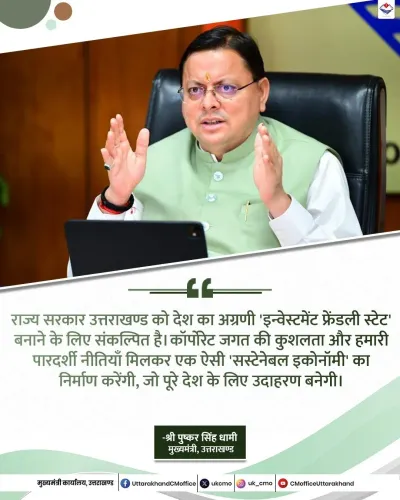
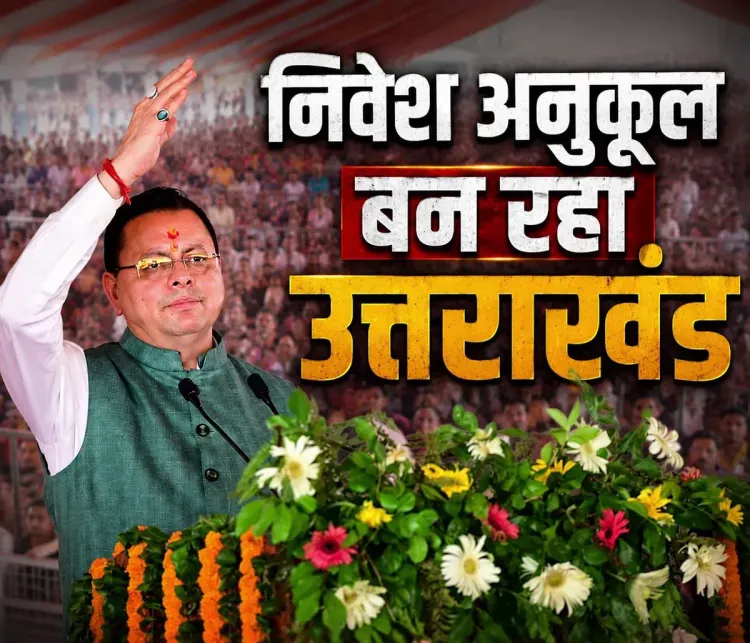
Posting in Hindi on X, CM Dhami wrote: 'उत्तराखंड निवेशकों की पहली पसंद बन रहा है' ('Uttarakhand is becoming the first choice of investors'), adding that these investment agreements represent a milestone 'for the first time in the history of the state.'
Context
Uttarakhand, a Himalayan state carved out of Uttar Pradesh in 2000, has historically lagged behind larger plains states in attracting industrial capital. Its economy has leaned on tourism, hydropower, and a modest pharmaceutical and FMCG manufacturing belt concentrated in the plains districts of Haridwar, Udham Singh Nagar, and Dehradun.
The Dhami government has positioned investment attraction as a central pillar of its economic agenda, participating in national roadshows and hosting state-level investor meets to pitch Uttarakhand as an alternative destination to saturated clusters in NCR and Gujarat.
Policy Backdrop
The state's Industrial Policy 2021 introduced a package of capital subsidies, stamp duty concessions, and single-window clearance mechanisms aimed at reducing friction for incoming manufacturers. These measures were designed to complement the central government's Production Linked Incentive (PLI) schemes and India's broader ease-of-doing-business push.
A landmark moment in this effort was the Global Investors Summit 2023, held in Dehradun, which generated a large volume of MoU commitments across manufacturing and services sectors. The ₹3 lakh crore figure cited by CM Dhami appears to aggregate MoUs signed across multiple such events and bilateral investor engagements since the current government took office.
The claim that more than ₹1 lakh crore has been 'grounded' — a term used in Indian investment tracking to indicate that a project has moved from a signed agreement to actual on-site activity — is significant, as MoU-to-ground conversion rates have historically been a weak point for many state investment summits across India.
Stakeholders and Impact
The primary beneficiaries of industrial investment at this scale would be the local workforce in Uttarakhand's plains districts, where manufacturing units are most viable. The state has one of the higher out-migration rates among hill states, and sustained industrial employment is seen as a tool to slow that trend.
Private investors — spanning sectors such as pharmaceuticals, food processing, logistics, and renewable energy — stand to benefit from the state's incentive architecture. The Uttarakhand Industrial Development Authority (UIDA) is the nodal body responsible for facilitating and tracking these investments.
What's Next
The critical test for these numbers will come through quarterly grounding and employment reports from the Uttarakhand Industrial Development Authority. Analysts and opposition parties are likely to scrutinise the gap between MoUs signed and projects that generate actual jobs and tax revenue.
With BJP-ruled states across India running parallel investor summits and competing for domestic capital, Uttarakhand's ability to sustain and deepen this investment pipeline — and convert remaining MoUs into operational units — will define the economic legacy of the Dhami administration. A follow-up investor summit is being watched as a potential vehicle to refresh commitments and announce new sectoral targets.
Point of View
Particularly ahead of electoral cycles. The distinction he draws — between MoUs signed and investment actually grounded — is notable, as it pre-empts a standard criticism that such commitments remain on paper. However, the credibility of these figures will ultimately rest on independent verification by the Uttarakhand Industrial Development Authority and on downstream employment data, which remain the real measure of industrial policy success. For a small hill state competing against larger, better-connected industrial corridors, sustaining this momentum into actual job creation is the harder, more consequential challenge.
NationPress
14 Oct 2026
Frequently Asked Questions
How much investment has Uttarakhand attracted under CM Dhami?
According to CM Pushkar Singh Dhami, Uttarakhand has signed MoUs worth more than ₹3 lakh crore — the highest in the state's history — with over ₹1 lakh crore already grounded as of July 2026.
What does 'grounding' of investment mean in India?
'Grounding' refers to the stage at which a signed MoU or investment commitment transitions into actual on-site activity — such as land acquisition, construction, or production — rather than remaining a paper agreement.
What is the Uttarakhand Industrial Policy 2021?
The Uttarakhand Industrial Policy 2021 offers capital subsidies, stamp duty concessions, and single-window clearance to attract manufacturing and services investments to the state, positioning it as a business-friendly destination.
Which districts in Uttarakhand have the most industrial activity?
Industrial activity in Uttarakhand is primarily concentrated in the plains districts of Haridwar, Udham Singh Nagar, and Dehradun, which have better connectivity and infrastructure than the hill regions.
What was the Global Investors Summit 2023 in Uttarakhand?
The Global Investors Summit 2023 was a state-hosted investment event held in Dehradun that generated significant MoU commitments across manufacturing and services sectors, forming a key part of Uttarakhand's investment pipeline.