Rajnath Singh Backs Cabinet Nod for Urea Policy NIPU-2026

Synopsis
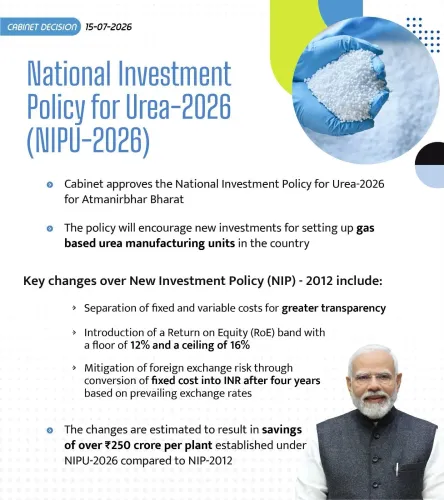
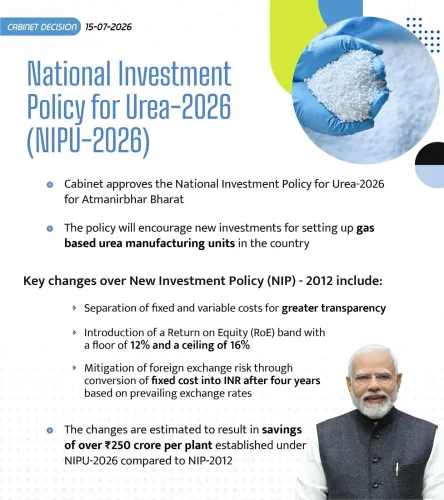
The Union Cabinet on 15 July 2026 approved NIPU-2026, a national investment policy to incentivise new gas-based urea plants, cut import dependence, and strengthen farmer welfare. Defence Minister Rajnath Singh hailed the decision as part of PM Modi's Atmanirbhar Bharat push for self-reliance in fertilizers.
Key Takeaways
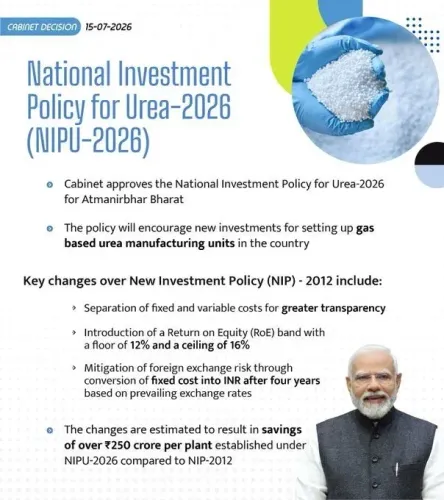
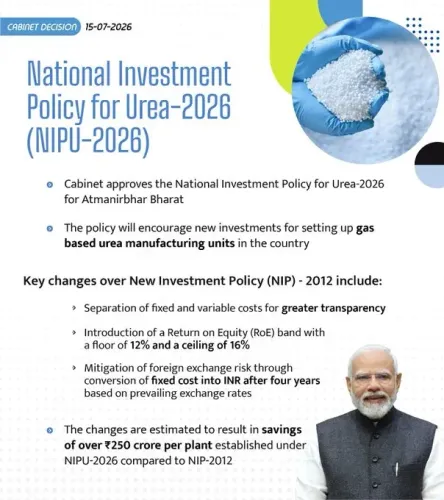
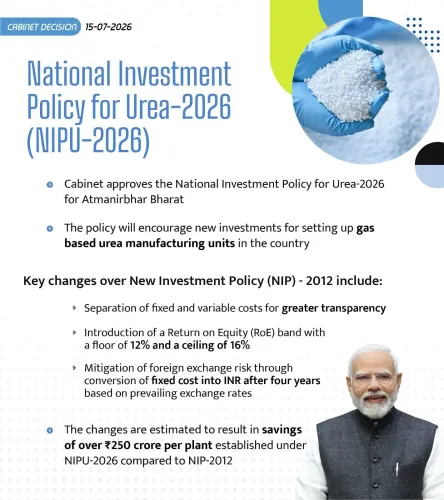
The Union Cabinet approved the National Investment Policy for Urea 2026 (NIPU-2026) on 15 July 2026 .
The policy aims to incentivise new gas-based urea manufacturing units inside India.
Key goals include reducing urea import dependence , ensuring supply availability, and strengthening farmer welfare .
The decision is positioned under the Atmanirbhar Bharat self-reliance framework launched in May 2020 .
The policy is expected to generate new investment and employment in the fertilizer sector.
Moderation of the government's annual fertilizer subsidy bill is an anticipated long-term outcome as domestic output rises.
Union Defence Minister Rajnath Singh on Wednesday, 15 July 2026 welcomed the Union Cabinet's approval of the National Investment Policy for Urea 2026 (NIPU-2026), describing the decision as a significant step toward self-reliance in the fertilizer sector and a boost to the interests of India's farming community.
Posting on X, Singh said the Cabinet had approved 'यूरिया-2026 (NIPU-2026) राष्ट्रीय निवेश नीति' — the National Investment Policy for Urea-2026 — as part of Prime Minister Narendra Modi's continuing efforts to benefit farmers. He expressed gratitude to PM Modi for the decision and outlined four core objectives: ensuring urea availability, reducing import dependence, strengthening farmer welfare, and promoting long-term stability in the agriculture sector.
Context
India is one of the world's largest consumers of urea, a nitrogen-based fertilizer essential to paddy, wheat, and other staple crop cultivation. A significant share of domestic demand has historically been met through imports, creating both fiscal pressure on the government's fertilizer subsidy bill and supply-chain vulnerabilities during global commodity disruptions. NIPU-2026 is designed to address this structural gap by incentivising the establishment of new gas-based urea manufacturing units inside the country.
The Union Cabinet, chaired by PM Modi, is the apex decision-making body of the central government and its approval signals a formal policy commitment backed by the full executive authority of the administration.
Policy Backdrop
The current move builds on a lineage of fertilizer-sector reforms. The New Urea Policy of 2015 sought to encourage energy-efficient domestic production and rationalise subsidy expenditure. Separately, the Atmanirbhar Bharat initiative — announced in May 2020 — placed fertilizers and agriculture inputs among the priority sectors for domestic capacity building and import substitution.
Under successive policy cycles, the government has also pursued the revival of closed urea plants and greenfield gas-based capacity additions. NIPU-2026 represents the latest iteration of this approach, extending the self-reliance framework into a dedicated investment policy instrument for the urea segment specifically.
Stakeholders and Impact
The policy's most direct beneficiaries are India's estimated 140 million-plus farm households, for whom urea is the single most widely used crop nutrient. Assured domestic supply and reduced import exposure could help stabilise prices and prevent the kind of shortage-driven disruptions that have periodically affected sowing seasons. Singh specifically cited the strengthening of farmer interests as a central outcome of the Cabinet's decision.
For the fertilizer industry, NIPU-2026 is expected to open a window for fresh private and public investment in gas-based manufacturing, with attendant employment generation across plant construction, operations, and ancillary supply chains. The government's subsidy outgo — which runs into tens of thousands of crore rupees annually — could also moderate over time as domestic output scales up and import volumes decline.
What's Next
Attention will now turn to the detailed guidelines and incentive structures that the government notifies under NIPU-2026, including timelines for new plant commissioning, eligibility criteria for investors, and the gas-linkage framework that will underpin the economics of fresh capacity. Trends in urea import volumes and the government's annual fertilizer subsidy allocation in subsequent Union Budgets will serve as key indicators of the policy's on-ground impact. The broader test will be whether NIPU-2026 can translate a Cabinet-level commitment into measurable self-sufficiency in one of agriculture's most critical inputs.
Point of View
Infrastructure gaps, and investor risk appetite. Whether NIPU-2026 can resolve those structural bottlenecks will determine if this marks a genuine inflection point or another incremental step in a long-running policy effort.
NationPress
15 Jul 2026
Frequently Asked Questions
Why did India introduce a new urea investment policy?
India imports a significant share of its urea requirement, which strains the government's fertilizer subsidy budget and creates supply vulnerabilities. NIPU-2026 seeks to address this by attracting fresh investment into domestic gas-based urea capacity under the Atmanirbhar Bharat self-reliance framework.
How will NIPU-2026 benefit farmers?
By expanding domestic urea production, NIPU-2026 aims to ensure more reliable availability of the fertilizer, reduce the risk of supply shortages during critical sowing seasons, and support long-term agricultural input stability — outcomes that directly benefit India's farming households.
What is Atmanirbhar Bharat and how does it relate to this policy?
Atmanirbhar Bharat is a self-reliance initiative announced by PM Narendra Modi in May 2020 to promote domestic manufacturing and reduce import dependence across sectors. NIPU-2026 is positioned as part of this broader framework applied specifically to the urea and fertilizer segment.
What happens after the Cabinet approves NIPU-2026?
Following Cabinet approval, the government is expected to notify detailed guidelines covering investor eligibility, gas-linkage arrangements, and timelines for new plant commissioning. Subsequent urea import volumes and fertilizer subsidy allocations in Union Budgets will indicate whether the policy achieves its stated objectives.