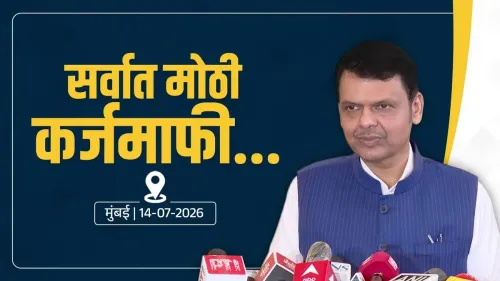
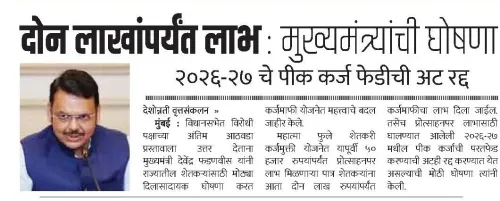
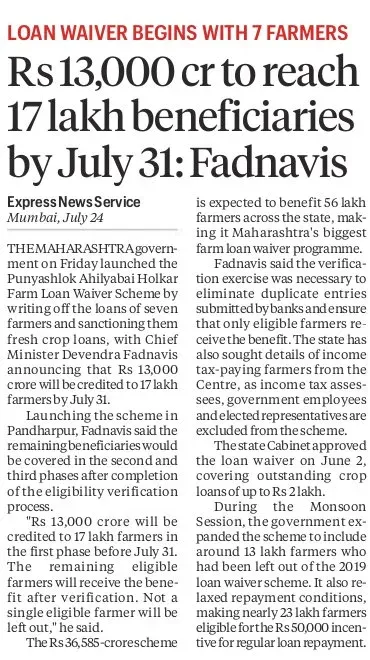
CM Fadnavis: ₹13,000 Cr to Reach 17 Lakh Farmers by July 31
Synopsis
Chief Minister Devendra Fadnavis has announced that ₹13,000 crore in farmer welfare funds will be disbursed to 17 lakh Maharashtra beneficiaries by 31 July 2026, setting a firm public deadline for one of the state's largest recent rural transfer drives.
Key Takeaways
₹13,000 crore in farmer welfare funds is to be disbursed by 31 July 2026 .
The programme targets 17 lakh beneficiaries across Maharashtra .
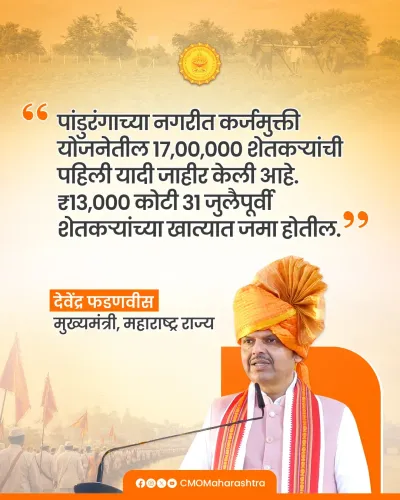
The announcement was made by Chief Minister Devendra Fadnavis via the official CMO Maharashtra account.
The average transfer works out to approximately ₹76,000 per beneficiary .
The deadline coincides with the peak kharif sowing window, when farm liquidity is most critical.
Maharashtra previously executed a farm loan waiver exceeding ₹30,000 crore in 2017 under an earlier Fadnavis term.
The Chief Minister's Office of Maharashtra announced on Saturday, 25 July 2026 that Chief Minister Devendra Fadnavis has committed to disbursing ₹13,000 crore in farmer welfare funds to 17 lakh beneficiaries by 31 July 2026, setting a firm deadline for one of the state's largest recent rural transfer drives.
Context
The post, shared from the official @CMOMaharashtra handle, quotes Chief Minister Devendra Fadnavis directly: '₹13,000 crore to reach 17 lakh beneficiaries by July 31.' The announcement signals that the Fadnavis administration is in the active disbursement phase of a large-scale farmer support programme, with a hard deadline now publicly stated. The 31 July 2026 cutoff gives the state machinery fewer than seven days to complete transfers at the time of the post.
No scheme name was specified in the post. The figure — ₹13,000 crore across 17 lakh farm households — works out to an average transfer of roughly ₹76,000 per beneficiary, a substantial per-household amount consistent with either a debt-relief or a large direct-benefit structure.
Policy Backdrop
Maharashtra has a long record of state-level interventions for its farming population, which spans rain-fed and irrigated belts across Vidarbha, Marathwada, and the Western Ghats foothills. The state under Fadnavis previously executed a farm loan waiver exceeding ₹30,000 crore in 2017, one of the largest such exercises in the country at the time, covering millions of cultivators facing agrarian distress.
Across successive governments, Maharashtra has alternated between loan-waiver models and direct cash or input-subsidy transfers to stabilise rural incomes. Variable monsoon performance and volatile market prices for key crops — including cotton, soybean, and onion — have made periodic large-scale interventions a recurring feature of state fiscal planning.
Stakeholders and Impact
The 17 lakh targeted beneficiaries represent a significant slice of Maharashtra's farming community. Rural households receiving transfers at this scale can use funds to service existing debt, purchase inputs for the upcoming kharif season, or stabilise household consumption ahead of the harvest period. The July 31 deadline aligns with the peak of the southwest monsoon sowing window, when liquidity is most critical for cultivators.
State government machinery — including district-level agriculture offices and bank correspondents — will bear the operational load of ensuring funds reach the correct accounts within the stated window. Any shortfall in disbursement by the deadline is likely to attract scrutiny from opposition benches and farmer organisations active in the state.
What's Next
Official confirmation of actual funds transferred by 31 July 2026 will be the immediate marker of programme execution. If the deadline is met in full, the Fadnavis administration is expected to cite it as a governance benchmark; any slippage will likely prompt calls for an extension or an audit of beneficiary lists. Subsequent state budget sessions may also reflect whether this disbursement is a one-time measure or part of a multi-year farmer welfare framework under the current government.
Point of View
000 crore disbursement is a deliberate accountability move by the Fadnavis administration, converting a welfare programme into a measurable governance promise. It follows a pattern seen across Indian states where ruling dispensations time large farmer transfers to monsoon-season sentiment, when agrarian distress is most visible. For Maharashtra's BJP government, meeting the deadline in full would shore up rural credibility ahead of any electoral cycle; missing it would hand the opposition a concrete failure to prosecute. The scale — 17 lakh households — also suggests this is designed as a headline-level intervention rather than a targeted relief measure.
NationPress
25 Jul 2026
Frequently Asked Questions
What is the Maharashtra government's ₹13,000 crore farmer scheme?
The Chief Minister's Office of Maharashtra announced that ₹13,000 crore in farmer welfare funds will be disbursed to 17 lakh beneficiaries by 31 July 2026. The exact scheme name was not specified in the official post.
Who are the 17 lakh beneficiaries of CM Fadnavis's farmer scheme?
The 17 lakh beneficiaries are farmer households in Maharashtra identified under the state's current farmer welfare programme. Specific eligibility criteria have not been publicly detailed in the announcement.
What is the deadline for Maharashtra's ₹13,000 crore farmer fund disbursement?
Chief Minister Devendra Fadnavis has set 31 July 2026 as the deadline for the ₹13,000 crore to reach all 17 lakh targeted beneficiaries.
Has Maharashtra done a farm loan waiver before under Fadnavis?
Yes. During an earlier term, the Fadnavis government announced a farm loan waiver exceeding ₹30,000 crore in 2017, one of the largest such exercises in Maharashtra's history.
How much money will each farmer get under Maharashtra's 2026 welfare drive?
Based on the announced figures of ₹13,000 crore for 17 lakh beneficiaries, the average transfer works out to approximately ₹76,000 per household, though individual amounts may vary by scheme criteria.