CM Fadnavis Announces ₹13,000 Cr Plan to Free Mumbai from Floods
Synopsis
The Chief Minister's Office of Maharashtra announced a ₹13,000 crore flood-mitigation package for Mumbai during the Monsoon Session 2026, tagging CM Devendra Fadnavis. The outlay aims to address the city's chronic monsoon flooding through drainage upgrades, river management, and coastal protection works.
Key Takeaways
The CMO Maharashtra announced ₹13,000 crore for flood mitigation in Mumbai on 9 July 2026 .
The announcement was made during the Monsoon Session 2026 of the Maharashtra legislature.
Chief Minister Devendra Fadnavis was tagged, indicating his direct ownership of the initiative.
Mumbai's flood problem stems from an ageing drainage network, encroachment on rivers like the Mithi , and coastal vulnerabilities.
The Brihanmumbai Municipal Corporation (BMC) is expected to be the primary implementing agency.
Project phasing, tendering details, and possible central-government coordination are anticipated to emerge during the ongoing session.
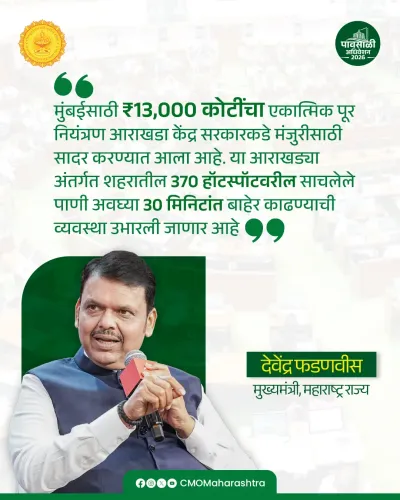
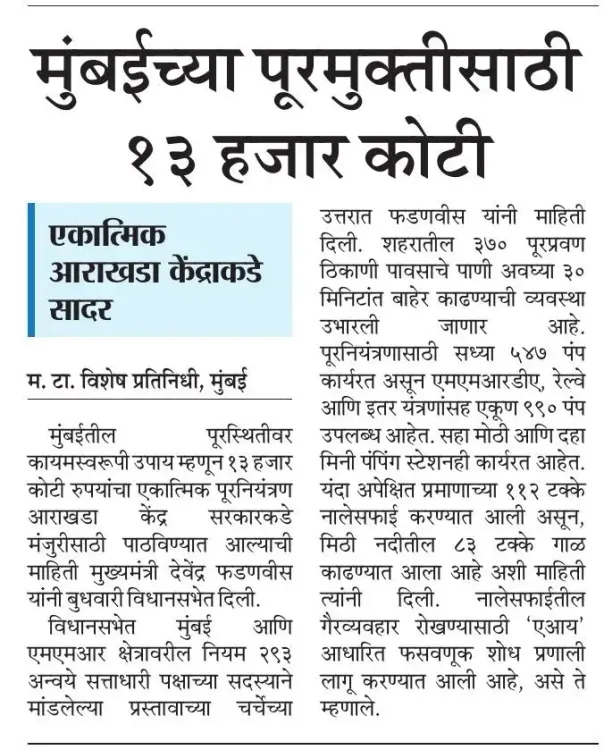
The Chief Minister's Office of Maharashtra announced on Thursday, 9 July 2026 that the state government will allocate ₹13,000 crore for flood mitigation in Mumbai, sharing the development on X and tagging Chief Minister Devendra Fadnavis. The post, hashtagged #MonsoonSession2026, signals that the package is expected to be taken up during the ongoing legislative session.
Context
The CMO's post — 'मुंबईच्या पूरमुक्तीसाठी ₹13,000 कोटी' ('₹13,000 crore for Mumbai's flood freedom') — frames the outlay as a comprehensive flood-relief measure for India's financial capital. Mumbai has battled chronic monsoon flooding for decades, driven by an ageing drainage network, encroachment along rivers such as the Mithi, and low-lying coastal zones. The announcement comes as the state legislature is in its Monsoon Session 2026, a politically significant window for infrastructure commitments.
Policy Backdrop
Maharashtra's efforts to tame Mumbai's flooding date to the catastrophic 26 July 2005 deluge, which killed more than 1,000 people and prompted the launch of the Brihanmumbai Storm Water Drainage (BMSWD) project with World Bank support. Subsequent phases under Chief Minister Fadnavis — who has served multiple terms and made urban infrastructure a centrepiece of his administration — included Mithi River desilting, widening works, and coastal-road components designed to ease waterlogging in the city's most vulnerable pockets. The ₹13,000 crore figure, if formally approved, would represent one of the largest single flood-mitigation commitments in the city's history.
Maharashtra administrations have repeatedly combined state budgetary outlays with central-government schemes and international financing for such projects. Packages of this scale are often announced during monsoon legislative sessions to underscore urgency and align with the public's lived experience of seasonal flooding.
Stakeholders and Impact
Mumbai's roughly 2 crore residents stand to be the primary beneficiaries of any sustained flood-mitigation programme. Urban local bodies — chiefly the Brihanmumbai Municipal Corporation (BMC) — would be key implementing agencies, responsible for tendering, execution, and maintenance of drainage and river-management works. Real-estate, transport, and small-business sectors in flood-prone areas such as Kurla, Sion, Hindmata and parts of the western suburbs also have a direct stake in the programme's success.
Civil-society groups and residents' associations in low-lying localities have long demanded faster progress on drainage upgrades, making this announcement politically resonant ahead of future civic elections. Environmental watchdogs are likely to scrutinise the river-widening and coastal components for ecological compliance.
What's Next
Detailed project phasing, fund-release timelines, and tendering schedules are expected to be elaborated during the Monsoon Session 2026. Coordination with central ministries — including the Ministry of Housing and Urban Affairs and the Ministry of Jal Shakti — may be pursued to unlock additional grants under national urban and river-rejuvenation missions.
If the ₹13,000 crore package clears legislative and financial approval, the pace of on-ground work on drainage tunnels, river desilting, and pumping-station upgrades will be the real test of whether Mumbai can finally move toward becoming a flood-resilient city before the next monsoon cycle.
Point of View
000 crore announcement fits a well-established pattern in Maharashtra politics: major flood-mitigation commitments timed to the monsoon legislative session, when public anxiety about waterlogging is highest and media attention is guaranteed. For CM Fadnavis, who has built his urban-infrastructure credentials over multiple terms, the package reinforces a signature policy identity ahead of future electoral cycles. However, Mumbai's flood problem has proven stubbornly resistant to successive multi-thousand-crore announcements, and the credibility of this commitment will ultimately hinge on tendering speed, execution quality, and inter-agency coordination — not the headline figure alone.
NationPress
9 Jul 2026
Frequently Asked Questions
What is the ₹13,000 crore Mumbai flood mitigation plan announced by Maharashtra?
The Chief Minister's Office of Maharashtra announced a ₹13,000 crore package aimed at making Mumbai flood-free, shared on 9 July 2026 during the Monsoon Session 2026 and attributed to CM Devendra Fadnavis. The funds are expected to cover drainage upgrades, river desilting, and coastal flood-protection works.
Why does Mumbai flood every monsoon?
Mumbai floods recurrently due to an ageing and under-capacity storm water drainage network, encroachment along rivers like the Mithi, low-lying coastal geography, and rapid urbanisation that has reduced natural water absorption. The 2005 deluge that killed over 1,000 people highlighted the severity of the problem and triggered the first major drainage overhaul project.
What is the Brihanmumbai Storm Water Drainage (BMSWD) project?
The BMSWD project was launched after the catastrophic 26 July 2005 Mumbai floods with World Bank support to upgrade the city's storm water drainage network. It has been implemented in phases over the years, with successive Maharashtra governments adding components such as Mithi River widening and desilting.
What role does Devendra Fadnavis play in Mumbai's flood mitigation?
As Chief Minister of Maharashtra, Devendra Fadnavis has made urban infrastructure — including Mumbai flood management — a key policy priority across his terms in office. His government has approved multiple phases of drainage and river-management works, and the latest ₹13,000 crore package has been announced under his leadership.
When will the Mumbai flood mitigation project details be released?
Detailed project phasing, fund-release timelines, and tendering schedules are expected to be disclosed during the Monsoon Session 2026 of the Maharashtra legislature. Coordination with central government ministries for additional funding may also be announced in the coming weeks.