CM Fadnavis Dismisses Opposition March as Hunt for Lost Ground
Synopsis
Maharashtra CM Devendra Fadnavis dismissed the opposition's Nagpur march on 4 October 2026 as a desperate bid to reclaim lost political ground, posting a sharp bilingual jab on X that reframes the rally as proof of the opposition's post-2024 weakness.
Key Takeaways
Devendra Fadnavis responded on 4 October 2026 to an opposition march held in Nagpur .
He framed the march as an attempt by the opposition to find 'their lost ground,' not a demonstration of strength.
The post was written in both Marathi and Hindi , giving it a national as well as state audience.
Nagpur is Fadnavis's home city and a BJP stronghold, making an opposition march there politically significant.
The remark lands in the backdrop of the Mahayuti alliance's decisive 2024 assembly election victory.
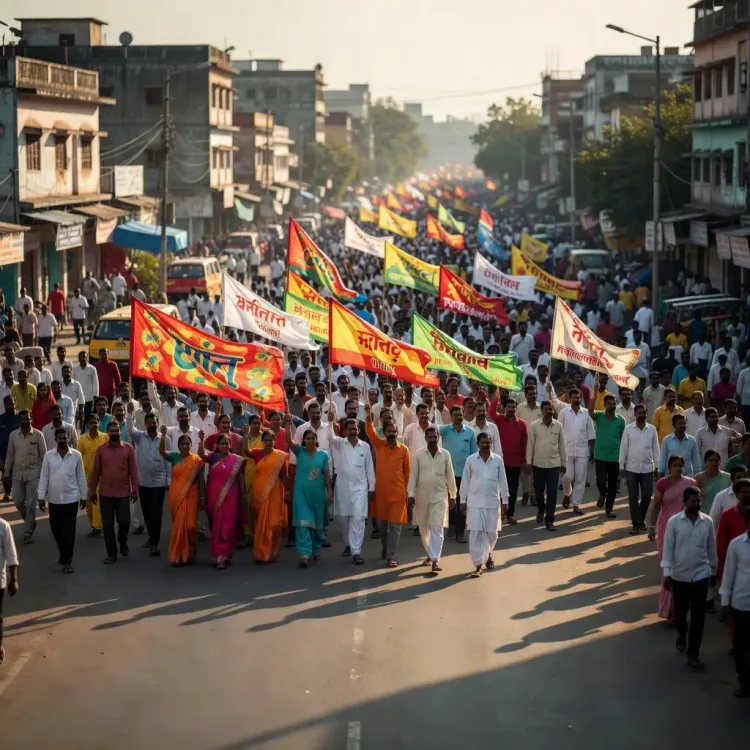
A political rally draws a crowd, but Maharashtra Chief Minister Devendra Fadnavis is asking a sharper question: what exactly is the opposition searching for? On Sunday, 4 October 2026, Fadnavis fired off a pointed retort on X, framing the opposition's march in Nagpur as a desperate exercise in political reclamation — not a show of strength.
In his post, Fadnavis wrote in both Marathi and Hindi: 'विरोधकांचा मोर्चा म्हणजे आपली हरवलेली जमीन शोधण्याचा प्रयत्न.' — 'The opposition's march is an attempt to find their lost ground.' The bilingual framing — Marathi for Maharashtra's ear, Hindi for the national conversation — was deliberate, signalling that Fadnavis sees this as a story worth telling beyond state borders.
The Nagpur Backdrop: Why the Venue Matters
Nagpur is not a neutral stage. It is Fadnavis's home turf, the seat of the RSS headquarters, and a city the BJP has treated as its ideological heartland for decades. An opposition march here is inherently provocative — and Fadnavis knows it. His response, rather than alarm, is a dismissive counter-narrative: the march is not a mobilisation, it is a search party.
The Chief Minister's one-liner does significant political work. It concedes nothing — no acknowledgement of grievance, no engagement with the march's stated demands — and instead reframes the entire event as evidence of the opposition's weakness. In Maharashtra's current political landscape, where the Mahayuti alliance swept back to power in the November 2024 assembly elections, Fadnavis clearly feels the wind is still at his back.
The Opposition's Shrinking Map in Maharashtra
Since the Mahayuti coalition — comprising the BJP, the Shinde-led Shiv Sena faction, and the Ajit Pawar-led NCP faction — secured a commanding mandate in 2024, the opposition Maha Vikas Aghadi has been navigating questions about its direction and unity. Public marches and morcha politics have traditionally served as pressure-valve demonstrations when legislative space narrows. Fadnavis's framing turns that optic on its head: a march becomes proof of marginalisation, not resistance.
Whether the opposition accepts that framing — or uses the rally to write a different headline — is the real contest playing out on Nagpur's streets.
Point of View
He rewrites the event itself as evidence of their decline. It is a strategy that works best when the ruling party holds enough electoral capital to dismiss rather than rebut — which, after the 2024 Mahayuti sweep, the BJP-led government in Maharashtra arguably does. The bilingual post also signals that Fadnavis is positioning this moment for a national BJP audience, not just a Maharashtra one. The real test is whether the opposition march generates enough visible momentum to challenge his dismissive counter-narrative on the ground.
NationPress
4 Oct 2026
Frequently Asked Questions
What did CM Devendra Fadnavis say about the opposition march in Nagpur?
Fadnavis posted on X saying the opposition's march is 'an attempt to find their lost ground,' dismissing it as a sign of political weakness rather than a show of strength.
When and where did Fadnavis make this comment?
Fadnavis posted the comment on 4 October 2026 , referring to events in Nagpur , Maharashtra.
Why is the opposition holding a march in Nagpur?
The specific demands of the march were not stated in Fadnavis's post and no verified details are currently available. Opposition marches in Maharashtra have broadly followed the Maha Vikas Aghadi 's efforts to regroup after the 2024 assembly election defeat.
What is the political significance of Nagpur for Devendra Fadnavis?
Nagpur is Fadnavis's home constituency and a long-standing BJP stronghold, also known as the headquarters of the RSS. An opposition rally there is seen as a direct challenge to his political turf.
What is the Mahayuti alliance that Fadnavis leads in Maharashtra?
The Mahayuti alliance consists of the BJP, the Eknath Shinde-led Shiv Sena faction, and the Ajit Pawar-led NCP faction. It won a decisive majority in Maharashtra's November 2024 assembly elections, returning Fadnavis to the Chief Minister's office.