CM Fadnavis hails court for triple death sentence in Nasrapur case
Synopsis
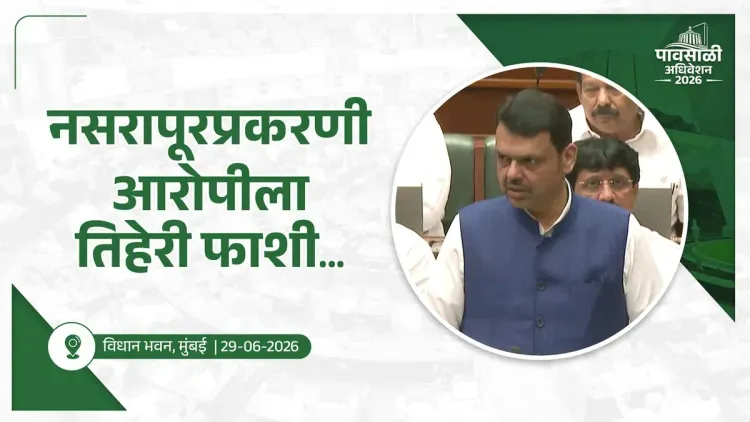
Maharashtra CM Devendra Fadnavis on 29 June 2026 praised a court for delivering a triple death sentence in the Nasrapur case within 29 days, after examining 55 witnesses — highlighting the verdict as a model of swift criminal justice during the Monsoon Session.
Key Takeaways
Maharashtra CM Devendra Fadnavis publicly thanked the court for the verdict in the Nasrapur case on 29 June 2026 .
The court examined 55 witnesses and delivered a triple death sentence in just 29 days .
The statement was made from the Maharashtra Vidhan Sabha, Mumbai during the Monsoon Session 2026 .
Under Indian law, the death sentence must be confirmed by the Bombay High Court before execution.
The convict retains the right to appeal and file mercy petitions before the Governor and President.
The case is being cited as an example of fast-track court efficiency in serious criminal matters.
Maharashtra Chief Minister Devendra Fadnavis on Monday, 29 June 2026 expressed gratitude to the court for delivering a triple death sentence in the Nasrapur case, noting that the verdict was reached in just 29 days after examining 55 witnesses — an unusually swift conclusion for a criminal trial of this magnitude. The Chief Minister made the remarks from the Maharashtra Vidhan Sabha, Mumbai, during the ongoing Monsoon Session 2026.
Context
Fadnavis posted in both English and Marathi, stating: 'नसरापूरप्रकरणी केवळ 29 दिवसांत 55 साक्षीदार तपासून मा. न्यायालयाने गुन्हेगाराला तिहेरी फाशीची शिक्षा ठोठावली.' [Translation: 'In the Nasrapur case, after examining 55 witnesses in just 29 days, the honourable court awarded the convict a triple death sentence.'] He specifically thanked the court for its expeditious handling of the matter. The post was made from the Vidhan Sabha premises, underscoring the political significance the government attaches to the verdict.
The Nasrapur area falls in Pune district, Maharashtra. While full details of the underlying crime are not available in the post, the nature of the sentence — a triple hanging — indicates the case involved offences of extreme severity, likely including murder of multiple victims.
Policy Backdrop
Fast-track court proceedings for heinous crimes have been a recurring policy priority for successive Maharashtra governments. The completion of a trial involving 55 witnesses within 29 days is a notable departure from India's historically slow criminal justice timeline, where sessions court trials in serious cases can stretch for years. Special fast-track courts, empowered under central and state directives, are designed to handle cases involving crimes against women, children, and multiple homicides with compressed timelines.
The Monsoon Session 2026 of the Maharashtra legislature, currently under way in Mumbai, provides the political backdrop for the Chief Minister's statement. Law-and-order outcomes and judicial efficiency are frequently cited by ruling parties as indicators of governance performance, and a swift capital punishment verdict in a high-profile local case carries both legal and political weight.
Stakeholders and Impact
For the families of victims in the Nasrapur case, the verdict and its speed represent a rare instance of timely justice within a system often criticised for prolonged delays. Legal observers are likely to note the case as a benchmark for what fast-track processes can achieve when judicial resources are concentrated on a single matter. The 55 witnesses examined in under a month reflects intensive court scheduling and cooperation from the prosecution.
Civil society voices on capital punishment may raise questions about due process given the compressed timeline, though the court's own satisfaction with the evidence — reflected in the sentence — carries legal authority. The convict retains the right to appeal before higher courts, including the Bombay High Court and ultimately the Supreme Court of India, where death sentences are mandatorily reviewed.
What's Next
Under Indian law, a death sentence awarded by a sessions court must be confirmed by the respective High Court before it can be executed. The Nasrapur case will therefore proceed to the Bombay High Court for mandatory confirmation proceedings. The convict also has the right to file a mercy petition before the Governor of Maharashtra and the President of India. Chief Minister Fadnavis's public acknowledgement of the verdict signals that the state government will likely support confirmation of the sentence at higher judicial stages.
The case may also prompt the Maharashtra government to highlight fast-track court outcomes as a legislative talking point during the ongoing Monsoon Session, reinforcing its law-and-order narrative heading into the second half of 2026.
Point of View
And Maharashtra is no exception. By spotlighting the 29-day timeline and 55-witness examination, Fadnavis is also implicitly pressing for systemic replication of this model in other pending serious cases. The mandatory Bombay High Court review, however, means the final chapter of this case remains some distance away.
NationPress
28 Sept 2026
Frequently Asked Questions
What is the Nasrapur case in Maharashtra?
The Nasrapur case is a criminal matter from the Nasrapur area of Pune district, Maharashtra, in which a convict was sentenced to triple death penalty by a court after 55 witnesses were examined in 29 days. Full details of the underlying crime have not been officially disclosed beyond the Chief Minister's statement.
What does a triple death sentence mean in India?
A triple death sentence means the court has awarded capital punishment — death by hanging — on three separate counts or charges within the same case, typically when multiple victims are involved or multiple grave offences are proven.
Can the Nasrapur death sentence be appealed?
Yes. Under Indian law, every death sentence awarded by a sessions court must be mandatorily confirmed by the High Court — in this case the Bombay High Court. The convict can also appeal to the Supreme Court and file mercy petitions before the Governor of Maharashtra and the President of India.
Why did CM Fadnavis thank the court for the Nasrapur verdict?
CM Devendra Fadnavis expressed gratitude for the court's swift delivery of justice — completing a trial involving 55 witnesses in just 29 days — which he highlighted as an example of efficient judicial functioning in a serious criminal case.
What is the Maharashtra Monsoon Session 2026?
The Monsoon Session 2026 is the ongoing legislative session of the Maharashtra Vidhan Sabha in Mumbai, during which lawmakers debate policy, pass legislation, and raise matters of public importance. CM Fadnavis made his statement about the Nasrapur verdict from the Vidhan Sabha premises on 29 June 2026.