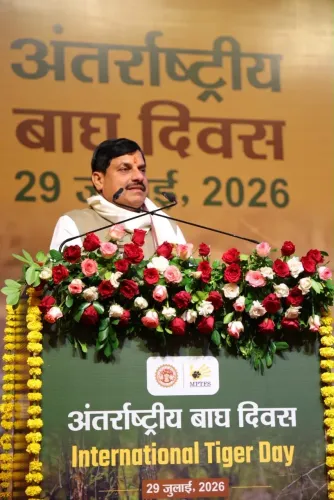
CM Fadnavis inaugurates International Tiger Day 2026 event in Nagpur

Synopsis
Chief Minister Devendra Fadnavis inaugurated Maharashtra's International Tiger Day 2026 event in Nagpur on 29 July. The ceremony highlights the state's role in India's tiger conservation landscape, anchored by reserves like Tadoba-Andhari and the five-decade legacy of Project Tiger.
Key Takeaways
CM Devendra Fadnavis inaugurated the International Tiger Day 2026 programme in Nagpur on 29 July 2026 .
International Tiger Day is observed annually on 29 July to build global awareness around tiger conservation.
Nagpur sits near Tadoba-Andhari Tiger Reserve , one of Maharashtra's premier big-cat habitats and a key central Indian corridor.
Project Tiger , launched in 1973 , remains the backbone of India's tiger protection framework, under which Maharashtra's reserves operate.
India has recorded steady tiger population growth through expanded reserves and anti-poaching efforts managed by the National Tiger Conservation Authority .
Annual observances align with national tiger censuses and state budget cycles for reserve management.
On the day the world turns its attention to one of nature's most iconic predators, Maharashtra Chief Minister Devendra Fadnavis stepped into the spotlight in Nagpur to inaugurate the state's official programme marking International Tiger Day 2026 on 29 July 2026 — a city that sits at the gateway of central India's most critical tiger corridors.
Nagpur as the natural stage for tiger conservation
Nagpur is no arbitrary choice of venue. Eastern Maharashtra's largest city sits within striking distance of Tadoba-Andhari Tiger Reserve, one of India's most celebrated big-cat habitats and a flagship reserve under the national Project Tiger framework. Hosting the International Tiger Day event here carries a pointed geographical logic: the forest corridors threading through this region are among the most ecologically vital stretches for tiger movement across the subcontinent.
Project Tiger's five-decade arc and Maharashtra's role
Project Tiger, launched in 1973, set the template for India's approach to reversing the species' decline — creating protected reserves, deploying anti-poaching measures, and linking habitats through managed corridors. Over five decades, India has emerged as the world's most significant stronghold for wild tigers, with successive national censuses recording steady population growth. Maharashtra's network of reserves, anchored by Tadoba-Andhari, contributes directly to the central Indian tiger landscape that connects populations across multiple states.
Why annual observances still carry weight
International Tiger Day, observed every 29 July, was established to build global awareness and political will around tiger conservation. In the Indian context, these annual moments align with the cadence of national tiger estimation exercises and state-level budget decisions on reserve management. A Chief Minister's direct participation in the inauguration signals that wildlife conservation remains a visible priority on Maharashtra's governance calendar — not merely a departmental footnote.
The stakes are real: forest officials, wildlife conservationists, and communities living on the edges of these reserves all watch for policy signals that translate into on-ground funding, staffing, and habitat protection. Every tiger census, every reserve expansion, every anti-poaching initiative traces its mandate back to moments of political commitment like this one.
Maharashtra's tigers are a national asset. The question now is what concrete commitments follow the inauguration.
Point of View
Proximate to Tadoba-Andhari and central India's tiger landscape, reinforces the state's claim to being a frontline actor in India's broader conservation success story. For a government that must balance agrarian interests, infrastructure expansion, and forest rights, this kind of high-profile participation is also a message to communities on reserve boundaries. The real test will come in the next state budget cycle and the subsequent national tiger estimation exercise.
NationPress
29 Jul 2026
Frequently Asked Questions
When is International Tiger Day observed?
International Tiger Day is observed every year on 29 July to raise global awareness about tiger conservation and the need to protect wild tiger habitats.
Why was the International Tiger Day 2026 event held in Nagpur?
Nagpur was chosen because it sits near Tadoba-Andhari Tiger Reserve and serves as a gateway to central India's most important tiger corridors, making it a symbolically and ecologically fitting venue.
What is Project Tiger and when was it launched?
Project Tiger is India's flagship wildlife conservation programme launched in 1973 to reverse declining tiger numbers by creating protected reserves, deploying anti-poaching measures, and managing habitat corridors.
Which tiger reserves does Maharashtra have?
Maharashtra hosts several tiger reserves, with Tadoba-Andhari Tiger Reserve being the most prominent. These reserves form part of the central Indian tiger landscape and contribute to the national tiger population.
What is the National Tiger Conservation Authority?
The National Tiger Conservation Authority (NTCA) is the apex body overseeing tiger protection in India, managing reserve administration, periodic tiger censuses, and anti-poaching frameworks under which state reserves like those in Maharashtra operate.