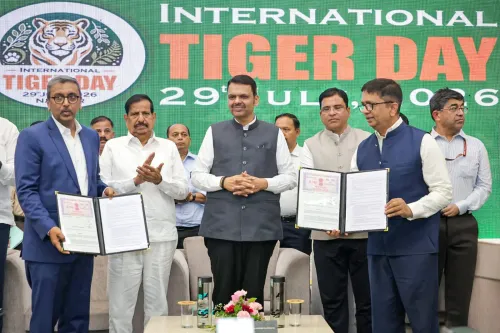
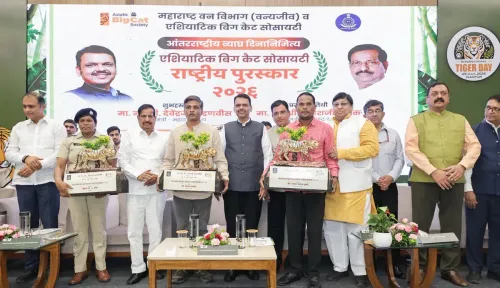
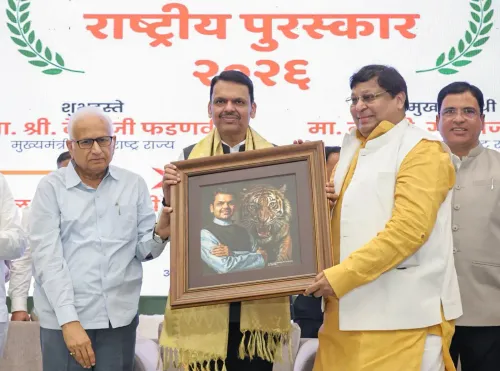
CM Fadnavis calls for tiger and forest protection on International Tiger Day

Synopsis
On International Tiger Day, 29 July 2026, Maharashtra Chief Minister Devendra Fadnavis called for renewed commitment to tiger and forest conservation, framing it as a powerful step toward ecological balance — echoing India's Project Tiger legacy and the state's active role in national tiger estimation efforts.
Key Takeaways
Maharashtra CM Devendra Fadnavis posted a bilingual (English and Marathi) message on 29 July 2026 marking International Tiger Day .
International Tiger Day was established after the 2010 St Petersburg Tiger Summit , which set a target of doubling wild tiger numbers by 2022.
India reported achieving that doubling target in its 2018–19 All India Tiger Estimation .
Project Tiger , launched in 1973 , remains the backbone of India's tiger conservation framework, overseen by the National Tiger Conservation Authority .
Maharashtra's key tiger reserves — Tadoba-Andhari and Pench — contribute to India's national tiger population count.
Fadnavis framed conservation as protecting not just tigers but entire forest ecosystems and the balance of nature.
Every year on 29 July, the world pauses to reckon with one of nature's most iconic creatures — and in Maharashtra, Chief Minister Devendra Fadnavis used International Tiger Day 2026 to turn that pause into a pledge. Posting on X, Fadnavis called on citizens to commit to protecting tigers and the forests that sustain them.
In his post, Fadnavis wrote: 'On this International Tiger Day, let us commit ourselves to protect these magnificent species and take steps to ensure the survival of forests and maintain the balance of nature.' In Marathi, he went further — framing tiger conservation not as a mere appeal but as 'एक सशक्त पाऊल' ('a powerful step') toward preserving ecosystems and keeping nature in balance.
Why 29 July carries real weight for India's forests
International Tiger Day was established after the landmark 2010 St Petersburg Tiger Summit, where tiger-range nations set an audacious goal: double wild tiger populations by 2022. India reported achieving that target in its 2018–19 national census — a milestone that put the country's conservation model on the global map.
The engine behind that recovery is Project Tiger, launched by the Government of India in 1973, which created a network of dedicated reserves with strict habitat protection and anti-poaching measures. Decades later, that network continues to expand, coordinated by the National Tiger Conservation Authority (NTCA) through periodic All India Tiger Estimations.
Maharashtra's stake in the tiger story
Maharashtra is not a bystander in this national effort. The state is home to reserves including Tadoba-Andhari and Pench, both of which contribute meaningfully to India's overall tiger count. The state's forest department participates in the NTCA-coordinated estimation exercises, and managing human-wildlife conflict near reserve boundaries remains an active challenge for local communities and administrators alike.
State-level messaging on days like this carries policy weight — it signals the government's posture on habitat corridors, community relocation, and funding priorities heading into legislative sessions. Fadnavis's post, hashtagged #SaveTigers and #Maharashtra, lands squarely within that tradition.
The next All India Tiger Estimation report will be the real test of whether India's conservation momentum is holding — and whether Maharashtra's reserves are pulling their weight in that count.
Point of View
With high-profile reserves and recurring human-wildlife conflict headlines, a CM's visible commitment can shape both departmental priorities and community-level policy. The bilingual framing — English for national reach, Marathi for local resonance — reflects a dual-audience strategy common among BJP's Maharashtra leadership. The real measure will come when the next tiger estimation figures are released and Maharashtra's reserve-level performance is in the public domain.
NationPress
28 Oct 2026
Frequently Asked Questions
When is International Tiger Day celebrated?
International Tiger Day is observed every year on 29 July . It was established following the 2010 St Petersburg Tiger Summit , where tiger-range countries pledged to double wild tiger populations by 2022.
What did CM Devendra Fadnavis say on International Tiger Day 2026?
Devendra Fadnavis called on citizens to commit to protecting tigers and forests, describing tiger conservation in Marathi as 'a powerful step' toward preserving ecosystems and maintaining the balance of nature.
Which tiger reserves are in Maharashtra?
Maharashtra has several tiger reserves, most notably Tadoba-Andhari Tiger Reserve and Pench Tiger Reserve , both of which contribute to India's national tiger population estimates coordinated by the National Tiger Conservation Authority .
What is Project Tiger in India?
Project Tiger is a centrally sponsored conservation programme launched in 1973 by the Government of India. It established dedicated tiger reserves across the country with strict habitat protection and anti-poaching measures, and is widely credited with the recovery of India's tiger population.
Has India met the global tiger doubling target?
Yes. The 2010 St Petersburg Declaration set a goal of doubling wild tiger numbers by 2022. India reported achieving this target in its 2018–19 All India Tiger Estimation , making it one of the leading success stories in global tiger conservation.