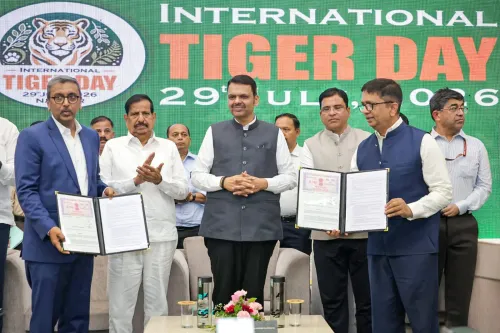
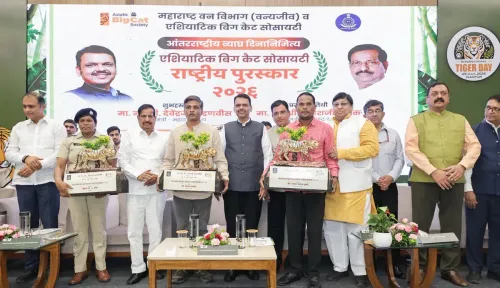
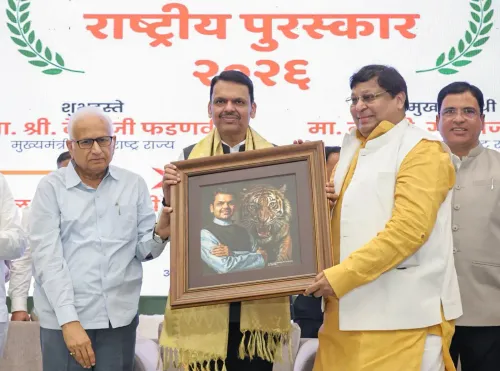
CM Fadnavis Marks International Tiger Day in Nagpur

Synopsis
On International Tiger Day, 29 July 2026, Maharashtra CM Devendra Fadnavis posted a bilingual message from Nagpur highlighting tigers' essential role in forest ecosystems, reinforcing the state's conservation commitment amid India's ongoing Project Tiger efforts.
Key Takeaways
Maharashtra CM Devendra Fadnavis marked International Tiger Day on 29 July 2026 with a bilingual post from Nagpur .
He stated that tigers play a 'vital role in protecting the entire forest ecosystem.' Nagpur is a gateway city to Tadoba-Andhari Tiger Reserve , Maharashtra's flagship tiger reserve.
India's Project Tiger , launched in 1973 , underpins the national framework for big-cat conservation.
The National Tiger Conservation Authority (NTCA) manages India's network of tiger reserves, with Maharashtra as a key contributor.
International Tiger Day was established at the 2010 Saint Petersburg Tiger Summit to double global wild tiger populations.
On the occasion of International Tiger Day, 29 July 2026, Maharashtra Chief Minister Devendra Fadnavis underscored the irreplaceable role tigers play in sustaining forest ecosystems — a message delivered from Nagpur, the city that sits at the edge of some of India's most storied tiger country.
Posting in both English and Marathi, Fadnavis stated: 'Tigers play a vital role in protecting the entire forest ecosystem' — संपूर्ण वन परिसंस्थेच्या संरक्षणात वाघांची भूमिका अत्यंत महत्त्वाची आहे (the entire forest ecosystem's protection depends critically on tigers). The bilingual message signals a deliberate outreach to both a national conservation audience and Maharashtra's Marathi-speaking heartland.
Why Nagpur, and Why It Matters
Nagpur is no accidental backdrop. The city lies within reach of Tadoba-Andhari Tiger Reserve, Maharashtra's largest and most visited tiger reserve, making it a natural anchor for the state's wildlife conservation narrative. The choice of venue aligns the Chief Minister directly with the region's forest-management identity.
India's tiger conservation architecture runs deep. Project Tiger, launched in 1973, remains one of the world's longest-running large-carnivore protection programmes. The National Tiger Conservation Authority (NTCA) oversees a network of reserves across the country, with Maharashtra contributing multiple sites to that national grid. Tigers, as apex predators, regulate prey populations and, by extension, the health of entire forest biomes — the ecological logic behind Fadnavis's message is well-established in conservation science.
A Global Observance with Local Stakes
International Tiger Day, observed every 29 July, was established at the 2010 Saint Petersburg Tiger Summit to rally global commitment to doubling wild tiger numbers. India has been central to that effort — successive national tiger censuses have shown a steady population recovery, a rare conservation success story on a planet where biodiversity loss is accelerating.
For Maharashtra, the annual observance is as much a policy signal as a symbolic one. Forest budget allocations, anti-poaching infrastructure, and buffer-zone community programmes all feed into whether reserve populations hold or grow. The next national tiger estimation report will be a key test of whether that investment is paying off.
A Chief Minister speaking in two languages from the country's tiger heartland on the world's dedicated tiger day is not background noise — it is a state putting its conservation credentials on the record.
Point of View
And a Chief Minister speaking Marathi alongside English on a global platform reinforces both local rootedness and national ambition. With the next tiger census on the horizon, such public commitments also set a benchmark against which the state's actual forest-budget decisions will be measured.
NationPress
28 Oct 2026
Frequently Asked Questions
Why did CM Fadnavis post about tigers on 29 July 2026?
29 July is International Tiger Day , an annual global observance established in 2010 to promote tiger conservation. CM Devendra Fadnavis used the occasion to highlight tigers' role in protecting forest ecosystems.
What is International Tiger Day?
International Tiger Day is observed every 29 July . It was established at the 2010 Saint Petersburg Tiger Summit with the goal of doubling wild tiger populations globally by 2022 and sustaining conservation momentum beyond that.
Which tiger reserves does Maharashtra have?
Maharashtra's most prominent tiger reserve is Tadoba-Andhari Tiger Reserve near Nagpur . The state also hosts several other reserves that fall under the National Tiger Conservation Authority's national network.
What is Project Tiger in India?
Project Tiger was launched by the Indian government in 1973 to protect tigers and their forest habitats. It is one of the world's longest-running large-carnivore conservation programmes and is administered by the National Tiger Conservation Authority (NTCA) .
Why is Nagpur significant for tiger conservation in Maharashtra?
Nagpur is located in eastern Maharashtra and serves as the nearest major city to Tadoba-Andhari Tiger Reserve , making it a natural hub for regional wildlife events and conservation policy discussions in the state.