Fadnavis unveils ₹13,000 crore flood plan, defends Mahayuti rule in Assembly
Synopsis
Fadnavis didn't just defend his government — he came armed with rainfall data that reframed Mumbai's flooding as a climate emergency, not administrative failure. A ₹13,000 crore flood plan, ₹2 lakh crore redirected from BMC fixed deposits, and a 10,000-home Dharavi delivery promise backed by PM Modi's name: this was a political counter-offensive dressed as a policy briefing.
Key Takeaways
CM Devendra Fadnavis announced a ₹13,000 crore Flood Control Plan targeting 370 vulnerable hotspots in Mumbai , pending Central Government clearance.
Mumbai received 882 mm of rain at Colaba and 988 mm at Santacruz in just six days — exceeding full-month averages by over 100 per cent .
The BMC has redirected ₹2 lakh crore from fixed deposits into capital public works, earning a claimed 15 per cent socio-economic return versus 3 per cent bank interest.
Under the Dharavi Redevelopment Project , 1,60,000 tenements will be rehabilitated; first 10,000 homes to be delivered within 18 months .
The Gargai Dam has received environmental clearance and will be completed by May 2029 , addressing Mumbai's 500 million litre daily water deficit.
Pothole maintenance costs have dropped from ₹203 crore in 2023 to ₹45 crore in 2026 as 1,913 km of roads are converted to cement concrete.
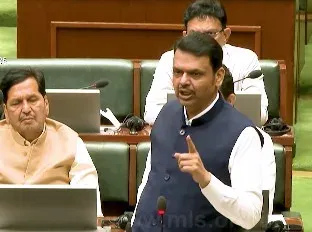
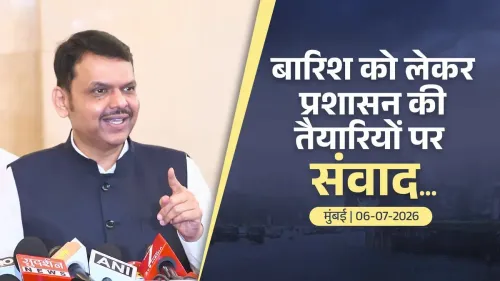
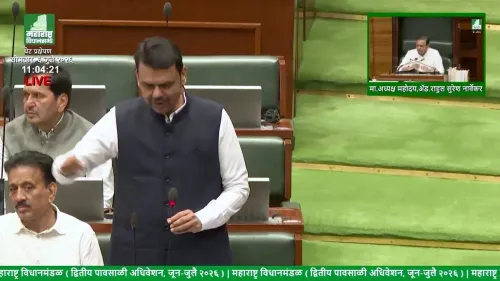
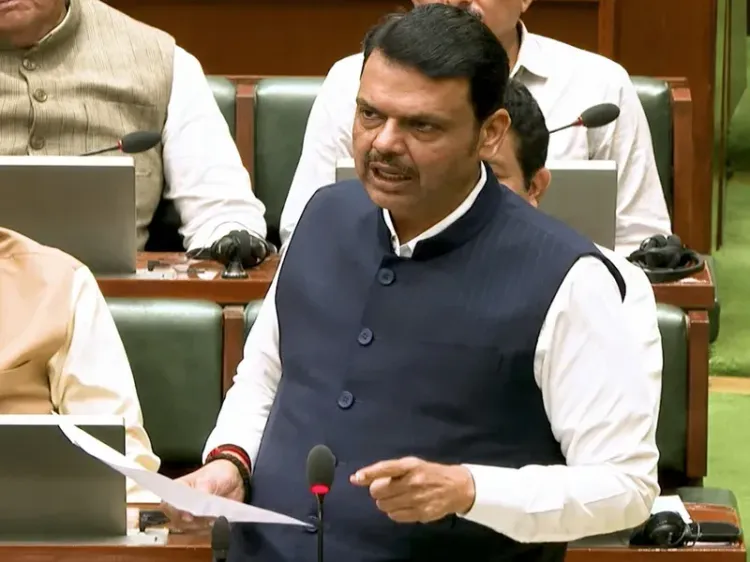
Chief Minister Devendra Fadnavis on 8 July 2026 presented a detailed, data-driven defence of the Mahayuti government's governance record in the Maharashtra State Legislative Assembly, responding to a high-voltage debate under Rule 293. At the centre of his address was a ₹13,000 crore comprehensive Flood Control Plan targeting 370 vulnerable hotspots across Mumbai, which has been submitted to the Centre for final clearance, with an aim to drain floodwater within 30 minutes of high-tide surges.
Mumbai's Unprecedented Rainfall Crisis
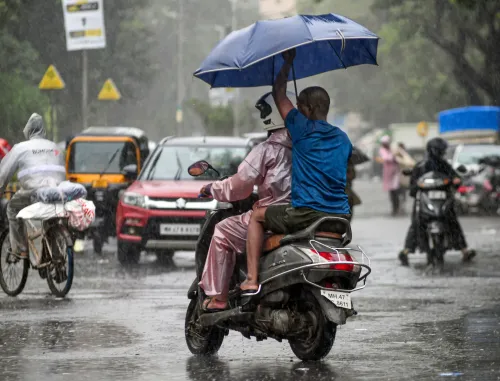
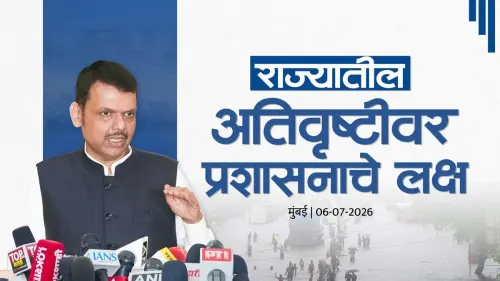
Fadnavis anchored his defence in stark meteorological data. Historically, Colaba averages 734 mm and Santacruz averages 856 mm of rainfall for the entire month of July. This year, in just six days, Colaba recorded 882 mm — 111 per cent of its monthly average — while Santacruz received 988 mm, or 102 per cent of its July quota. Notably, 90 per cent of this rain fell over a mere four days.
The CM drew a striking regional comparison: the six-day deluge amounted to 117 per cent of Delhi's entire annual monsoon rainfall, 113 per cent of Pune's, and 96 per cent of Bengaluru's. The crisis was compounded by gale-force winds of 50–75 km/h and a high tide exceeding four metres, causing widespread uprooting of trees.
Flood Infrastructure and Drainage Overhaul
Fadnavis said the 25-year-old 'Brimstowad' drainage masterplan, which had languished for decades under successive governments, will see its pending components completed within the next two years. On the ground, 990 dewatering pumps were deployed across the Brihanmumbai Municipal Corporation (BMC), MMRDA, and the Railways, alongside 10 fully operational pumping stations. Micro-drainage cleaning this year reached 112 per cent of target, while the critical Mithi River saw 83 per cent desilting.
To eliminate fraudulent billing in civic contracts — a reference to past desilting scams where vehicles logged as transporting metric tonnes of silt turned out to be scooters and auto-rickshaws — the administration has integrated Artificial Intelligence (AI)-based tracking. This crackdown resulted in contractor fines totalling ₹12.5 crore in 2025 and ₹9.26 crore in 2026.
BMC Reserves Redirected to Capital Works
In a significant policy shift, Fadnavis questioned the rationale of holding large sums in BMC fixed deposits while basic infrastructure remained underfunded. He noted that civic fixed deposits stood at ₹78,000 crore in 2021, peaked at ₹91,000 crore during the pandemic, and were back at ₹78,000 crore as of June 2026. 'Should we just sit and admire fixed deposits while citizens face daily civic issues?' he asked.
He argued that municipal FDs earn barely 3 per cent interest against an inflation rate of 7 per cent, eroding 4 per cent of wealth annually. By redirecting surplus reserves, the administration has channelled ₹2 lakh crore into capital public works, claiming a 15 per cent socio-economic return versus the 3 per cent bank yield — while maintaining the BMC's solvency to fund a 300-km metro network transition.
Dharavi Redevelopment and Housing Commitments
On the Dharavi Redevelopment Project, Fadnavis clarified that of the 104-hectare land parcel, 95 million sq. ft. is reserved for rehabilitation and 130 million sq. ft. for saleable commercial development. The plan envisions Dharavi as a formalised, modern industrial hub rather than a housing township, with all commercial units receiving a five-year GST exemption. A total of 1,60,000 residential and commercial tenements will be rehabilitated.
Residents who settled before 2000 will receive free 350 sq. ft. homes within Dharavi. Those who arrived between 2000 and 2011 will get homes at a subsidised cost of ₹2.5 lakh. Fadnavis announced that the first 10,000 rehabilitation homes will be completed within 18 months, with keys to be handed over by Prime Minister Narendra Modi.
Infrastructure Push: Roads, Water, and the Missing Link
To address Mumbai's daily water deficit of 500 million litres, the long-delayed Gargai Dam project has secured environmental clearance and is slated for completion by May 2029, saving ₹270 crore through reverse bidding. Desalination plants at Manori and Versova will begin supplying drinking water by 2029–30. On roads, 95 per cent of Mumbai's 2,050-km road network — 1,913 km — is being converted to cement concrete, cutting pothole maintenance costs from ₹203 crore in 2023 to ₹45 crore in 2026.
Fadnavis also defended the newly launched Mumbai-Pune Expressway 'Missing Link' extension against criticism over minor landslide incidents, drawing a parallel with the Konkan Railway. He said the previous MVA government had officially shelved the project after the then Chief Minister listed 14 reasons it was 'impossible' to execute. He confirmed the main bridge has no cracks, the tunnel remains safe, automated sensors dispatched clean-up cranes within three minutes, and traffic resumed in under 18 hours. The CM described it as 'the world's widest twin tunnels and India's highest cable-stayed bridge, built to withstand wind speeds of 170 km/h.'
The Balasaheb Thackeray Memorial is set to open fully by January 2027, and structural work on the Dr B R Ambedkar Indu Mill Memorial is 100 per cent complete. Fadnavis concluded his address with an Urdu couplet: 'Manzil mil hi jayegi bhatakte huve hi sahi, Are gumrah toh wo hain jo ghar se nikle hi nahi' — broadly, that those who venture forward will find their destination, while those who never try are the truly lost.
Point of View
A ₹13,000 crore plan still awaiting Central clearance is not a solution — it is a promise. The BMC fixed-deposit redeployment argument is economically coherent, but ₹2 lakh crore in capital works demands accountability frameworks that have historically been the weakest link in Maharashtra's civic governance. The Dharavi timeline — 10,000 homes in 18 months, keys from the PM — is politically loaded and will be judged against delivery, not announcements. And the Missing Link defence, while rhetorically strong, does not answer why slope-stabilisation protocols were not completed before inauguration.
NationPress
8 Jul 2026
Frequently Asked Questions
What is the ₹13,000 crore Flood Control Plan announced by CM Fadnavis?
It is a comprehensive flood mitigation scheme targeting 370 vulnerable hotspots across Mumbai, submitted to the Central Government for final clearance. The plan aims to drain floodwater within 30 minutes of high-tide surges and complements the long-pending Brimstowad drainage masterplan.
Why did Mumbai flood so severely in early July 2026?
According to data presented by CM Fadnavis, Colaba received 882 mm and Santacruz received 988 mm of rainfall in just six days — exceeding their entire July monthly averages. The deluge was compounded by gale-force winds of 50–75 km/h and a high tide exceeding four metres.
What are the key changes to the Dharavi Redevelopment Project?
A total of 1,60,000 residential and commercial tenements will be rehabilitated. Residents who settled before 2000 get free 350 sq. ft. homes; those who arrived between 2000 and 2011 get homes at ₹2.5 lakh. The first 10,000 homes are promised within 18 months, with PM Modi scheduled to hand over the keys.
How has the BMC used its fixed deposit reserves?
The Mahayuti government redirected surplus BMC fixed deposits — which stood at ₹78,000 crore as of June 2026 — into capital public works, unlocking ₹2 lakh crore for development. Fadnavis argued that FDs earning 3 per cent against 7 per cent inflation were effectively eroding public wealth.
What is the status of the Mumbai-Pune Expressway Missing Link after the landslide?
CM Fadnavis confirmed the main bridge has no structural cracks and the tunnel is completely safe. Automated sensors deployed clean-up cranes within three minutes of the landslide, and traffic resumed in under 18 hours. The structure is built to withstand wind speeds of 170 km/h.