CM Rekha Gupta pays tribute to Lokmanya Tilak on death anniversary
Synopsis
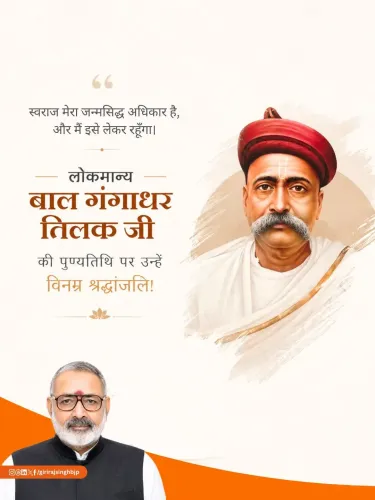
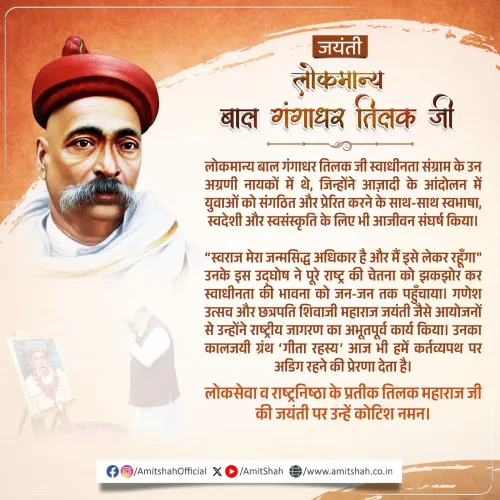
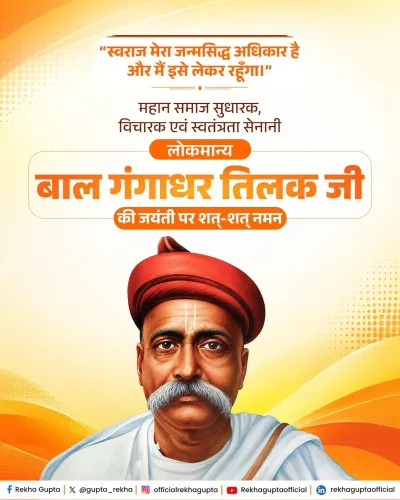
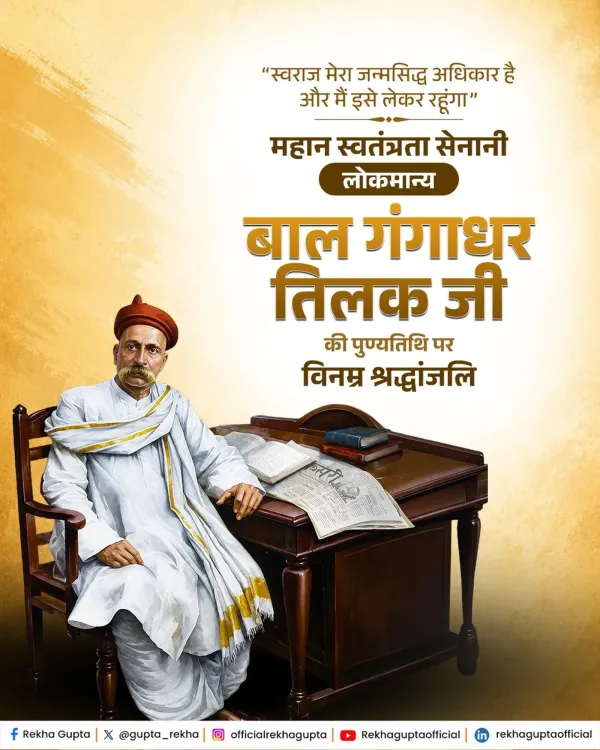
Delhi Chief Minister Rekha Gupta paid tribute to Lokmanya Bal Gangadhar Tilak on his death anniversary, honouring his role in transforming Ganesh Utsav and Shivaji Jayanti into platforms for national consciousness and the Swadeshi and Swaraj movements.
Key Takeaways
Delhi CM Rekha Gupta paid tribute to Lokmanya Bal Gangadhar Tilak on his death anniversary, 1 August 2026 .
Tilak began organising public Ganesh Utsav celebrations in 1893 and Shivaji Jayanti in 1896 to build national consciousness.
He was convicted on sedition charges in 1897 and 1908 , which amplified rather than diminished his public stature.
Tilak died on 1 August 1920 ; his death anniversary is regularly marked by BJP leaders linking his cultural-nationalist legacy to the party's ideology.
CM Gupta's tribute emphasised 'rashtrabhakti, swabhimaan aur sanskritik asmita' — patriotism, self-respect, and cultural identity.
A century after his passing, Lokmanya Bal Gangadhar Tilak still commands the political imagination of India — and on Saturday, 1 August 2026, Delhi Chief Minister Rekha Gupta joined the nation in remembering the freedom fighter on his death anniversary with a tribute that invoked his legacy of cultural awakening and self-rule.
Posting in Hindi on X, CM Gupta offered her 'vinamra shraddhanjali' — humble homage — to Tilak, describing him as a 'great pioneer of Swadeshi, Swaraj and national renaissance.' She specifically highlighted how Tilak transformed Ganesh Utsav and Chhatrapati Shivaji Maharaj Jayanti into vehicles of national consciousness, social harmony, and mass awakening — a reading of history that sits at the heart of the BJP's ideological inheritance.
The festivals that became a freedom movement
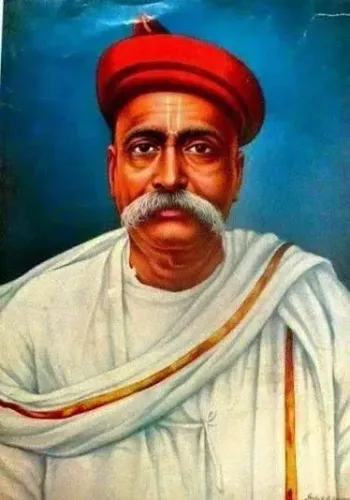
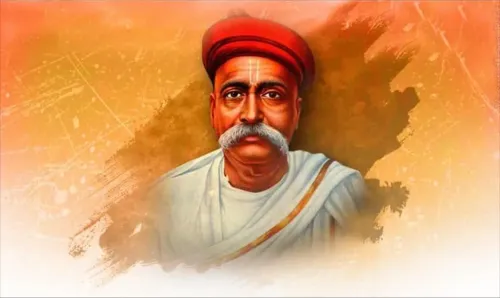
Tilak's genius was organisational as much as oratorical. In 1893, he began publicly organising Ganesh Utsav celebrations in Maharashtra, turning a largely private religious observance into a mass gathering where nationalist ideas could circulate freely — beyond the reach of colonial censors who monitored the press. Three years later, in 1896, he launched public Shivaji Jayanti commemorations, invoking the 17th-century Maratha king Chhatrapati Shivaji Maharaj as a symbol of indigenous resistance and self-determination. Both festivals gave ordinary Indians a shared civic ritual at a time when formal political assembly was tightly controlled. The British understood the threat. Tilak was convicted on sedition charges in 1897 and again in 1908, each trial only amplifying his stature. It was the colonial government, ironically, that cemented his title: Lokmanya — 'accepted by the people as their leader.'Why BJP leaders invoke Tilak on 1 August
Tilak died on 1 August 1920, and his death anniversary has become a fixture in the BJP's political calendar. The party's ideological lineage traces a direct line between Tilak's emphasis on cultural pride, Hindu festivals as civic spaces, and the Swadeshi movement — and the contemporary BJP's stress on cultural nationalism and self-reliance. CM Gupta's tribute, with its explicit reference to 'rashtrabhakti, swabhimaan aur sanskritik asmita' (patriotism, self-respect, and cultural identity), fits squarely within that framing. For Delhi's government, the tribute also carries a local dimension: Maharashtra may be Tilak's home ground, but his ideas shaped nationalist politics across the subcontinent, and Delhi — as the seat of the national government — marks the anniversary with its own political weight. A freedom fighter who used culture as a weapon for liberation, Lokmanya Tilak left behind not just a legacy but a method — one that continues to be claimed, contested, and commemorated more than a hundred years on.Point of View
Weaving his emphasis on cultural festivals and Swadeshi into the party's broader ideological narrative. The specific mention of Ganesh Utsav and Shivaji Jayanti is not incidental — both festivals remain politically resonant in Maharashtra and beyond, where they carry layered meanings of Hindu cultural assertion and anti-colonial pride. For a Delhi Chief Minister, invoking Tilak also signals alignment with the national party line on cultural nationalism ahead of any state-level commemorations. The tribute is routine in form but deliberate in content, reinforcing the BJP's self-positioning as the inheritor of a particular strand of nationalist thought.
NationPress
15 Sept 2026
Frequently Asked Questions
When did Lokmanya Bal Gangadhar Tilak die?
Lokmanya Bal Gangadhar Tilak died on 1 August 1920 , and his death anniversary is observed annually across India.
Why did Tilak start Ganesh Utsav as a public festival?
Tilak began organising public Ganesh Utsav celebrations in 1893 to create a mass gathering space where nationalist ideas could be shared freely, beyond colonial restrictions on the press and political assembly.
What is the meaning of 'Lokmanya'?
Lokmanya means 'accepted by the people as their leader' — a title that became inseparable from Bal Gangadhar Tilak's identity, reflecting his enormous popular following during the independence movement.
Why do BJP leaders pay tribute to Tilak every year?
BJP leaders regularly mark Tilak's death anniversary because his emphasis on Swadeshi, cultural pride, and Hindu festivals as civic spaces aligns with the party's ideological stress on cultural nationalism and self-reliance.
What did Rekha Gupta say about Lokmanya Tilak?
Delhi CM Rekha Gupta described Tilak as a 'great pioneer of Swadeshi, Swaraj and national renaissance,' and highlighted how he turned Ganesh Utsav and Shivaji Jayanti into platforms for national consciousness and social harmony.