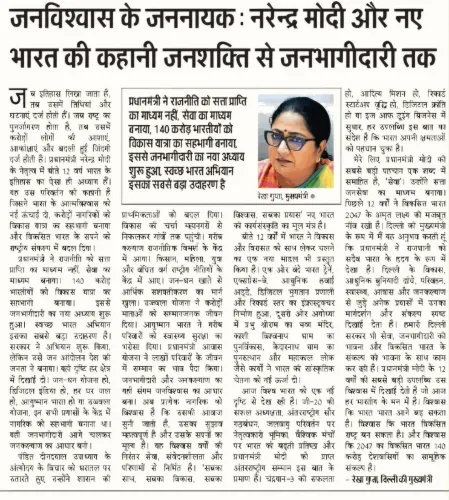
CM Rekha Gupta Hails PM Modi's Leadership at G7 Summit
Synopsis
Delhi Chief Minister Rekha Gupta on June 17 lauded PM Modi's presence at the G7 Summit, saying India has become a trusted global voice championing the Global South, innovation and inclusive growth under his leadership, linking the milestone to the Viksit Bharat vision.
Key Takeaways
Delhi CM Rekha Gupta praised PM Modi 's leadership on June 17, 2026 , in the context of India's participation in the G7 Summit .
India has attended G7 Summits as an invited guest since 2019 , gradually shifting from observer to agenda-shaper.
During the 2023 G20 presidency , India secured the African Union's permanent G20 membership , a flagship Global South win.
Gupta linked the foreign-policy milestone to the #ViksitBharat vision — India's goal of becoming a developed nation by 2047 .
Concrete G7 deliverables in AI, climate finance and critical minerals are being watched as the next benchmark for India's diplomatic influence.
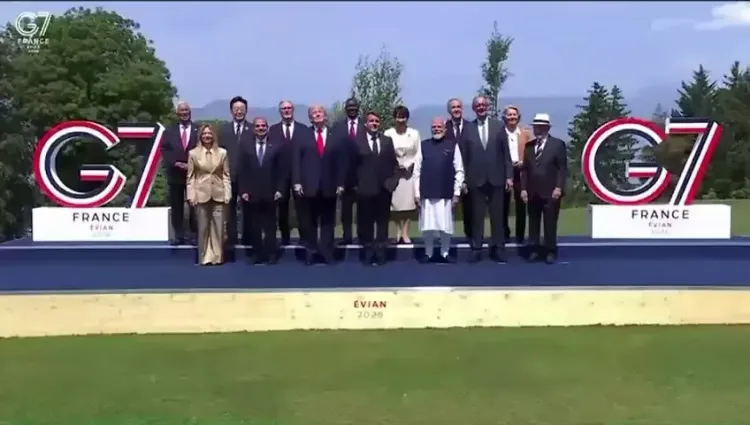
Delhi Chief Minister Rekha Gupta on Wednesday, June 17, 2026, praised Prime Minister Narendra Modi's global statesmanship, stating that India has emerged as a 'trusted voice in shaping the global future' under his leadership, with the country's presence at the G7 Summit reflecting growing international respect for its role.
Context
Gupta's post comes as Prime Minister Modi participates in the G7 Summit, where India has been invited as a guest nation. She described India's contributions as 'increasingly influencing international discourse,' citing its championing of the Global South and its push for innovation, sustainability and inclusive growth.
India has attended G7 Summits as an invited guest since 2019, a pattern that reflects its growing weight in Western-led multilateral forums. The current participation continues that trajectory, with New Delhi positioning itself as a bridge between developed economies and the developing world.
Policy Backdrop
India's claim to speak for the Global South gained significant institutional backing during its 2023 G20 presidency, when New Delhi secured the African Union's permanent membership in the grouping — a landmark diplomatic achievement widely attributed to Prime Minister Modi's personal lobbying.
At the 2023 G7 Summit in Hiroshima, Modi emphasised technology cooperation and the concerns of developing nations, setting a template that successive BJP leaders have since framed under the #ViksitBharat vision — the government's roadmap for a developed India by 2047. Gupta's post explicitly invokes that hashtag, linking foreign-policy milestones to the domestic development narrative.
India has simultaneously deepened engagement in BRICS, the SCO and the Quad, a multi-alignment strategy that allows New Delhi to retain non-aligned credentials while shaping agendas in Western-led forums.
Stakeholders and Impact
Global South nations stand to gain the most if India successfully channels their priorities — climate finance, technology access and debt relief — into G7 deliberations. India's diplomatic corps has been central to building the coalitions that give New Delhi this convening power.
Domestically, statements like Gupta's serve to reinforce the BJP's narrative that Modi's foreign-policy record is a tangible electoral and governance asset — connecting global summitry to the promise of a Viksit Bharat by 2047.
What's Next
Attention will now turn to any formal deliverables that emerge from India's G7 engagement — particularly in areas such as artificial intelligence, climate finance and critical minerals, where New Delhi has sought concrete cooperation frameworks. A follow-up statement from the Ministry of External Affairs is expected to detail the outcomes of Prime Minister Modi's bilateral meetings on the summit sidelines.
If India secures tangible commitments in any of these areas, it would further cement the argument — advanced by leaders like Rekha Gupta — that the country has moved from being a peripheral invitee to a genuine agenda-setter in the world's most influential economic forums.
Point of View
The party draws a direct line between international prestige and domestic development ambition. India's repeated G7 invitations do reflect a genuine elevation of its diplomatic standing, but the gap between symbolic participation and binding commitments remains the critical test. Whether the 2026 summit yields concrete deliverables — on climate finance, AI governance or critical minerals — will determine how durable this narrative proves to be.
NationPress
19 Sept 2026
Frequently Asked Questions
Why is India at the G7 Summit if it is not a G7 member?
India is not a permanent G7 member but has been invited as a guest nation since 2019 because of its size, economic weight and role as a voice for Global South countries. The G7 host nation typically invites select partners to broaden the summit's reach.
What is the Global South and why does India claim to represent it?
The Global South broadly refers to developing and emerging economies, mostly in Asia, Africa and Latin America. India has positioned itself as their advocate in multilateral forums, most visibly during its 2023 G20 presidency when it secured the African Union's permanent membership in the group.
What is Viksit Bharat?
Viksit Bharat is the Indian government's vision to make India a fully developed nation by 2047, the centenary of independence. BJP leaders frequently connect foreign-policy achievements to this domestic goal to argue that global standing accelerates development at home.
What did PM Modi achieve at the 2023 G7 Summit in Hiroshima?
At the 2023 G7 Summit in Hiroshima, PM Modi emphasised technology cooperation and the concerns of developing nations, reinforcing India's role as a bridge between the G7 and the Global South. The visit was part of a broader diplomatic push that also included the landmark African Union G20 membership later that year.
What should India's next steps be after the G7 Summit?
Analysts are watching for formal deliverables in artificial intelligence governance, climate finance and critical minerals cooperation. A follow-up statement from India's Ministry of External Affairs is expected to outline specific outcomes from PM Modi's bilateral meetings held on the sidelines of the summit.