CM Rekha Gupta Pays Tribute to Bhagat Singh on Birth Anniversary
Synopsis
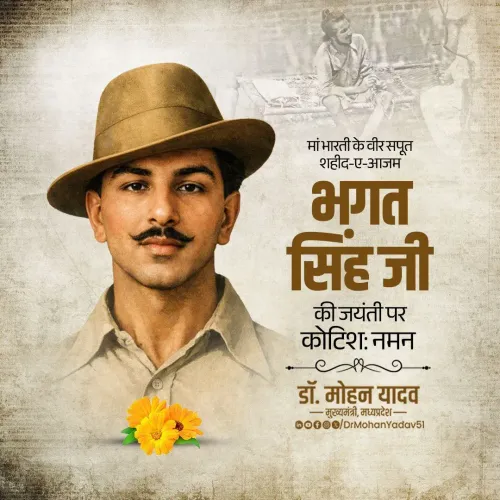
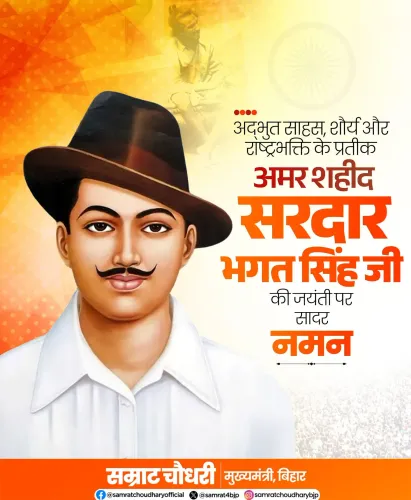
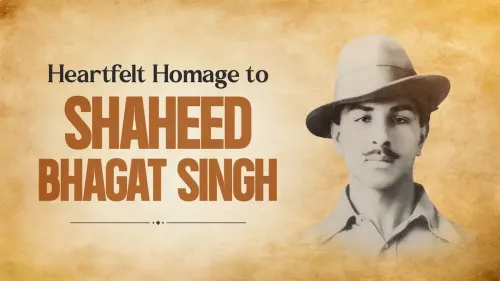
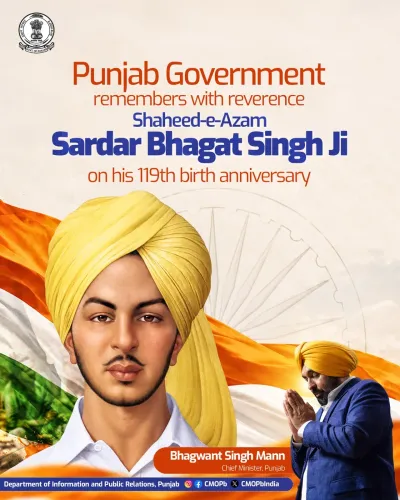
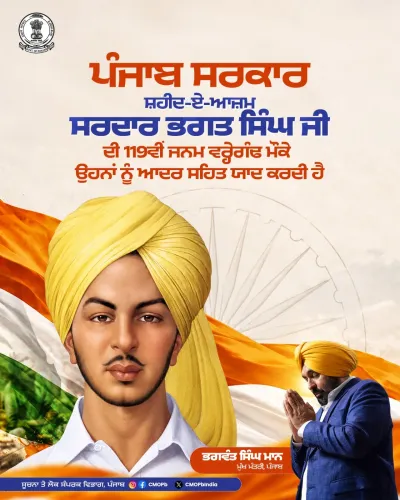
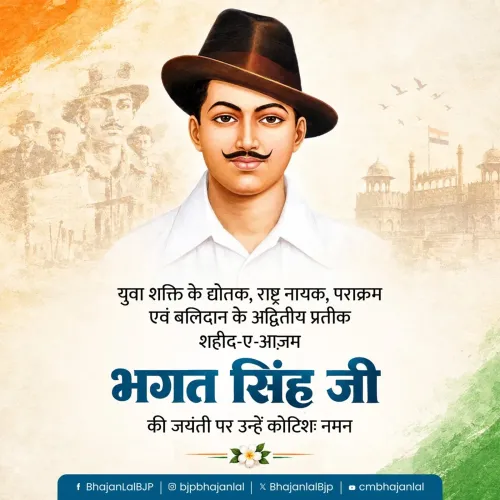
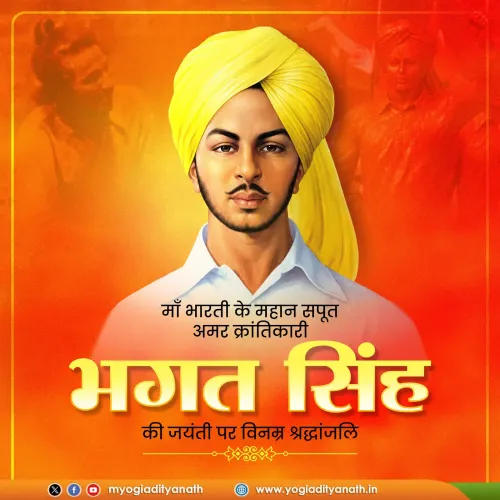
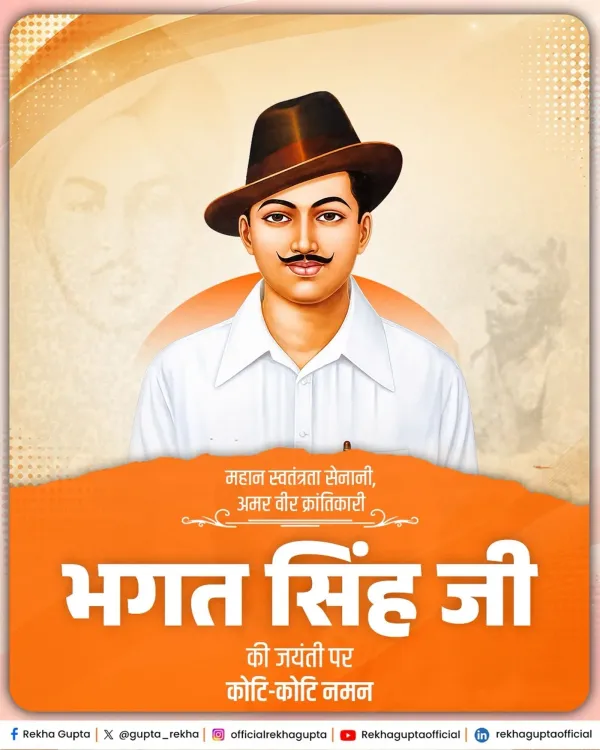
Delhi Chief Minister Rekha Gupta paid tribute to Shaheed-e-Azam Bhagat Singh on his 119th birth anniversary on 28 September 2026, honouring the revolutionary's sacrifice, intellectual courage, and enduring inspiration to generations of Indians.
Key Takeaways
Delhi CM Rekha Gupta posted a tribute to Bhagat Singh on his 119th birth anniversary, 28 September 2026 .
She described him as 'the eternal consciousness of India's valour, courage, and self-respect' whose life inspires patriotism in every generation.
Bhagat Singh was born on 28 September 1907 in Punjab and executed by British authorities on 23 March 1931 , aged 23 .
His 1929 Central Legislative Assembly bombing in Delhi is specifically referenced in the tribute's imagery of a 'roar echoing across Delhi's land.' Tributes to Bhagat Singh on his birth anniversary are observed across India's political spectrum, with commemorative events in Delhi and Punjab.
He was 23 years old when the British empire silenced him — but Shaheed-e-Azam Bhagat Singh has never stopped speaking. On his 119th birth anniversary, Monday, 28 September 2026, Delhi Chief Minister Rekha Gupta offered a tribute to the revolutionary, invoking his legacy of courage, sacrifice, and the fire that lit India's freedom movement.
In her post, CM Gupta wrote: 'Punjab ki mitti mein janma shaurya, Delhi ki dharti par goonji jiski hunkar' — 'The valour born in Punjab's soil, whose roar echoed across Delhi's land, and whose name became immortal in the heart of Mother India.' She described Bhagat Singh's youthful resolve as 'as vast as ages' and his vision as having ignited the consciousness of freedom across the nation.
Born in Punjab, Hanged at 23 — A Life That Shaped a Nation
Bhagat Singh was born on 28 September 1907 in Lyallpur, Punjab (present-day Faisalabad, Pakistan), into a family already steeped in the independence struggle. By his early twenties, he had become the most electrifying face of armed resistance against British rule — his actions in the Central Legislative Assembly bombing of 1929 and the shooting of British officer John Saunders turning him into a national icon almost overnight. He was hanged on 23 March 1931 in Lahore, alongside Rajguru and Sukhdev, at an age when most young men are just beginning.
What has made Singh endure across nearly a century is not just the martyrdom but the intellect behind it. He was a voracious reader, a committed socialist, and a sharp-penned thinker who wrote from his prison cell until the end. His pamphlet 'Why I Am an Atheist' remains studied in universities today. CM Gupta's tribute captured this duality — the warrior and the dreamer — calling him 'the eternal consciousness of India's valour, courage, and self-respect.'
Why Delhi's CM Pauses on This Date Every Year
Bhagat Singh's birth anniversary has a particular resonance for Delhi, the city whose colonial-era heart he shook with the 1929 Assembly bombing — a deliberate act designed to be heard, not to kill. The roar that CM Gupta invokes — 'Delhi ki dharti par goonji jiski hunkar' — is a direct reference to that moment. Tributes from political figures on 28 September are a near-universal ritual across India's party spectrum, but BJP leaders have consistently framed Singh's memory within a broader narrative of cultural nationalism and national duty.
Commemorative events, school programmes, and public memorials typically mark the day in both Delhi and Punjab, keeping Singh's story alive for generations who inherit a free country he never lived to see.
A young man from Punjab who gave everything so that a nation could have everything — that debt, CM Gupta reminds us, is never fully repaid.
Point of View
But BJP leaders have been particularly consistent in tethering his memory to themes of cultural nationalism and civilisational pride. CM Gupta's tribute follows this established pattern — framing Singh not just as an anti-colonial fighter but as an 'eternal consciousness' of national self-respect, language that resonates with the BJP's broader ideological vocabulary. The Delhi connection — the 1929 Assembly bombing — gives her tribute a geographic authenticity that goes beyond routine remembrance. As India's political calendar is dense with such anniversaries, what distinguishes a tribute is the specificity of its imagery, and Gupta's invocation of both Punjab's soil and Delhi's echo is notably grounded.
NationPress
28 Sept 2026
Frequently Asked Questions
When is Bhagat Singh's birth anniversary?
Bhagat Singh was born on 28 September 1907 , and his birth anniversary is observed nationally on that date every year with tributes, school programmes, and public memorials.
Why is Bhagat Singh called Shaheed-e-Azam?
Shaheed-e-Azam means 'the Greatest Martyr.' Bhagat Singh earned the title because of his fearless resistance to British rule and his execution at the young age of 23 on 23 March 1931 , alongside Rajguru and Sukhdev.
What did Delhi CM Rekha Gupta say about Bhagat Singh?
CM Rekha Gupta described Bhagat Singh as 'the eternal consciousness of India's valour, courage, and self-respect,' saying his life awakens patriotism in every generation and inspires dedication to the motherland.
What is the connection between Bhagat Singh and Delhi?
Bhagat Singh is directly linked to Delhi through the Central Legislative Assembly bombing of 1929 , a deliberate act of protest in which he and Batukeshwar Dutt threw non-lethal bombs inside the assembly to register resistance against repressive British laws.
Which state was Bhagat Singh from?
Bhagat Singh was born in Lyallpur, Punjab (now Faisalabad in Pakistan) on 28 September 1907, into a family with a history of participation in the Indian independence movement.