CM Himanta Acknowledges CMRF Donations from Assam Orgs
Synopsis
Chief Minister Himanta Biswa Sarma acknowledged six contributions totalling over ₹6.61 lakh to Assam's Chief Minister's Relief Fund, with donors ranging from Karimganj Zilla Parishad to the Babasaheb Dr BR Ambedkar Society of Hailakandi, on 30 September 2026.
Key Takeaways
Six donors contributed a combined ₹6,61,500 to the Chief Minister's Relief Fund of Assam, acknowledged on 30 September 2026 .
Karimganj Zilla Parishad was the largest single donor at ₹3,70,500 .
Donors spanned local government, academia, a BJP district functionary, and civil society organisations.
All six donors are based in or associated with the Barak Valley region of southern Assam.
The CMRF is Assam's primary instrument for channelling public donations during flood and disaster emergencies.
CM Sarma's office named each donor publicly, reinforcing a pattern of individual acknowledgement to encourage further civic contributions.
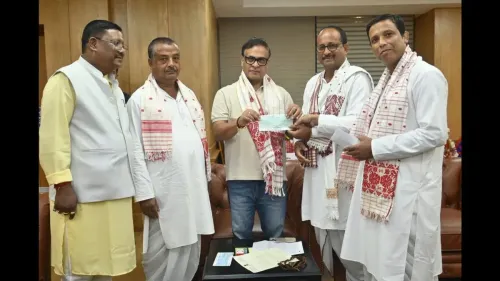
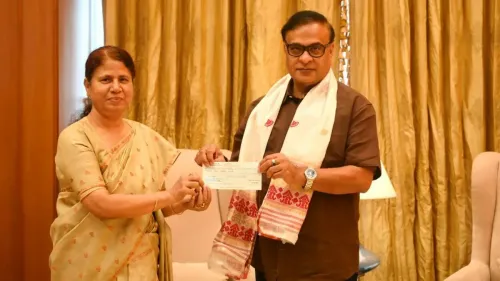
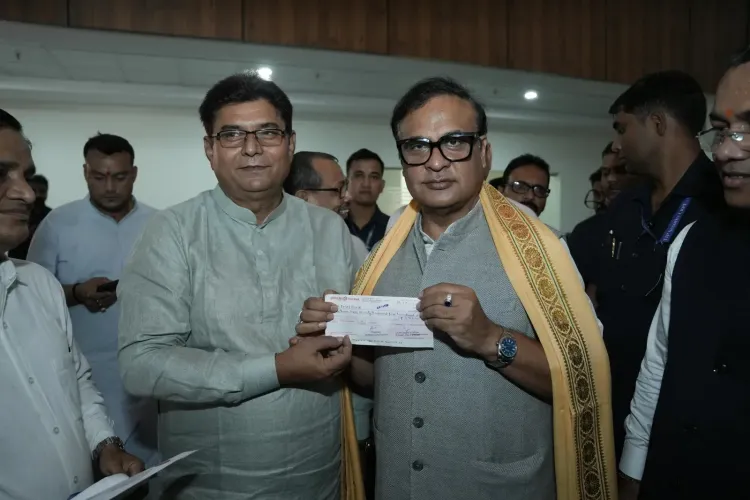
Solidarity poured in from across Assam's Barak Valley and beyond on Wednesday, 30 September 2026, as Chief Minister Dr Himanta Biswa Sarma formally acknowledged a fresh round of contributions to the Chief Minister's Relief Fund (CMRF) — totalling over ₹6,61,500 from six donors spanning local government bodies, academic institutions, political representatives, and private citizens.
Who gave what: the six donors and their contributions
Leading the round was Karimganj Zilla Parishad, which contributed ₹3,70,500 — the single largest donation in the batch, underlining how district-level governance bodies in flood-prone southern Assam are channelling institutional resources toward state relief. Assam University Teachers' Association followed with ₹1,00,000, a signal that the academic community is participating in the relief ecosystem beyond the classroom.
Shri Rupam Nandi Purakayastha, Executive Member of the BJP in Cachar, matched the teachers' contribution at ₹1,00,000. Dr Jaysree Chakraborty, Principal of PDUAM (Panchayat Development Under-Graduate Arts and Multi-Purpose College), Eraligool, donated ₹50,000. Shri Pradip Kumar Surana (Lala) contributed ₹21,000, while the Babasaheb Dr BR Ambedkar Society of Hailakandi rounded off the list with ₹20,000 — a contribution from a community organisation named after the architect of the Indian Constitution.
Why the CMRF matters in flood-season Assam
The Chief Minister's Relief Fund is a decades-old instrument of Assam's disaster-response architecture, activated with particular urgency during the state's annual flood cycle that inundates millions of hectares and displaces hundreds of thousands of residents each year. Contributions from a diverse cross-section — local government, academia, party workers, civil society — reflect the broad social compact that keeps the fund replenished between government allocations.
The geography of this particular batch is telling: Karimganj, Cachar, Eraligool, and Hailakandi all sit in the Barak Valley, a region in southern Assam historically vulnerable to both floods and displacement. That the bulk of these donations originate from that corridor suggests relief needs remain acute in the area even as the monsoon season draws to a close.
Sarma's acknowledgement: normalising civic participation in relief
By publicly recognising each donor by name and exact amount, CM Sarma follows a deliberate pattern his office has maintained — treating acknowledgement as accountability, making every contribution visible rather than absorbing it into an anonymous pool. It is a governance practice that nudges further civic participation: when a district Zilla Parishad or a college principal sees their name and number published by the Chief Minister's Office, it sets a precedent for peer institutions to follow.
The next marker to watch is how the state government reports fund utilisation — whether disbursements match the pace of incoming contributions, and which districts receive priority relief in the current cycle.
Point of View
Who has consistently used social media to signal administrative responsiveness, these acknowledgements serve a dual function — validating donors and signalling to constituents that the government notices and records civic generosity. The concentration of donors from the Barak Valley also hints at sustained relief pressure in southern Assam even as the peak flood season winds down. The fund's long-term credibility, however, will hinge on whether utilisation data becomes equally public.
NationPress
1 Oct 2026
Frequently Asked Questions
What is the Chief Minister's Relief Fund of Assam?
The Chief Minister's Relief Fund (CMRF) of Assam is a state-managed fund that channels public and institutional donations for immediate disaster relief, particularly during the state's annual flood season. It has been operational for decades and accepts contributions from individuals, organisations, and government bodies.
Who donated to the Assam CMRF on 30 September 2026?
Six donors contributed: Karimganj Zilla Parishad (₹3,70,500), Assam University Teachers' Association (₹1,00,000), Rupam Nandi Purakayastha of BJP Cachar (₹1,00,000), Dr Jaysree Chakraborty of PDUAM Eraligool (₹50,000), Pradip Kumar Surana (₹21,000), and Babasaheb Dr BR Ambedkar Society, Hailakandi (₹20,000).
How can I donate to the Assam Chief Minister's Relief Fund?
Donations to the Assam CMRF can be made through the official Assam government portal. Individuals, institutions, and organisations can contribute online or through designated bank accounts notified by the government.
Why does CM Himanta Biswa Sarma publicly acknowledge CMRF donations?
CM Sarma's office regularly names donors publicly to ensure transparency, validate contributions, and encourage further civic participation in the state's disaster relief ecosystem — a practice that treats public acknowledgement as a form of accountability.
Which districts in Assam are most affected by floods?
Assam's Brahmaputra Valley and Barak Valley districts — including Karimganj, Cachar, Hailakandi, and others — are among the most flood-prone regions in the state, experiencing annual inundation that displaces large numbers of residents and damages agricultural land.