White House: South Korea to Invest Billions in US Energy, Alaska LNG
Synopsis
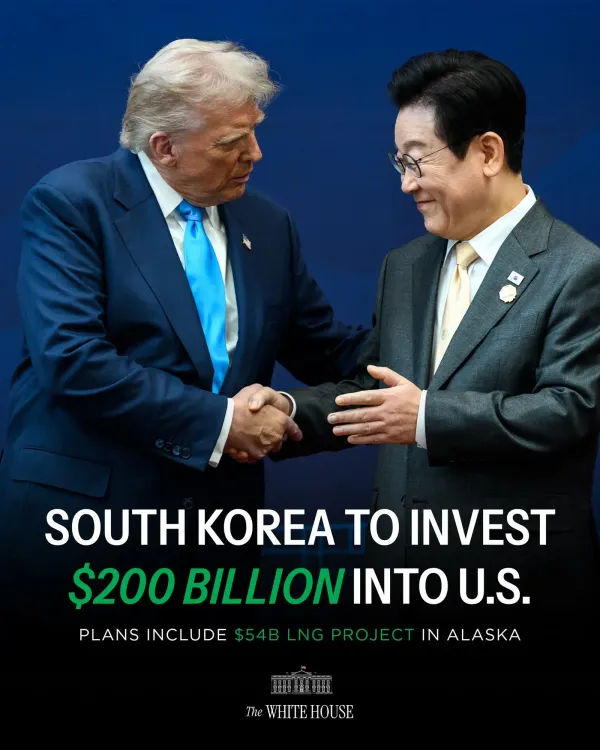
The White House announced on 1 October 2026 that South Korea plans to invest billions of dollars in major US energy projects, headlined by the Alaska LNG export scheme, with the administration promising thousands of American jobs and lower energy costs.
Key Takeaways
South Korea plans to invest billions of dollars into major US energy projects , as announced by the White House on 1 October 2026 .
The centrepiece is the Alaska LNG project, which would export natural gas from Alaska's North Slope to Asian markets.
The White House says the investments will generate thousands of jobs and help reduce energy costs for American households.
South Korea has been among the largest buyers of US LNG since American exports scaled up after 2016 .
The US-South Korea Free Trade Agreement , in force since 2012 , underpins the broader bilateral investment and trade framework.
Regulatory milestones — including federal export permits — remain ahead before Alaska LNG construction can begin in earnest.
South Korea is set to pour billions of dollars into major American energy infrastructure — and the centrepiece is a long-awaited liquefied natural gas project in Alaska that has been decades in the making. The White House announced the move on Thursday, 1 October 2026, framing the investment as a win for American jobs and household energy costs.
Alaska LNG: A decades-old dream nearing reality
The Alaska LNG project has been one of the most ambitious — and most deferred — energy infrastructure proposals in US history. It envisages piping vast volumes of natural gas from Alaska's North Slope to a southern export terminal, from where cargoes would flow to Asian buyers hungry for cleaner-burning fuel. South Korea, one of the world's largest LNG importers and already a significant buyer of American gas since US exports scaled up after 2016, is now positioned as a cornerstone financier of that vision.
The White House declared the investments 'will generate thousands of jobs and help reduce energy costs for Americans' — a dual-payoff framing that signals the administration is selling this as both a foreign-policy and kitchen-table win.
Seoul's strategic bet on US energy
South Korea has long walked the tightrope between energy security and alliance management. Locked into a region where energy supply disruptions carry acute geopolitical risk, Seoul has steadily diversified its import base toward the United States since the US-South Korea Free Trade Agreement came into force in 2012. Investing directly in upstream US infrastructure — rather than simply buying spot or term cargoes — is a meaningful escalation of that strategy, giving Korean firms a stake in supply chains they previously only consumed.
For Washington, the logic is equally clear: foreign direct investment in domestic LNG infrastructure expands export capacity, tightens alliance ties, and produces visible, countable jobs in politically significant states.
What the jobs-and-costs promise actually means
Large-scale LNG infrastructure projects — pipelines, liquefaction trains, export terminals — are among the most labour-intensive construction undertakings in the energy sector. The White House's promise of 'thousands of jobs' is consistent with the pattern of prior Gulf Coast LNG expansions. On the consumer side, the argument is that increasing export capacity tightens the link between abundant domestic gas supply and lower utility bills, though the precise transmission from export volume to retail prices depends on multiple market variables.
Specific investment figures and job estimates cited in the announcement could not be independently verified, but the directional commitment from Seoul is consistent with its established role as a top-tier US LNG partner.
Regulatory path still ahead for Alaska LNG
Announcements of intent are one thing; permits and financing are another. Alaska LNG still faces federal export authorisations and environmental review milestones before construction can begin in earnest. The next concrete signals to watch are any formal US-South Korea energy memoranda, project-level financing term sheets, and decisions from the Federal Energy Regulatory Commission on export permits. If those dominoes fall in sequence, a project that has waited a generation could finally be in the ground.
South Korea's billions, if formalised, would give the Alaska LNG plan something it has historically lacked: a committed anchor buyer with skin in the game.
Point of View
The announcement threads two domestic imperatives at once: job creation in an energy-producing state and a tangible demonstration that alliances have economic dividends. The Alaska LNG project has accumulated decades of deferred promise, and an anchor foreign investor would change its financing calculus fundamentally. Watch whether this announcement hardens into binding term sheets, because the gap between a bilateral announcement and a final investment decision is where many mega-projects have historically stalled.
NationPress
1 Oct 2026
Frequently Asked Questions
What is the Alaska LNG project?
Alaska LNG is a long-proposed infrastructure scheme to pipe natural gas from Alaska's North Slope to a southern coastal terminal for export as liquefied natural gas, primarily to Asian markets including South Korea.
Why is South Korea investing in US energy projects?
South Korea is one of the world's largest LNG importers and a top buyer of US gas. Investing directly in US energy infrastructure strengthens its energy security, deepens alliance ties with Washington, and gives Korean firms a stake in supply chains they depend on.
How will South Korea's investment create jobs in the US?
Large-scale LNG infrastructure — pipelines, liquefaction facilities, and export terminals — requires intensive construction workforces. The White House says the South Korean investment will generate thousands of jobs, consistent with the labour patterns of prior US LNG expansions.
Will this investment lower energy costs for Americans?
The White House claims the investments will help reduce energy costs. Expanding LNG export infrastructure can support domestic supply development, though the precise effect on retail energy prices depends on broader market conditions.
What happens next for Alaska LNG after this announcement?
Key next steps include formal energy agreements or memoranda between the US and South Korea, project-level financing decisions, and federal regulatory approvals — including export permits — before construction on Alaska LNG can begin in earnest.