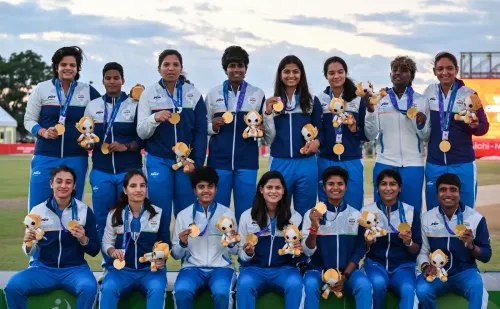
Mu Xinyue makes history as first female Asian Games esports gold medallist
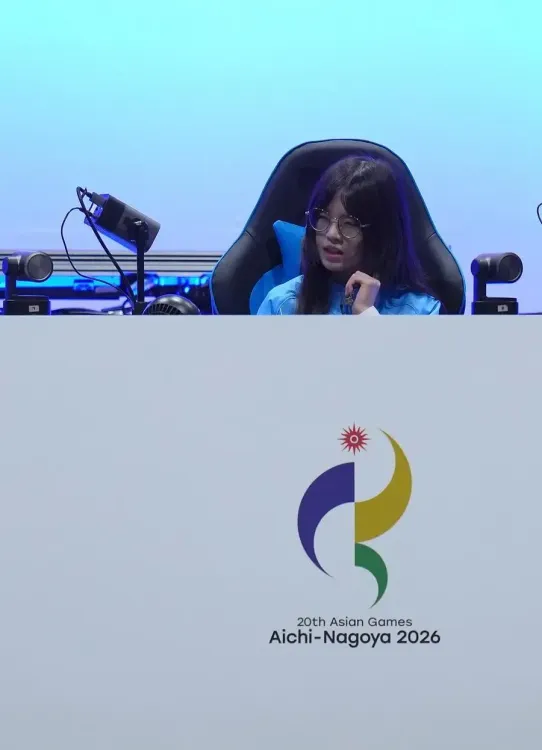
Synopsis
At Aichi-Nagoya 2026, China's Mu Xinyue became the first woman to win an esports gold medal at the Asian Games — a landmark in a discipline where only 14 of more than 500 registered competitors were female. China wrapped up its esports campaign with three golds and a silver, capping a dominant showing in a sport that is growing fast on the continental stage.
Key Takeaways
Mu Xinyue of China became the first female athlete to win an Asian Games esports gold medal on 1 October 2026 .
China defeated Japan in the Identity V Asian Games Version final at the Aichi-Nagoya Asian Games .
Only 14 women were registered among more than 500 esports athletes at Aichi-Nagoya, highlighting the gender gap in elite competitive gaming.
The final went to a decisive fifth round , with a technical stoppage of nearly 30 minutes due to a network cable fault.
China concluded its esports campaign with three gold medals (Naraka: Bladepoint, Honour of Kings, Identity V) and one silver (Game for Peace).
Aichi-Nagoya features 11 esports medal events , up from seven at Hangzhou 2023, with Identity V making its Asian Games debut.
China's Mu Xinyue etched her name into sporting history on 1 October 2026 at the Aichi-Nagoya Asian Games, becoming the first female athlete to win an esports gold medal at the Asian Games after China defeated Japan in the Identity V Asian Games Version final in Nagoya, Japan. The milestone arrives in a competition where women remain a stark minority — of more than 500 athletes registered for esports at Aichi-Nagoya, only 14 were women.
A Historic Moment at the Medal Ceremony
Mu, whose in-game ID is 'Tao Wan'an' and who is the only female member of China's esports delegation at these Games, was visibly overcome by the occasion. 'When I first started competing, I never imagined that I would be able to win a gold medal on the Asian Games stage,' she said. 'When the national anthem was played, and the gold medal was around my neck, I was so excited and happy. I think this may be the happiest moment of my life.'
The 20-year-old is part of China's Identity V squad alongside hunters Shi Xiangwei (in-game ID: 'Nianjin') and Sun Le, and survivors Lu Shujia, Chen Mingming, Lu Yahui, and Fan Siqi.
How the Final Unfolded
Identity V is an asymmetrical competitive game in which each round consists of two halves, with teams alternating between the roles of survivors and hunters. Four players compete on the survivor side while one plays as the hunter, with points awarded based on escapes and eliminations.
The final was tightly contested from the outset. The opening two rounds were tied 4-4 and 5-5 respectively, before China asserted control with a dominant 7-2 scoreline in the third round. A fourth-round 4-4 tie sent the match into a decisive fifth round, where China built a 3-1 lead in the first half — enough to secure the gold.
The contest was briefly disrupted by a technical issue between the two halves of the fourth round, with play suspended for nearly 30 minutes due to an on-site network cable fault. Mu said she remained composed throughout the stoppage. 'I didn't really have any emotional fluctuations at that time,' she said. 'We just waited to see what the referees and the organisers would decide. All we needed to do was wait patiently.'
What It Means for Women in Esports
Asian Games esports events are open to both male and female athletes, but men continue to dominate the registered athlete pool by a wide margin. The 14 women among more than 500 registered esports competitors at Aichi-Nagoya underscore the gender gap that still defines competitive gaming at the elite level. Mu's gold medal is being viewed, notably, not just as a personal achievement but as a landmark for the visibility of women in Asian esports.
Hunter Shi Xiangwei reflected on the unique weight of representing the nation rather than a professional club. 'First of all, there is a change of identity, and there is also greater responsibility on your shoulders,' he said. 'You can be nervous, and you can feel pressure, but you shouldn't let the pressure and nerves affect your performance in the game. Accept the nerves and the pressure, face them naturally, and just play your normal game.'
China's Strong Esports Campaign at Aichi-Nagoya
China entered four of the 11 esports medal events at Aichi-Nagoya — Naraka: Bladepoint, Honour of Kings, Game for Peace Asian Games Version, and Identity V Asian Games Version. The Identity V gold rounded off China's esports campaign, which concluded with three gold medals and one silver — gold in Naraka: Bladepoint and Honour of Kings, silver in Game for Peace, and now gold in Identity V.
Esports made its Asian Games debut as a demonstration sport at Jakarta 2018 before earning official medal status at Hangzhou 2023, where seven medal events were held. Aichi-Nagoya has expanded that to 11 events, with Identity V Asian Games Version making its debut at these Games. With the number of events growing and a historic first female champion now on record, the trajectory of esports at the Asian Games continues to accelerate.
Point of View
But it also throws a harsh light on where esports stands on gender inclusion: 14 women among 500-plus competitors is not a pipeline problem — it is near-total exclusion. The Asian Games umbrella lends legitimacy and visibility to esports, yet the governing bodies have so far treated mixed-open formats as a substitute for structured gender equity policies. Without dedicated women's events or clear participation targets, the next female esports gold medallist at the Asian Games could be another decade away — and one breakthrough moment should not obscure that structural reality.
NationPress
1 Oct 2026
Frequently Asked Questions
Who is Mu Xinyue and why is she historic?
Mu Xinyue is a 20-year-old Chinese esports player whose in-game ID is 'Tao Wan'an.' She became the first female athlete in history to win a gold medal in esports at the Asian Games, after China defeated Japan in the Identity V Asian Games Version final at Aichi-Nagoya 2026.
What is Identity V and how is it played at the Asian Games?
Identity V is an asymmetrical competitive game where each round has two halves — teams alternate between playing as survivors (four players) and a hunter (one player). Points are awarded based on the number of survivors who escape and the hunter's eliminations. It made its Asian Games debut at Aichi-Nagoya 2026.
How did the Identity V Asian Games final play out?
China and Japan played a closely fought five-round final. The first two rounds ended in ties (4-4 and 5-5), China won the third 7-2, the fourth ended 4-4, and China secured a decisive lead in the fifth round. A technical stoppage of nearly 30 minutes due to a network cable fault interrupted the fourth round before play resumed.
How many women competed in esports at the Aichi-Nagoya Asian Games?
Only 14 of more than 500 registered esports athletes at the Aichi-Nagoya Asian Games were women. Esports events are open to both male and female athletes, but men continue to make up the overwhelming majority of competitors.
How did China perform overall in esports at Aichi-Nagoya 2026?
China competed in four of the 11 esports medal events and finished with three gold medals — in Naraka: Bladepoint, Honour of Kings, and Identity V Asian Games Version — and one silver in Game for Peace Asian Games Version.