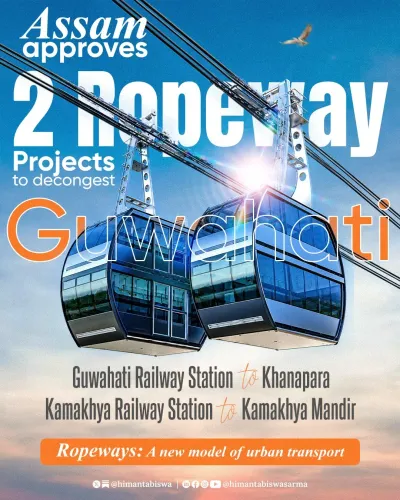
CM Himanta announces 5 ropeways across Assam

Synopsis
Assam Chief Minister Himanta Biswa Sarma has announced five ropeway projects spanning Guwahati, Barak Valley, and the hilly Dima Hasao district, aiming to ease travel, spur tourism, and improve last-mile connectivity across the state's most challenging terrain.
Key Takeaways
Five ropeway projects have been announced by Assam CM Himanta Biswa Sarma on 8 November 2026 .
The projects span three distinct geographies: Guwahati , Barak Valley (Cachar, Karimganj, Hailakandi), and Dima Hasao .
The initiative aligns with the Centre's Parvatmala Pariyojana , launched in 2022 for ropeway development in hilly and tourist regions.
Goals include easing travel, boosting tourism, and improving last-mile connectivity for tribal and valley communities.
Exact routes, costs, and timelines remain unannounced; detailed project reports and central funding approvals are the next key milestones.
Five new ropeway projects stretching from the urban sprawl of Guwahati to the remote hills of Dima Hasao and the culturally distinct Barak Valley — Assam Chief Minister Himanta Biswa Sarma has announced an ambitious connectivity push that could redraw how people move across one of India's most topographically diverse states.
Five ropeways, three very different Assams
The announcement covers terrain that has long frustrated planners and travellers alike. Guwahati, the state's largest city and the primary gateway to Northeast India, sits at one end of this plan. Barak Valley — comprising the districts of Cachar, Karimganj, and Hailakandi in southern Assam — brings a distinct linguistic and cultural identity to the mix, one historically underserved by fast infrastructure. And then there is Dima Hasao, the hilly central district formerly known as North Cachar Hills, where tribal communities navigate some of the most difficult terrain in the state. Five projects. Three distinct geographies. One overarching ambition.
Parvatmala Pariyojana and the national ropeway push
The projects align with the Centre's Parvatmala Pariyojana, a national scheme launched in 2022 by the Ministry of Road Transport and Highways to build ropeways for tourism and last-mile connectivity in hilly regions. Assam's move fits squarely within the broader federal push to modernise Northeast infrastructure — a priority that has seen steady central investment under both state and central administrations in recent years. Ropeways offer a rare advantage in hill terrain: they cut travel time, sidestep the cost of blasting mountain roads, and double as tourist draws in their own right.
Sarma framed the announcement in direct, human terms — 'better views, better journeys, a better-connected Assam' — signalling that the pitch is as much about lived experience as it is about logistics. Tourism in Dima Hasao and connectivity in Barak Valley are real gaps; the ropeway model, if executed, addresses both simultaneously.
What comes next: DPRs, tenders, and funding approvals
The critical milestones now are the detailed project reports, the tendering process, and central funding approvals for each of the five corridors. The exact routes, costs, and timelines have not yet been made public. The pace at which those documents move will determine whether this announcement translates into steel cables and gondolas — or joins the long queue of Northeast infrastructure promises awaiting ground-breaking.
For the hill communities of Dima Hasao and the valley residents of Barak, the stakes are tangible: faster access to markets, schools, and hospitals, and a tourism economy that could grow around the view from above.
Point of View
Delivering visible infrastructure in difficult terrain ahead of any electoral cycle reinforces his administration's core pitch: that remote Assam is not an afterthought. The ropeway model is strategically attractive because it generates both economic utility and tourism optics simultaneously. The real test, however, is execution speed — Northeast infrastructure announcements have a long history of promising timelines that slip; moving swiftly from DPR to tendering will define whether this becomes a legacy project or a headline footnote.
NationPress
8 Nov 2026
Frequently Asked Questions
Where will the 5 new ropeways in Assam be built?
The five ropeway projects will be spread across Guwahati, Barak Valley (covering Cachar, Karimganj, and Hailakandi districts), and the hilly Dima Hasao district. Exact routes have not yet been made public.
What is Parvatmala Pariyojana and how does it relate to Assam's ropeway plan?
Parvatmala Pariyojana is a central government scheme launched in 2022 by the Ministry of Road Transport and Highways to develop ropeways for tourism and last-mile connectivity in hilly areas. Assam's five ropeway projects are consistent with this national framework.
Who announced the 5 ropeway projects in Assam?
Assam Chief Minister Himanta Biswa Sarma announced the five ropeway projects on 8 November 2026 via a post on X.
What is the purpose of the Assam ropeway projects?
The ropeways are aimed at easing travel in difficult terrain, boosting tourism, and improving connectivity for residents of Barak Valley and Dima Hasao, areas that have historically been hard to access.
When will the Assam ropeways be completed?
No official timelines have been announced yet. The next steps involve detailed project reports, tendering, and central funding approvals before construction can begin.