CM Himanta flags Guwahati ropeway plan linking Railway Station to Khanapara
Synopsis
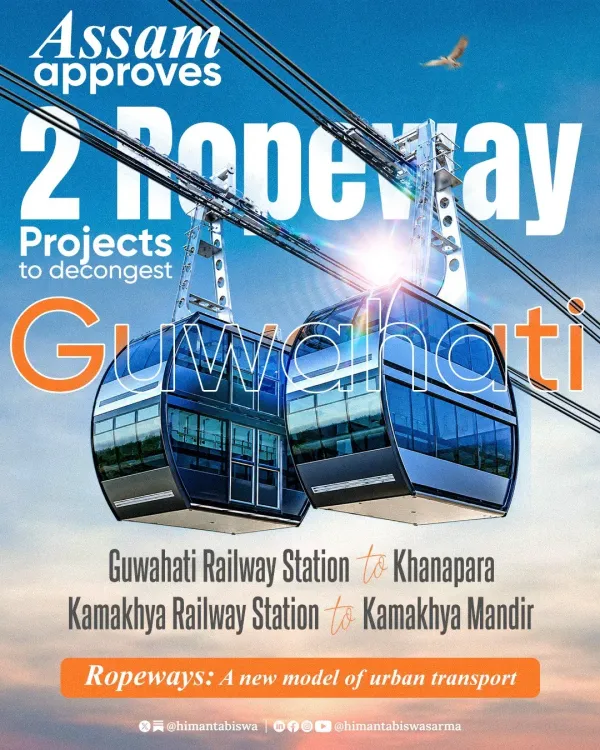
Assam Chief Minister Himanta Biswa Sarma has announced a planned aerial ropeway connecting Guwahati Railway Station with Khanapara, aiming to give commuters an elevated alternative to the city's congested road network.
Key Takeaways
CM Himanta Biswa Sarma announced a planned ropeway linking Guwahati Railway Station and Khanapara .
The project aims to ease chronic road congestion in Guwahati , Northeast India's largest city.
Khanapara is a key eastern traffic node near the Assam-Meghalaya border.
Guwahati was included in the Smart Cities Mission in 2015 , with urban mobility listed as a priority.
The detailed project report, funding, and tendering details are yet to be made public.
The proposal reflects a broader push for multimodal, topography-aware urban transit in Assam.
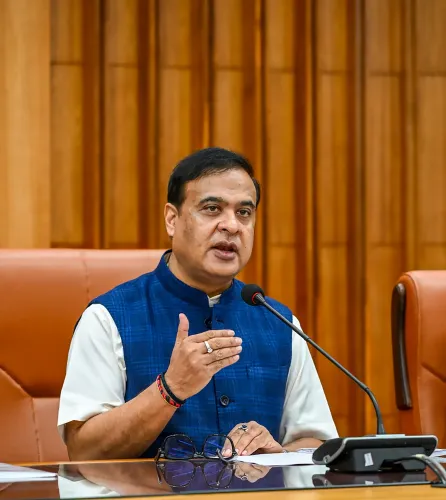
Above the gridlock, a cable car. Assam Chief Minister Himanta Biswa Sarma announced on Saturday, 7 November 2026 that a planned aerial ropeway will connect Guwahati Railway Station with Khanapara, promising commuters a way to bypass the city's notoriously choked arterial roads.
Guwahati's congestion problem and why Khanapara matters
Guwahati is the largest city and commercial gateway of Northeast India — and it is bursting at the seams. Rapid urbanisation, a topography hemmed in by hills and the Brahmaputra, and a vehicle count that has outpaced road expansion have turned daily commutes into an endurance test. Khanapara, on the city's eastern edge near the Assam-Meghalaya border, is a critical node: educational institutions, commercial activity and inter-state traffic all converge there, making it one of the busiest corridors in the city.
A ropeway threading over that corridor would offer something Guwahati's road network simply cannot — a route that ignores surface congestion entirely.
Ropeways as urban transit: a growing Northeast playbook
The proposal fits a broader pattern the Assam government has been building: multimodal urban transport options that work within the city's constrained geography rather than against it. Elevated and aerial transit ideas have gained traction across congested Indian cities, and Guwahati's inclusion in the Smart Cities Mission in 2015 specifically flagged urban mobility and decongestion as priority areas.
CM Sarma, who also convenes the North-East Democratic Alliance (NEDA), has consistently positioned infrastructure upgrades as a centrepiece of Assam's development pitch. A ropeway between two of the city's busiest transit anchors would be among the most visible of those bets.
What comes next for the project
The announcement is a declaration of intent. The detailed project report, tendering process, and any integration with existing rail infrastructure or the proposed Guwahati Metro corridor are still to be worked out and made public. Those steps will determine whether the ropeway moves from a compelling idea to a construction timeline.
For now, the city's commuters have a new dot on the map to watch — one that floats above the traffic rather than sitting in it.
Point of View
Modern mobility solutions that contrast sharply with the status quo of gridlocked streets. Aerial transit, once exotic in Indian urban planning, is increasingly a credible tool in hilly or topographically constrained cities, and positioning Guwahati as an early mover strengthens the Northeast's case for specialised infrastructure investment. The real test, however, will come at the project report and tender stage: ambitious ropeway proposals in Indian cities have historically struggled to convert announcement energy into operational systems. How quickly the Assam government publishes technical details will signal whether this is a firm commitment or an aspirational marker.
NationPress
7 Nov 2026
Frequently Asked Questions
What is the Guwahati ropeway project announced by CM Himanta?
It is a proposed aerial ropeway that would connect Guwahati Railway Station in central Guwahati with Khanapara in the city's east, offering commuters an elevated, traffic-free travel option.
Why is traffic so bad between Guwahati Railway Station and Khanapara?
The corridor is one of Guwahati's busiest, carrying inter-city, commercial and educational traffic through a city whose road network is constrained by hills and the Brahmaputra river, leaving little room for road widening.
Has Guwahati received any central government support for urban mobility?
Yes. Guwahati was included in the Smart Cities Mission in 2015, which specifically identified urban mobility and decongestion as priority areas for the city.
When will the Guwahati ropeway be built?
No construction timeline has been announced yet. The detailed project report and tendering process are still pending, and those steps will determine a realistic schedule.
Are ropeways used as public transport elsewhere in India?
Yes. Several Indian cities and state capitals, particularly in hilly or congested regions, have explored or implemented urban ropeway systems as part of multimodal transport strategies.