CM Sai: Bastar's old security camps now serve villagers

Synopsis
Chhattisgarh CM Vishnu Deo Sai says former security camps in Bastar are being converted into 'Veer Gundadhur Seva Dera' centres, providing Aadhaar enrolment, banking and essential services to remote tribal villages once gripped by insurgency.
Key Takeaways
Chhattisgarh CM Vishnu Deo Sai announced on 7 November 2026 that old security camps in Bastar are being converted into civilian service centres.
The initiative is named 'Veer Gundadhur Seva Dera' , after a revered Bastar tribal leader from the colonial era.
Services delivered include Aadhaar enrolment , banking access , and other essential government facilities for remote villagers.
Security camps were originally established in Bastar during anti-Naxal operations in the 2000s and 2010s .
The model mirrors a broader pattern across central India's insurgency-affected districts of pairing security presence with welfare delivery to build local trust.
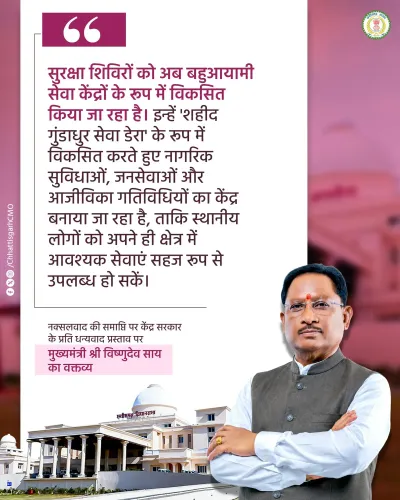
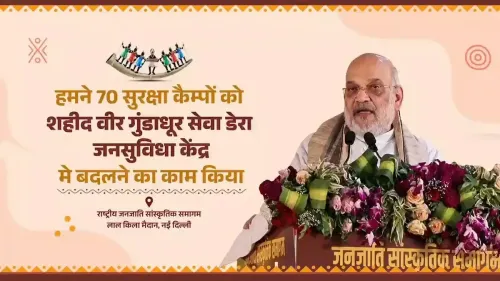
Camps once built to hold a line against insurgency are now dispensing Aadhaar cards and banking services — a quiet but telling reversal of fortune in one of India's most conflict-scarred regions. Chhattisgarh Chief Minister Vishnu Deo Sai on Saturday, 7 November 2026, highlighted how former security posts in Bastar are being repurposed as welfare hubs under a scheme called 'Veer Gundadhur Seva Dera', bringing essential services to remote tribal villages that have long lived beyond the state's functional reach.
From gun-posts to Aadhaar counters
The Chief Minister's post, written in Hindi, captures the shift with deliberate contrast: 'जहां कभी भय और असुरक्षा का माहौल था, वहां आज विश्वास, सुविधा और विकास की नई तस्वीर उभर रही है' — 'Where once there was fear and insecurity, today a new picture of trust, convenience and development is emerging.' The framing is intentional. For Bastar, a sprawling southern division of Chhattisgarh that bore the brunt of Naxalite violence through the 2000s and 2010s, even the physical presence of a government service point in a remote village represents a structural shift.
Security camps were planted across Bastar during the most intense phase of counter-insurgency operations — their purpose then was explicitly defensive. Repurposing those same structures for civilian delivery is a pointed signal: the state apparatus is moving from holding territory to serving it.
What 'Veer Gundadhur Seva Dera' offers tribal communities
Named after Veer Gundadhur — a revered tribal leader who led the Bhumkal rebellion against British rule in 1910 and remains a powerful symbol of Bastar's indigenous identity — the scheme routes foundational services directly to villages. Aadhaar enrolment and updates, banking access, and other essential administrative services are among the offerings, reducing the need for residents to travel to distant district headquarters. For many adivasi families in Bastar's forested interior, that journey has historically been neither easy nor safe.
The choice of name is itself a governance move: invoking a local hero signals cultural ownership of the programme rather than imposition from above, addressing a long-standing criticism that welfare delivery in tribal zones feels alien or extractive.
A pattern emerging across Naxal-affected belts
Chhattisgarh is not alone in this approach. Similar repurposing of security infrastructure for civilian functions has been reported across insurgency-affected districts in central India over the past decade. The underlying logic is consistent — a permanent physical presence builds familiarity, and familiarity, over time, builds the legitimacy the state needs to function in areas where it has historically been contested or absent.
CM Sai, who took office in December 2023, has repeatedly positioned Bastar's development as a flagship test of his government's governance model. The Seva Dera initiative feeds directly into that narrative, linking security dividends to tangible welfare outcomes for the tribal communities that make up a significant share of Bastar's population.
The road from a checkpoint to a service centre is short in distance. In Bastar, it has taken decades to travel — and the journey is still unfolding.
Point of View
The Sai government is attempting to close the trust deficit that has historically made welfare delivery in Bastar feel imposed rather than owned. If the model scales, it could serve as a template for how central India's Naxal-affected districts transition from conflict management to routine governance — but the real test will be whether service delivery becomes consistent and community-led rather than episodic and camp-centric.
NationPress
7 Nov 2026
Frequently Asked Questions
What is Veer Gundadhur Seva Dera in Chhattisgarh?
Veer Gundadhur Seva Dera is a Chhattisgarh government initiative that repurposes former security camps in Bastar to deliver services such as Aadhaar enrolment, banking access, and other essential facilities directly to remote tribal villages.
Who was Veer Gundadhur and why is the scheme named after him?
Veer Gundadhur was a tribal leader from Bastar who led the Bhumkal rebellion against British rule in 1910. He is a revered symbol of indigenous identity in the region, and naming the scheme after him signals cultural connection to local communities.
Why were security camps set up in Bastar?
Security camps were established across Bastar during the 2000s and 2010s as part of intensified anti-Naxalite operations to address insurgency and restore order in the region.
What services are available at Veer Gundadhur Seva Dera centres?
The centres currently offer Aadhaar card enrolment and updates, banking services, and other essential government facilities for villagers in remote areas of Bastar.
What has Chhattisgarh CM Vishnu Deo Sai said about Bastar development?
CM Vishnu Deo Sai has highlighted the transformation of Bastar's former security camps into welfare service hubs, stating that areas once marked by fear and insecurity are now seeing trust, convenience and development.