CM Vishnu Deo Sai hails Bastar outreach under Sushasan Tihar
Synopsis
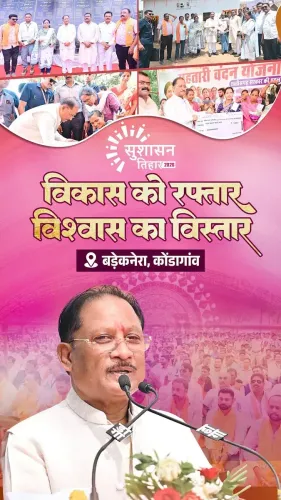
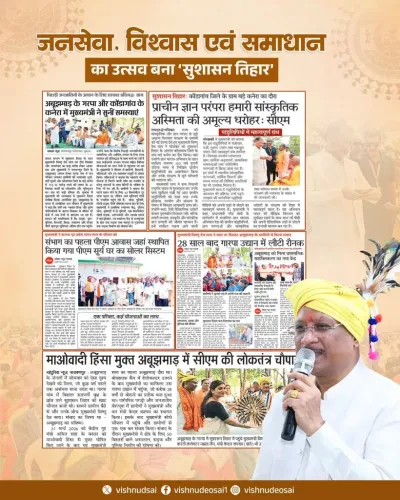
Chhattisgarh Chief Minister Vishnu Deo Sai said good governance and development are reaching every village of Bastar during his Sushasan Tihar 2026 district tour, citing gains for children, women, farmers and villagers using Atal Seva Kendras across the forested tribal division.
Key Takeaways
CM Vishnu Deo Sai posted from his Bastar division tour under Sushasan Tihar 2026.
He cited direct dialogue with residents across multiple Bastar districts.
Education, women's self-reliance, farmer welfare and Atal Seva Kendras were highlighted.
The post frames Bastar as moving from deprivation to 'new energy'.
Sushasan Tihar is a periodic grievance and scheme-delivery outreach by the state.
Bastar remains a priority zone for both anti-Naxal and welfare policy.
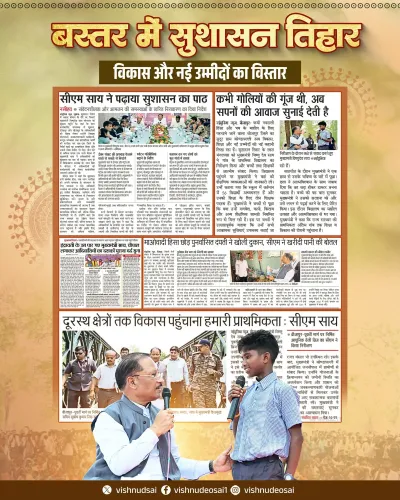
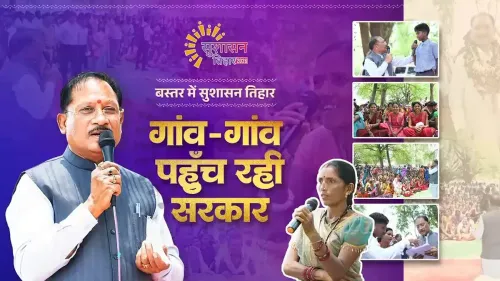
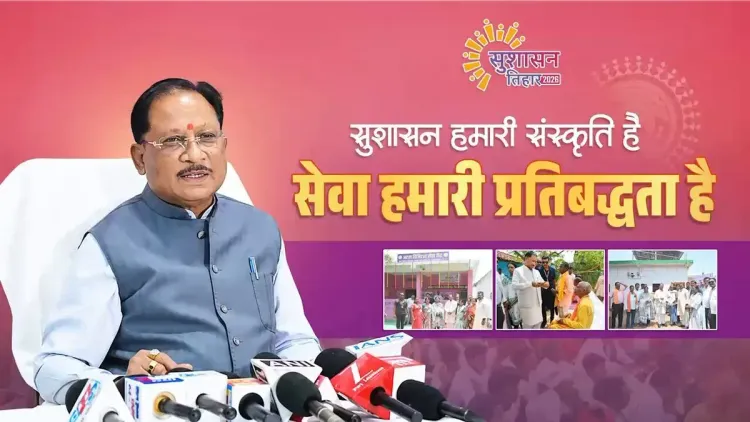
Chhattisgarh Chief Minister Vishnu Deo Sai on Tuesday said that governance and development were reaching the remotest villages of Bastar, sharing impressions from his ongoing district visits under the state government's Sushasan Tihar 2026 outreach programme. In a post on X, the BJP leader described direct interactions with residents across the Bastar division and said welfare schemes were now visibly transforming life in forested tribal pockets.
Context
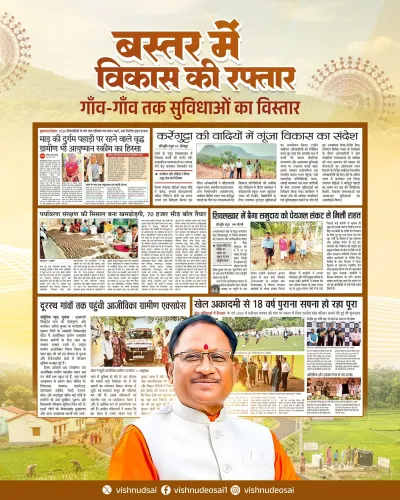
Writing in Hindi, the Chief Minister said 'Bastar ke gaon-gaon tak pahunchata sushasan, jan-jan tak pahunchata vikas' ('Good governance is reaching every village of Bastar, development is reaching every person'). He added that during his stay across different districts of the Bastar division, he was getting an opportunity for 'direct dialogue with ordinary people', and that it gave him 'satisfaction and happiness' to see government schemes finally reaching distant forest belts.
The post highlighted four constituencies he said were benefiting: children receiving better educational opportunities, women writing 'new stories of self-reliance', farmers becoming stronger, and villagers accessing government services locally through Atal Seva Kendras. He closed with the line that areas 'once deprived of development' were today witnessing 'new confidence, new possibilities and new energy'.
Policy backdrop
Sushasan Tihar, or 'good governance festival', is a periodic outreach format used by the Chhattisgarh government for grievance redressal, scheme verification and on-the-spot service delivery in rural areas. The 2026 edition, referenced in the post's hashtags #SushasanTihar2026, continues that template with a renewed focus on the Bastar division.
Mr. Sai took charge as Chief Minister in December 2023 after the BJP's victory in the Chhattisgarh assembly election, and his administration has repeatedly framed Bastar — a tribal-majority region long affected by Left-Wing Extremism — as a priority zone for both security operations and welfare expansion. The Atal Seva Kendras cited in his post are village-level common service points designed to deliver certificates, pensions and scheme benefits without requiring residents to travel to block or district headquarters.
Stakeholders and impact
The constituencies foregrounded in the message — tribal villagers, farmers, women's self-help groups and school-going children — are the demographic core of Bastar's seven districts, which include Bastar, Dantewada, Sukma, Bijapur, Kondagaon, Narayanpur and Kanker.
The Chief Minister's framing — of an area moving from deprivation to 'new energy' — is consistent with the BJP government's broader narrative that the combined push on anti-Naxal operations and last-mile welfare delivery is changing ground conditions in southern Chhattisgarh. Earlier BJP-led state governments in Chhattisgarh, between 2003 and 2018, also ran multiple infrastructure and tribal welfare packages aimed at the same belt.
The post does not announce a new scheme or release fresh data; it positions the visits themselves, and the testimony gathered during them, as evidence of delivery. The accompanying video footage shared on the handle showed scenes from the district tour.
What's next
Subsequent phases of the Sushasan Tihar 2026 calendar, including further district visits and any follow-up sanctions or infrastructure announcements for Bastar, will indicate how the outreach translates into budgetary or administrative action. Whether the state government attaches specific scheme targets — for school enrolment, women's livelihood collectives or farmer support — to the current round of consultations will be a key marker.
For now, the Chief Minister's message reinforces a political signal that Bastar remains central to the BJP's governance pitch in Chhattisgarh, with the administration seeking to convert anti-Naxal gains into a longer-term development story.
Point of View
Schools and women's livelihoods, Mr. Sai is positioning governance reach — not just security operations — as the headline metric for the region. The framing mirrors how BJP state governments in Jharkhand and Madhya Pradesh have used outreach festivals in tribal belts. The real test will be whether subsequent budget cycles attach measurable targets to the rhetoric.
NationPress
19 Sept 2026
Frequently Asked Questions
What is Sushasan Tihar 2026 in Chhattisgarh?
Sushasan Tihar is a periodic 'good governance festival' run by the Chhattisgarh government for direct public interaction, grievance redressal and on-the-spot delivery of welfare schemes in rural areas. The 2026 edition is currently being held across districts, including the Bastar division.
Why is Vishnu Deo Sai visiting Bastar?
The Chief Minister is touring districts of the Bastar division under Sushasan Tihar 2026 to interact directly with residents and review the reach of government schemes in remote forest areas. He has cited gains in education, women's self-reliance, farmer welfare and village-level service delivery.
What are Atal Seva Kendras?
Atal Seva Kendras are village-level common service centres in Chhattisgarh that allow rural residents to access government certificates, pensions and scheme benefits without travelling to block or district headquarters. The Chief Minister cited them as a key delivery channel in Bastar.
Which districts make up the Bastar division?
The Bastar division in southern Chhattisgarh comprises seven districts: Bastar, Dantewada, Sukma, Bijapur, Kondagaon, Narayanpur and Kanker. The region is tribal-majority and has historically been affected by Left-Wing Extremism.
When did Vishnu Deo Sai become Chief Minister of Chhattisgarh?
Vishnu Deo Sai took charge as Chief Minister of Chhattisgarh in December 2023, after the BJP won the state assembly election. He is a senior BJP leader from the state's tribal belt.