CM Sai Launches 'Seva Dera' to Transform Bastar Security Camps

Synopsis
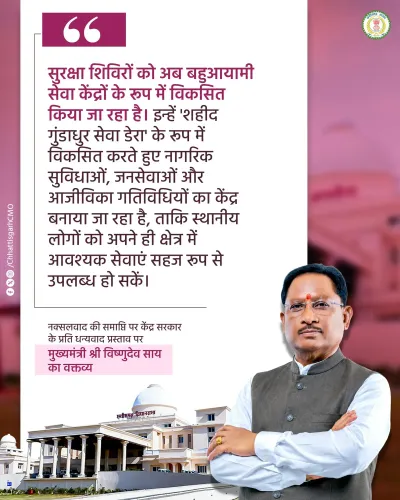
Chhattisgarh CM Vishnu Deo Sai has launched 'Seva Dera' at Netanar, Bastar — converting a security camp into a tribal community welfare centre named after martyr Veer Gundadhur, with sewing training already underway. The state plans to replicate the model across 70 camps.
Key Takeaways
The Chief Minister's Office of Chhattisgarh announced the Seva Dera initiative on 17 October 2026 .
The first Seva Dera is located at Netanar, Bastar , and named after tribal freedom fighter Shaheed Veer Gundadhur .
Sewing and tailoring training is already operational at the Netanar site.
The state government aims to convert 70 security camps across Bastar into Seva Dera community hubs.
The initiative is framed as part of a broader goal to make Bastar the country's model tribal division.
The programme continues a lineage of development-alongside-security strategies in Left-Wing Extremism-affected areas of Chhattisgarh.
A security camp turned skills centre — that is the quiet but consequential transformation underway in Netanar, Bastar, where Chhattisgarh Chief Minister Vishnu Deo Sai has launched the first 'Seva Dera', a state initiative that repurposes former security outposts into community welfare hubs for tribal residents. The announcement, made by the Chief Minister's Office of Chhattisgarh on Saturday, 17 October 2026, signals an ambitious plan to extend this model to 70 security camps across the Bastar division.
A Security Camp Gets a New Purpose at Netanar
The inaugural Seva Dera at Netanar has been named in honour of Shaheed Veer Gundadhur, the tribal freedom fighter who led the landmark 1910 Bastar rebellion against oppressive British forest policies. The choice of name is deliberate — invoking a revered local martyr anchors the programme in the region's own history of resistance and self-determination. Sewing and tailoring training is already underway at the site, with women and youth from surrounding tribal communities among the first participants.
CM Sai framed the initiative in broad terms: 'Bastar ko vikas ki nayi unchaaiyon tak le jaane aur desh ka adarsh aadivasi sambhag banaane ka lakshya' — the goal of taking Bastar to new heights of development and making it the country's model tribal division. That is an ambitious benchmark for a region that has carried the weight of Left-Wing Extremism for two decades.
70 Camps, One Blueprint — Bastar's Counterinsurgency Infrastructure Pivots
Security camps were incrementally established across Bastar from the mid-2000s onward as part of state and central anti-Naxal operations. For years they represented the frontline of a conflict; the Seva Dera model now asks them to also become the frontline of livelihood delivery. The state government has set a target of converting all 70 camps into such service centres, each potentially offering different welfare activities — skill training, health outreach, or agricultural support — depending on local need.
This approach fits into a pattern visible across Left-Wing Extremism-affected districts nationally: the argument that durable peace requires visible development dividends for communities that have long felt marginalised. Chhattisgarh's own Vanbandhu Kalyan Yojana, launched in 2014, pursued similar logic by directing infrastructure and livelihood investment into Scheduled Areas. Seva Dera takes that logic a step further by physically embedding welfare delivery inside security infrastructure.
Gundadhur's Legacy and the Politics of Naming
Veer Gundadhur is not a figure who needs introduction in Bastar. His 1910 uprising — locally called the Bhumkal — mobilised thousands of tribal communities against British encroachment on forest rights and remains a touchstone of indigenous identity in the region. Naming the first Seva Dera after him sends a message to tribal residents: this programme is rooted in your history, not imposed from outside. Whether that resonance translates into sustained community ownership of the centres will be the real test.
The roll-out of the remaining centres — which activities each camp hosts, how quickly the network expands, and whether women completing sewing training find viable market linkages — will determine if Seva Dera becomes a genuine development milestone or remains a well-intentioned symbol. Bastar is watching.
Point of View
Aligning the ruling BJP government with local indigenous identity rather than external authority. The 70-camp target is ambitious and the real measure of success will be whether these centres generate sustained economic outcomes — market linkages for trained women, for instance — rather than one-off inaugurations. If it scales, it could become a replicable model for other LWE-affected states navigating the same development-security tension.
NationPress
17 Oct 2026
Frequently Asked Questions
What is Seva Dera in Chhattisgarh?
Seva Dera is a Chhattisgarh government initiative that converts former security camps in the Bastar division into community welfare centres offering skill training and other services to tribal residents.
Where is the first Seva Dera located?
The first Seva Dera is located at Netanar in the Bastar district of Chhattisgarh, where sewing and tailoring training is currently underway.
Who is Veer Gundadhur and why is Seva Dera named after him?
Veer Gundadhur was a tribal freedom fighter who led the 1910 Bastar rebellion (Bhumkal) against British forest policies. The first Seva Dera is named after him to honour his legacy and connect the programme to Bastar's indigenous history.
How many security camps will become Seva Dera centres?
The Chhattisgarh government has set a target of converting 70 security camps across Bastar into Seva Dera community service hubs.
What activities are offered at a Seva Dera?
The Netanar Seva Dera currently offers sewing and tailoring training. Future centres are expected to offer a range of skill development and welfare activities tailored to local community needs.