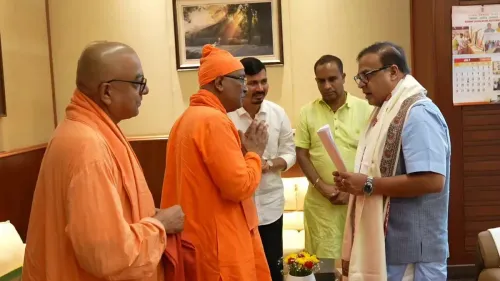
CM Himanta Launches Green Worship Initiative in Assam
Synopsis
Assam Chief Minister Himanta Biswa Sarma on 12 July 2026 promoted the Green Worship Initiative, a state programme to make religious sites cleaner, greener and more visitor-friendly, framing devotion and cleanliness as inseparable values.
Key Takeaways
Assam Chief Minister Himanta Biswa Sarma publicly promoted the Green Worship Initiative on 12 July 2026 .
The initiative aims to make Assam's religious places cleaner, greener and more visitor-friendly.
Sarma framed the drive with the message that 'devotion and cleanliness go hand in hand.' The programme aligns with the national Swachh Bharat Mission launched in 2014 .
Key stakeholders include pilgrims , temple authorities and local communities near religious sites.
Further details on site coverage and funding are expected in the next Assam state budget cycle.
Assam Chief Minister Himanta Biswa Sarma on Sunday, 12 July 2026 highlighted the state government's Green Worship Initiative, describing it as an effort to transform the state's religious places into cleaner, greener and more visitor-friendly spaces.
Posting on X, the Chief Minister wrote: 'श्रद्धा और स्वच्छता go hand in hand' — 'Devotion and cleanliness go hand in hand' — framing the initiative as a natural union of faith and environmental responsibility.
Context
The Green Worship Initiative is a state-level programme aimed at upgrading religious sites across Assam on cleanliness, greenery and pilgrim amenities. Chief Minister Sarma's post, accompanied by a video, signals that the programme is being actively promoted as a flagship environmental-cum-cultural effort by the BJP-led state government.
Assam is home to several high-footfall pilgrimage destinations, most notably the Kamakhya Temple in Guwahati — a revered Shakti Peetha that attracts lakhs of devotees annually. The ecological and sanitation pressure on such sites has long been a concern for temple authorities and local communities alike.
Policy Backdrop
The initiative draws on the spirit of the national Swachh Bharat Mission, launched in 2014, which targeted sanitation improvements at public, tourist and religious locations across India. BJP-led administrations at the state and central level have consistently linked cleanliness drives with religious and cultural sites, combining devotional sentiment with environmental messaging.
In the Northeast, state governments have pursued parallel green-tourism and waste-management programmes at pilgrimage centres, with the twin goals of improving visitor experience and reducing ecological pressure on the region's sensitive biodiversity corridors. The Green Worship Initiative fits squarely within this established policy pattern.
Stakeholders and Impact
The primary beneficiaries of the programme are pilgrims, temple authorities and local communities residing near religious sites. Cleaner surroundings and improved infrastructure can meaningfully reduce the environmental footprint of large religious gatherings, which often generate significant volumes of floral, plastic and food waste.
For local economies, a more visitor-friendly environment at religious sites can also support ancillary livelihoods — from vendors and guides to hospitality providers — by encouraging longer stays and repeat visits. The video shared alongside the post suggests on-ground implementation is already under way at one or more sites.
What's Next
Attention will now turn to site-level implementation details, including the number of religious places covered, funding allocations and any formal linkages with central schemes such as the Swachh Bharat Mission or tourism and environment budgets in the next Assam state budget cycle. The Chief Minister's public communication suggests the initiative will continue to be a visible part of the government's outreach on both faith and ecology.
As Assam positions itself as a green-tourism destination, the convergence of devotional infrastructure and environmental stewardship is likely to remain a recurring theme in the state's policy messaging through 2026 and beyond.
Point of View
Chief Minister Sarma reinforces his government's dual brand of cultural stewardship and development governance ahead of what promises to be an active political calendar in the Northeast. The framing of 'devotion and cleanliness' as inseparable is also a soft assertion that the state, not just the Centre, can deliver on the Swachh Bharat promise at the grassroots level. Whether the initiative translates into measurable ecological outcomes at high-footfall sites like Kamakhya Temple will determine its long-term credibility beyond political messaging.
NationPress
11 Oct 2026
Frequently Asked Questions
What is the Green Worship Initiative in Assam?
The Green Worship Initiative is an Assam state government programme aimed at making religious sites cleaner, greener and more visitor-friendly. It was publicly promoted by Chief Minister Himanta Biswa Sarma on 12 July 2026.
How does the Green Worship Initiative relate to Swachh Bharat Mission?
The initiative draws on the spirit of the national Swachh Bharat Mission launched in 2014, which targeted sanitation improvements at public, tourist and religious locations. The Assam programme applies similar goals specifically to the state's religious sites.
Which religious sites in Assam could benefit from the Green Worship Initiative?
High-footfall pilgrimage destinations such as the Kamakhya Temple in Guwahati are among the most prominent religious sites in Assam that stand to benefit from cleanliness and green-infrastructure improvements under such a drive.
What did CM Himanta Biswa Sarma say about the Green Worship Initiative?
CM Sarma stated that 'devotion and cleanliness go hand in hand,' framing the initiative as a natural union of faith and environmental responsibility in a post on X on 12 July 2026.
Who benefits from the Green Worship Initiative in Assam?
The primary beneficiaries are pilgrims, temple authorities and local communities near religious sites. Improved infrastructure and cleanliness can also support local livelihoods in the tourism and hospitality sectors.