CM Himanta Amends Assam Minor Mineral Rules for Green Compliance
Synopsis
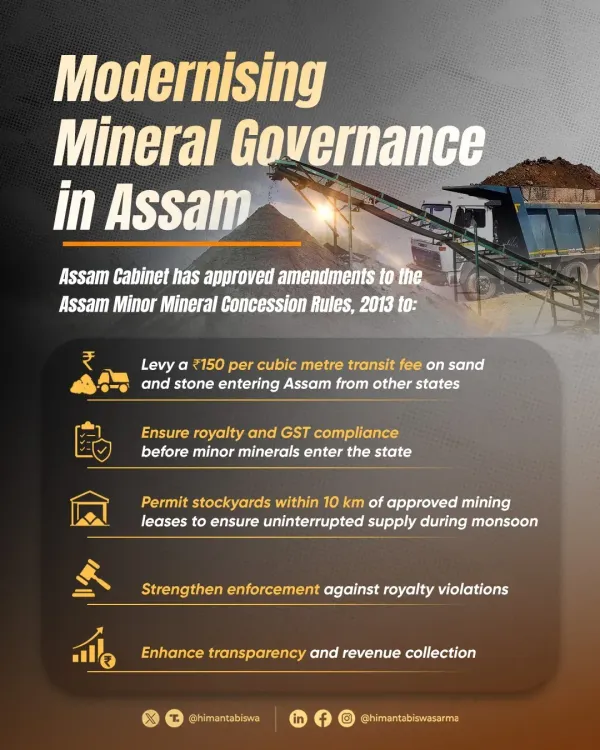
Assam CM Himanta Biswa Sarma announced amendments to the Minor Mineral Concession Rules on 12 July 2026, mandating royalty payments, GST compliance and green-cover restoration from mineral extractors, continuing the state's post-2021 push to curb revenue leakage and embed environmental obligation into mining leases.
Key Takeaways
Assam CM Himanta Biswa Sarma announced amendments to the Minor Mineral Concession Rules on 12 July 2026 .
The revised rules mandate royalty payments and GST compliance as binding conditions for mineral lease holders.
Extractors are now obligated to contribute to green-cover restoration , linking resource use to environmental repair.
The reform aims to curb revenue leakages and bring greater transparency to minor mineral operations in Assam .
The amendment aligns Assam with national trends following the 2015 and 2021 updates to the central Mines and Minerals (Development and Regulation) Act .
Revenue outcomes will be tracked in the next Assam state budget ; afforestation targets will be monitored by the Assam Forest Department .
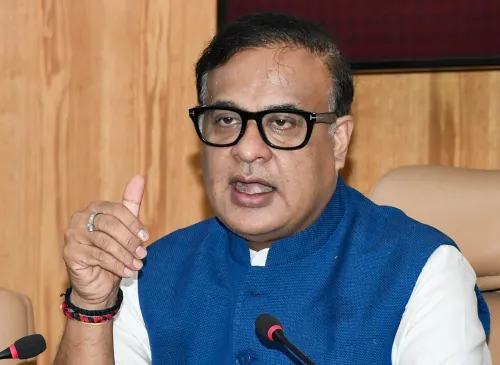
Assam Chief Minister Himanta Biswa Sarma on Sunday, 12 July 2026, announced amendments to the state's Minor Mineral Concession Rules, stating that those who benefit from natural resources must also contribute to restoring green cover. The revised rules aim to enforce royalty payments, ensure GST compliance, curb revenue leakages, and embed environmental responsibility into the state's mining framework.
Context
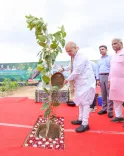
Posting under the hashtag #AssamRising, CM Sarma framed the amendment as a dual-purpose reform: fiscal discipline and ecological obligation. 'Those who benefit from our natural resources must also contribute to restoring green cover,' he wrote, linking extraction rights directly to environmental restitution for the first time under the revised framework.
Assam holds significant deposits of minor minerals — primarily sand and stone — that feed construction and infrastructure activity across the Northeast. Unregulated extraction has long been associated with revenue loss to the state exchequer and degradation of riverbanks and forest fringes.
Policy Backdrop
Since CM Sarma took office in May 2021, his administration has run coordinated drives against illegal sand and minor mineral mining to improve royalty realisation. The amended Minor Mineral Concession Rules are the legislative consolidation of those enforcement efforts, translating administrative crackdowns into binding regulatory obligations.
The move aligns Assam with a broader national pattern: mineral-bearing states across India have progressively updated their concession frameworks to plug revenue losses and link extraction rights with compensatory afforestation obligations. This trend accelerated after the 2015 and 2021 amendments to the central Mines and Minerals (Development and Regulation) Act, which pushed states to align their rules with national sustainability and fiscal federalism goals.
Northeast states have also been under pressure to synchronise their concession frameworks with central GST norms to strengthen fiscal outcomes — an objective the Assam amendment explicitly addresses by mandating GST compliance as a condition of mineral leases.
Stakeholders and Impact
Mining lease holders in Assam will face tighter compliance requirements, including mandatory royalty payments and GST filings, with the amended rules providing a clearer enforcement mechanism against defaulters. The state revenue authorities are expected to see improved royalty realisation as leakages are plugged through greater transparency in lease operations.
Local communities near extraction sites stand to benefit from the green-cover restoration mandate, which ties the right to extract to an obligation to repair environmental damage. The Assam Forest Department is likely to play a central role in monitoring and certifying compensatory afforestation commitments linked to mining leases.
What's Next
Observers will watch for the publication of the final amended rules in the Assam Gazette, which will detail specific provisions, notification dates, and quantified green-cover targets. Revenue figures for minor minerals in the next Assam state budget will serve as the first measurable indicator of whether the reforms achieve their stated fiscal goals.
If the amended framework delivers improved royalty realisation and verifiable afforestation outcomes, it could become a template for other Northeast states seeking to balance resource extraction with environmental and fiscal accountability.
Point of View
The government is threading environmental accountability into fiscal governance, a combination that is increasingly becoming a political differentiator in resource-rich states. The explicit emphasis on GST compliance also reflects the Centre's ongoing pressure on states to align sub-national resource regimes with national tax architecture. Whether the rules translate into measurable revenue gains or remain largely aspirational will define the reform's lasting political and policy value.
NationPress
12 Jul 2026
Frequently Asked Questions
What are the amended Minor Mineral Concession Rules in Assam?
The amended Minor Mineral Concession Rules are state regulations revised by the Assam government to make royalty payments, GST compliance and green-cover restoration mandatory for all minor mineral lease holders, aiming to curb revenue leakage and promote sustainable extraction.
Why did Assam amend its Minor Mineral Concession Rules?
Assam amended the rules to plug revenue leakages from sand and stone extraction, enforce GST and royalty compliance, and link mining rights to environmental obligations such as restoring green cover — continuing a reform drive that began after the 2021 change of government.
What is CM Himanta Biswa Sarma's role in Assam's mining reforms?
As Chief Minister since May 2021, Himanta Biswa Sarma has led coordinated crackdowns on illegal minor mineral mining and has now codified those enforcement efforts into binding amendments to the Minor Mineral Concession Rules.
How do the Assam minor mineral rules relate to GST?
The amended rules make GST compliance a condition of holding a mineral lease in Assam, aligning the state's concession framework with central tax norms and reducing the scope for tax evasion by extractors.
What is compensatory afforestation in the context of mining rules?
Compensatory afforestation requires entities that extract natural resources to fund or undertake the planting of trees to offset environmental damage — the Assam amendment embeds a similar green-cover restoration obligation directly into minor mineral lease conditions.