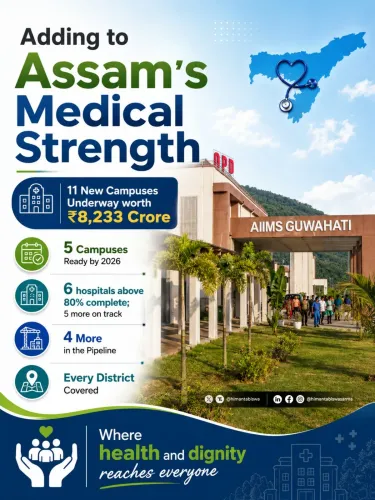
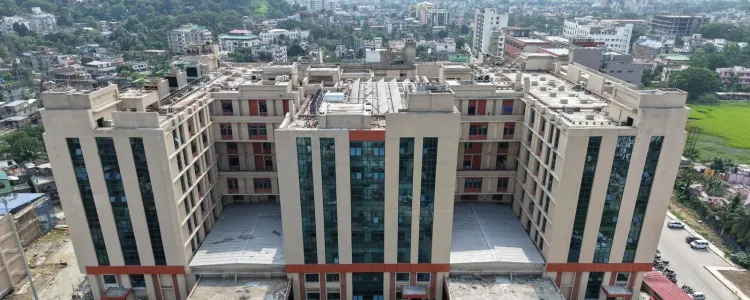
CM Himanta Eyes Guwahati as India's Healthcare Hub
Synopsis
Assam Chief Minister Himanta Biswa Sarma has called for Guwahati and Assam to be developed as India's healthcare nerve centre, framing health infrastructure as a key economic driver for the Northeast and signalling intent to attract investors and reduce patient outmigration.
Key Takeaways
CM Himanta Biswa Sarma on 1 July 2026 publicly articulated a vision to make Guwahati the nerve centre of India's healthcare economy.
The initiative, branded 'Reimagining Healthcare,' targets healthcare investors, hospital chains, and medical tourism operators.
AIIMS Guwahati , approved in 2015 and whose foundation stone was laid in 2017 , forms part of the existing tertiary-care infrastructure underpinning this ambition.
The vision aligns with India's Act East Policy , positioning the Northeast as a cross-border health services gateway.
Patients from eight northeastern states currently travel to distant metros for specialised care — a gap this initiative aims to close.
State budget allocations and formal MoUs with private hospital groups are the key near-term indicators to watch.
Assam Chief Minister Himanta Biswa Sarma on Wednesday, 1 July 2026, laid out an ambitious vision to position Guwahati and Assam as the nerve centre of India's healthcare economy, signalling a strategic push to transform the northeastern state into a premier destination for medical services and health-sector investment.
Context
In his post, Sarma framed the initiative as 'Reimagining Healthcare,' calling for Guwahati to anchor a regional health economy that extends beyond routine medical care into a broader economic proposition. The framing reflects a deliberate effort to attract healthcare investors, hospital chains, and allied-sector players to the Northeast, a region historically underserved by tertiary medical infrastructure.
The statement comes as Assam pursues an accelerated development agenda, with the health sector increasingly viewed as both a social imperative and an economic growth lever for the state.
Policy Backdrop
The push to build Guwahati as a healthcare hub sits within a longer policy arc. The central government approved AIIMS Guwahati in 2015 and laid its foundation stone in 2017, marking the first major step toward expanding tertiary care in the Northeast. Since the mid-2010s, successive governments have expanded medical colleges, AIIMS institutions, and public-private partnership hospital models across the region.
These efforts are closely tied to the Act East Policy, which positions the Northeast as a gateway for cross-border connectivity — including health services — with Southeast Asia and Bangladesh. A regional healthcare hub in Guwahati would align naturally with this diplomatic and economic framework.
India's broader push to develop tier-2 and tier-3 cities as secondary healthcare destinations — easing pressure on metros and growing medical value travel — provides additional tailwind for Assam's ambitions.
Stakeholders and Impact
The vision, if realised, would have direct implications for patients across the eight northeastern states, many of whom currently travel to Kolkata, Delhi, or Chennai for specialised care. A strengthened Guwahati ecosystem could reduce both the financial and logistical burden on these patients.
Healthcare investors and private hospital chains stand to benefit from early-mover advantage in a market with significant unmet demand. Medical tourism operators, particularly those catering to patients from Bangladesh and Myanmar, could find Guwahati's geographic proximity a compelling draw compared to distant metros.
For Assam's economy, a thriving health sector would generate employment across a wide skill spectrum — from specialist physicians and nurses to hospitality, diagnostics, and pharmaceutical supply chains.
What's Next
The immediate watch points are Assam's state budget allocations for health infrastructure and any formal memoranda of understanding with private hospital groups or medical institutions in Guwahati over the coming months. How the state translates this vision into concrete investment commitments and regulatory incentives will determine whether Guwahati can credibly claim a place on India's healthcare map alongside established metros. CM Sarma's track record of using high-visibility announcements to catalyse investor interest suggests formal policy instruments are likely to follow.
Point of View
' he is pitching to investors rather than voters alone — a signal that health infrastructure is now central to Assam's growth narrative, not just its social agenda. The move dovetails with the Act East Policy, giving it geopolitical resonance that could unlock central government support. Whether this translates into measurable outcomes will depend on the speed and scale of private capital mobilisation, which remains the missing variable in the Northeast's healthcare story.
NationPress
30 Sept 2026
Frequently Asked Questions
What is Himanta Biswa Sarma's plan for healthcare in Assam?
Chief Minister Himanta Biswa Sarma has proposed developing Guwahati and Assam as the nerve centre of India's healthcare economy, aiming to attract health-sector investment, expand medical infrastructure, and reduce patient outmigration from the Northeast.
Why is Guwahati being considered a healthcare hub?
Guwahati is the largest city in Assam and a natural gateway to all eight northeastern states. It already hosts or is host to institutions like AIIMS Guwahati, and its geographic proximity to Bangladesh and Myanmar makes it a strong candidate for regional medical tourism.
What is AIIMS Guwahati and when was it set up?
AIIMS Guwahati is a central government-funded tertiary care institution approved in 2015, with its foundation stone laid in 2017, designed to expand advanced medical services in the Northeast.
How does Assam's healthcare push connect to the Act East Policy?
India's Act East Policy positions the Northeast as a connectivity and trade gateway to Southeast Asia. A healthcare hub in Guwahati fits this framework by potentially serving patients from neighbouring countries such as Bangladesh and Myanmar.
What should investors and patients watch for next in Assam's healthcare plans?
Key indicators include Assam's state budget allocations for health infrastructure and any formal MoUs signed between the state government and private hospital chains or medical institutions in Guwahati in the coming months.