CM Himanta opens 3D Printing Centre of Excellence in Guwahati
Synopsis
Assam CM Himanta Biswa Sarma inaugurated the Digital Design and 3D Printing Centre of Excellence in Guwahati on 21 July 2026, targeting MSME-led innovation in healthcare, aerospace, agriculture and energy as a domestic import substitution tool.
Key Takeaways
Himanta Biswa Sarma inaugurated the Digital Design and 3D Printing Centre of Excellence in Guwahati on 21 July 2026 .
The facility offers advanced additive manufacturing and rapid prototyping capabilities to Assam's industrial and innovation ecosystem.
Target sectors include healthcare, aerospace, energy and agriculture .
MSMEs are the primary intended beneficiaries, with the centre designed to help them develop products locally in Assam.
Sarma described the centre as 'a very potent import substitution tool,' linking it to the national Atmanirbhar Bharat framework.
The facility in Guwahati could serve as a regional technology node for the broader Northeast India manufacturing ecosystem.
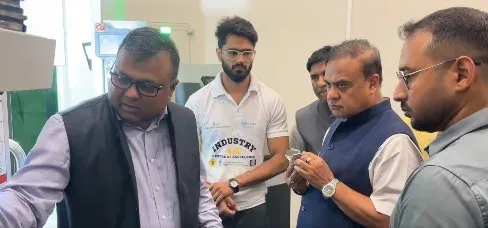
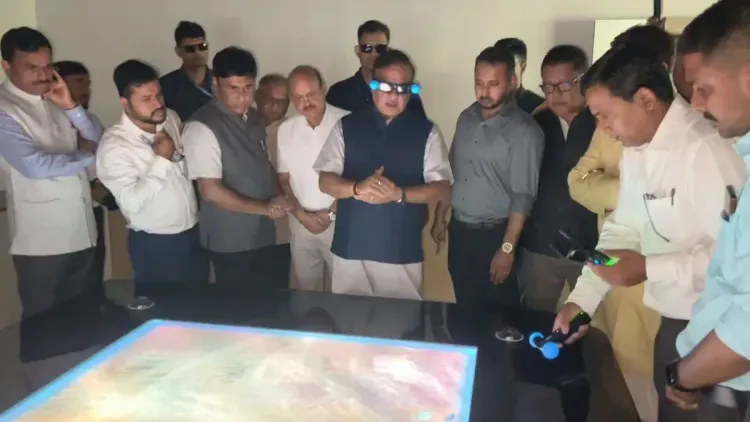
Assam Chief Minister Himanta Biswa Sarma on Tuesday, 21 July 2026, inaugurated the Digital Design and 3D Printing Centre of Excellence in Guwahati, positioning the facility as a catalyst for advanced manufacturing and import substitution across the state.
Context
Sarma announced the inauguration on X, stating that the facility 'brings advanced digital design, additive manufacturing and rapid prototyping capabilities to Assam, enabling faster innovation across healthcare, aerospace, energy, agriculture and more.' He described it as 'a very potent import substitution tool,' signalling the state's intent to reduce dependence on imported components and finished goods.
The centre is located in Guwahati, the largest city and primary economic hub of Assam, which has increasingly served as the launchpad for technology and industrial initiatives targeting the broader Northeast India region.
Policy Backdrop
The inauguration aligns directly with the Atmanirbhar Bharat Abhiyan, announced in May 2020, which promotes self-reliance and domestic manufacturing to reduce import dependence across strategic sectors. Additive manufacturing — commonly known as 3D printing — has been identified nationally as a key enabler of distributed production and rapid prototyping.
Assam has incrementally built out technology and skill centres to integrate advanced manufacturing into its economy. The emphasis on sectors such as aerospace, healthcare, and agriculture mirrors India's wider strategy of creating local prototyping ecosystems that can absorb and adapt global technologies for domestic needs.
The centre's focus on rapid prototyping and new product development is particularly significant for a state that has historically relied on goods manufactured in western and southern industrial corridors, or imported outright.
Stakeholders and Impact
Micro, Small and Medium Enterprises (MSMEs) are the primary intended beneficiaries. Sarma's post specifically cited encouraging 'our MSMEs to build solutions right here in Assam,' underscoring the state's push to localise innovation rather than outsource it. MSMEs constitute the backbone of India's domestic manufacturing base and are often the last to gain access to capital-intensive technologies such as additive manufacturing.
Sectors with direct stakes include healthcare — where 3D printing enables custom prosthetics, implants, and medical devices — as well as agriculture, where rapid prototyping can accelerate the development of localised equipment and tools. The aerospace and energy sectors stand to benefit from faster iteration cycles on components that currently require long procurement lead times.
For Northeast India more broadly, a functioning Centre of Excellence in Guwahati could serve as a regional node, reducing the geographic disadvantage that has historically slowed technology adoption in the region.
What's Next
The key question is whether the Guwahati facility becomes a standalone showcase or the first in a network of such centres across the Northeast. Sarma, as convenor of the North-East Democratic Alliance (NEDA), is positioned to advocate for replication of the model in partner states. Observers will watch whether Assam's existing startup and industrial policies are updated to formally integrate the centre into the state's MSME support architecture. The facility's ability to attract manufacturing partners and generate measurable import substitution will determine its long-term policy relevance.
Point of View
Translating a broad policy directive into physical infrastructure in a region often left behind in manufacturing investment cycles. For Sarma, the move carries dual utility: it signals industrial ambition domestically while reinforcing his role as the Northeast's primary political consolidator through NEDA. The explicit framing around import substitution and MSME enablement is politically astute, connecting a high-technology facility to the everyday economic concerns of small business owners. Whether the centre generates measurable outcomes will depend on how aggressively the state links it to procurement pipelines, startup incubation, and cross-sector industry partnerships.
NationPress
20 Oct 2026
Frequently Asked Questions
What is the Digital Design and 3D Printing Centre of Excellence in Guwahati?
It is a newly inaugurated facility in Guwahati, Assam, that provides advanced digital design, additive manufacturing, and rapid prototyping capabilities to support innovation in sectors including healthcare, aerospace, energy, and agriculture.
Who inaugurated the 3D Printing Centre of Excellence in Assam?
Assam Chief Minister Himanta Biswa Sarma inaugurated the Digital Design and 3D Printing Centre of Excellence in Guwahati on 21 July 2026.
How will the Guwahati 3D printing centre help MSMEs in Assam?
The centre is intended to give Assam's Micro, Small and Medium Enterprises access to advanced prototyping and manufacturing tools, enabling them to develop new products locally rather than sourcing them from outside the state or importing them.
What is the connection between the Guwahati centre and Atmanirbhar Bharat?
CM Sarma described the facility as an import substitution tool, directly aligning it with the Atmanirbhar Bharat Abhiyan launched in May 2020, which promotes domestic manufacturing and self-reliance across strategic sectors.
Which sectors will benefit from the 3D Printing Centre of Excellence in Assam?
The centre targets innovation in healthcare, aerospace, energy, and agriculture, among other sectors, by enabling faster product development and local manufacturing solutions in Assam.