CM Himanta Flags Tech as Key to Viksit Assam by 2047
Synopsis
Assam Chief Minister Himanta Biswa Sarma has reaffirmed the state's commitment to PM Modi's Viksit Bharat@2047 vision, calling technology the key enabler for faster delivery and smarter governance outcomes in Assam. He indicated the full impact of ongoing efforts will become evident in the years ahead.
Key Takeaways
CM Himanta Biswa Sarma publicly aligned Assam 's development agenda with PM Modi 's Viksit Bharat@2047 vision on 19 July 2026 .
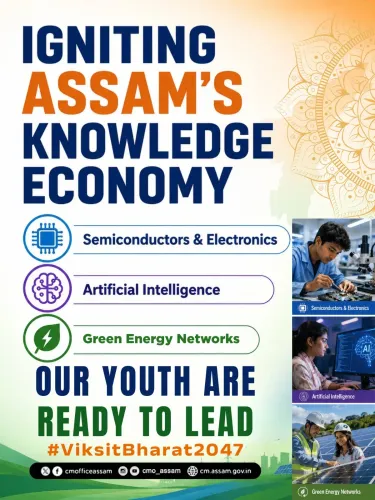
Technology has been identified as the 'key enabler' for achieving faster delivery and smarter governance outcomes in the state.
Assam has been integrating central digital-governance templates — including e-office systems and data-driven welfare delivery — since 2021 .
The Viksit Bharat@2047 framework, articulated by PM Modi from 2022–23 onward, calls on states to build matching development roadmaps targeting developed-economy status by 2047 .
Sarma , as convenor of the North-East Democratic Alliance (NEDA) , positions Assam 's digital governance model as potentially replicable across the northeastern region.
Assam Chief Minister Himanta Biswa Sarma on Sunday, 19 July 2026, reaffirmed his government's commitment to realising Prime Minister Narendra Modi's vision of a developed Assam by 2047, identifying technology as the central driver of faster and smarter governance outcomes.
Context
In his post on X, CM Sarma wrote that 'collective efforts are directed to realise Adarniya Modi ji's vision of a Viksit Assam by 2047,' adding that 'technology is key enabler in this process to achieve faster delivery and smarter outcomes.' He noted that 'the impact will be evident in the years to come,' signalling a long-horizon commitment rather than an immediate milestone announcement.
The statement situates Assam squarely within the national Viksit Bharat@2047 framework — the central government's flagship long-term vision to transform India into a developed economy by the centenary of independence. PM Modi has repeatedly outlined this framework in Independence Day addresses and planning documents since 2022–23, prompting states to formulate matching roadmaps.
Policy Backdrop
Since 2021, when Sarma assumed office, Assam has progressively integrated central digital-governance templates — including e-office systems and data-driven welfare delivery — mirroring patterns seen across other states governed by the North-East Democratic Alliance (NEDA), which Sarma himself convenes.
The broader national push ties technology adoption — spanning direct-benefit transfers, digital land records, and real-time grievance redressal — to measurable improvements in ease of living and administrative efficiency. States that align their budgets and ministry-level MoUs with central digital platforms have historically unlocked additional central funding under schemes such as the Digital India Mission.
Stakeholders and Impact
The primary beneficiaries of a technology-first governance model in Assam are its roughly 3.5 crore residents, particularly those in remote districts where physical access to government services has historically been limited. Streamlined digital delivery can reduce leakages in welfare schemes and cut turnaround times for public services.
For the Assam state administration, the emphasis on technology also implies continued investment in digital infrastructure, skilling of frontline government workers, and interoperability with central ministry platforms — all of which require sustained budgetary commitment and institutional coordination.
What's Next
Observers will watch for concrete follow-through in the form of state budget allocations, new MoUs with central ministries, or the rollout of Assam-specific digital infrastructure projects in the coming fiscal year. CM Sarma's framing of the 2047 goal as a collective and technology-mediated effort suggests that announcements on specific platforms or programmes could follow in the near term.
If Assam succeeds in embedding technology deeply into its governance architecture, it could serve as a replicable model for other NEDA-governed northeastern states, amplifying the regional impact of the Viksit Bharat@2047 vision well beyond a single state's boundaries.
Point of View
Sarma signals to both New Delhi and investors that Assam is a willing and capable partner in the digital-governance ecosystem. The long-horizon framing — 'impact will be evident in the years to come' — also manages expectations prudently, insulating the government from near-term accountability on specific deliverables. For the Northeast, where infrastructure deficits remain significant, this posture could accelerate the flow of central digital-infrastructure investment if matched by concrete budgetary action.
NationPress
18 Oct 2026
Frequently Asked Questions
What is the Viksit Assam 2047 vision?
Viksit Assam 2047 is Assam's state-level adaptation of PM Modi's Viksit Bharat@2047 framework, which aims to transform India into a developed economy by 2047, the centenary of independence. Assam CM Himanta Biswa Sarma has committed to achieving this through technology-driven governance reforms.
What role does technology play in Assam's development plan?
CM Sarma has described technology as the 'key enabler' for achieving faster service delivery and smarter governance outcomes in Assam, building on existing integrations such as e-office systems and data-driven welfare delivery.
What is Viksit Bharat@2047?
Viksit Bharat@2047 is a national long-term vision articulated by PM Narendra Modi from 2022–23, targeting developed-nation status for India by 2047. States have been encouraged to formulate matching roadmaps aligned with this overarching goal.
What is NEDA and what is Himanta Biswa Sarma's role in it?
NEDA, the North-East Democratic Alliance, is a political alliance of BJP and allied parties governing several northeastern states. Himanta Biswa Sarma is its convenor, giving him an influential coordinating role across the region's political and governance landscape.
How has Assam implemented digital governance so far?
Since 2021, Assam has progressively adopted central digital-governance templates including e-office systems and data-driven welfare delivery, in line with patterns seen across other NEDA-governed northeastern states.