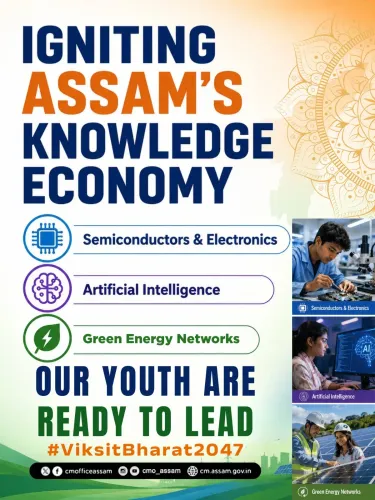
CM Himanta Backs Viksit Bharat 2047 With Resolute Pledge
Synopsis
Assam CM Himanta Biswa Sarma publicly reaffirmed the Viksit Bharat 2047 mission on October 7, 2026, declaring 'WE WILL DO IT! Come what May' — a short but charged pledge to India's centennial development goal.
Key Takeaways
Assam Chief Minister Himanta Biswa Sarma posted a public commitment to the Viksit Bharat 2047 goal on October 7, 2026 .
His post read: 'विकसित भारत by 2047 — WE WILL DO IT!
Come what May.' The Viksit Bharat framework targets transforming India into a fully developed nation by 2047 , the centenary of independence.
Sarma is also convenor of the North-East Democratic Alliance (NEDA) , amplifying the regional significance of his pledge.
The 'Come what May' framing signals resolve in the face of potential economic and political obstacles over the remaining 21 years .
A four-word declaration and an unmistakable deadline — Assam Chief Minister Himanta Biswa Sarma took to X on Wednesday, October 7, 2026, to stake his personal conviction on India's most ambitious long-term national goal: a developed India by 2047, the centenary of independence. The message was short, the intent emphatic.
Posting in a mix of English and Hindi, Sarma wrote: 'विकसित भारत by 2047' — 'Developed India by 2047' — followed by an all-caps affirmation: 'WE WILL DO IT! Come what May.' The phrase 'Come what May' signals a deliberate determination to hold the target regardless of political or economic headwinds.
What Viksit Bharat 2047 Actually Means
The Viksit Bharat vision is the BJP-led central government's centennial development framework — a blueprint to transform India into a fully developed nation by 2047, when the country marks 100 years of independence. The roadmap encompasses sustained high GDP growth, universal infrastructure, energy self-sufficiency, and social inclusion, drawing on mission-mode schemes across sectors.
For chief ministers like Sarma, the vision is not merely a central directive — it is a governance compass that filters state-level priorities, from industrial investment drives in Assam to connectivity projects linking the North-East with the national mainstream. Sarma, who also serves as convenor of the North-East Democratic Alliance (NEDA), has positioned the region's development as integral to the broader national goal.
Why a BJP State Leader's Public Commitment Carries Weight
Public endorsements of the 2047 target from prominent BJP chief ministers are politically significant — they reinforce party discipline around the vision, signal alignment with the central leadership's narrative, and keep the long-range goal in public discourse well ahead of any electoral cycle. Sarma is among the most vocal BJP voices in the North-East, making his reaffirmation a marker of regional buy-in.
The 'Come what May' framing is pointed — it acknowledges that economic uncertainties, governance challenges, and political opposition exist, but subordinates all of that to the 2047 target. It is the language of a committed stakeholder, not a cautious bureaucrat.
Twenty-one years remain on the clock. The resolve, at least, is on record — and loudly so.
Point of View
All-caps reaffirmation of Viksit Bharat 2047 is more than a social-media gesture — it is a public accountability marker by one of the BJP's most prominent North-East leaders. For a party that has made the 2047 centennial vision its overarching policy narrative, consistent endorsement from influential chief ministers sustains momentum and keeps the goal politically alive between election cycles. The 'Come what May' construction is strategically loaded: it pre-empts criticism about feasibility by framing doubt itself as an obstacle to be overcome. Over the next two decades, statements like this will be benchmarked against on-ground outcomes — particularly in a region like the North-East, where infrastructure gaps and economic indicators still lag national averages.
NationPress
7 Oct 2026
Frequently Asked Questions
What is Viksit Bharat 2047?
Viksit Bharat 2047 is the Indian government's long-term vision to make India a fully developed nation by 2047, the 100th anniversary of independence, focusing on high growth, infrastructure, energy self-sufficiency, and social inclusion.
What did Himanta Biswa Sarma say about Viksit Bharat 2047?
On October 7, 2026, Assam CM Himanta Biswa Sarma posted on X: 'Viksit Bharat by 2047 — WE WILL DO IT! Come what May,' reaffirming his commitment to the national development goal.
Who is Himanta Biswa Sarma?
Himanta Biswa Sarma is the Chief Minister of Assam and a senior BJP leader. He also serves as the convenor of the North-East Democratic Alliance (NEDA), a BJP-led coalition of parties in the North-East.
What does 'Come what May' mean in the context of Viksit Bharat?
The phrase signals that Sarma sees the 2047 development target as non-negotiable, regardless of economic challenges, political changes, or governance hurdles that may arise over the next two decades.
How does the North-East fit into the Viksit Bharat 2047 vision?
The North-East, including Assam, is considered a key frontier in the Viksit Bharat framework, with connectivity, infrastructure, and economic integration forming central pillars of the region's contribution to the 2047 goal.